Shuck and Jive


Showing posts with label A New Reformation. Show all posts

Saturday, July 04, 2009

A New Reformation, Part 6: Rockey

In my collection of lists for A New Reformation I have so far used lists from the big names (Funk, Fox, Spong) and from groups (TCPC, Creation Spirituality). I think the reformation of the church will come from regular folks who articulate their ideas.

This latest is from Allison Rockey, who blogs at iAllison. Here is her list of ten beliefs that I found resonates with me and with many progressive Christians. This is from her previous blog.


Ten Beliefs of This Progressive Christian

1) I believe that interfaith dialogue is essential to understanding the world and to know Truths my tradition has missed or omitted.

2) I believe stories found in the Bible, when understood as metaphor and myth can be used to teach me profound Truths.

3) I believe there are as many ways to be Christian as there are people in the tradition.

4) I believe the way I understand Jesus, as a radical activist, and a compassionate teacher, shows more about my way of viewing the world than it does any “truth” of Jesus. The truth is he lived a long time ago, and the records are not clear.

5) I believe religion should lead you to more questions than answers.

6) I believe my tradition causes me to question social values of the day, and to push society to be more inclusive. That being the case I believe Christianity should be on the forefront of fighting for the human rights of people who are gay, lesbian, and transgendered.

7) I believe religion is only one piece of the pie, and should not be confused with history, science, psychology, or other important disciplines. All are needed for a balanced life.

8) I believe much hatred has been caused by the interpretation of Christianity by some throughout history and today; leading to wars, bigotry, racism, sexism, homophobia, etc. This one belief alone has caused me to turn my back on Christianity many times, and constantly question why I am connected at all.

9) I believe the following of a religious or spiritual tradition with the support of a community can lead to great transformation of individuals and cultures. This one belief alone has caused me to stay within Christianity hoping to be a part of this transformation of consciousness, the next great awakening.

10) I believe no one knows what happens after this life, and if we spent even half as much time bringing the peace to this world what so many hope for in the next, we could experience heaven on earth.

Perhaps you have a list of your beliefs or have found a list from others. I can't promise I will post them, but I may if I like them!

Part 5, Spong
Part 4, Creation Spirituality
Part 3, TCPC
Part 2, Matthew Fox
Part 1, Robert Funk


Friday, July 03, 2009

A New Reformation, Part 5: Spong

I am enjoying this series on A New Reformation. Here is my pal, Bishop John Shelby Spong. I like him. I don't like him because he ticks off the fundies, but I have to say, that is an added bonus.

The good bishop nailed these theses to the internet over ten years ago. They are a bit dated and actually familiar-sounding now. They are more fully outlined in his book, Why Christianity Must Change or Die.

They are posted all over the web. Here is an accompanying article that goes with them in The 4th R. Like Holy Writ, they have slight variations from place to place. Here is a version I found on the website of St. Peter's Church, Nottingham.

  1. Theism as a way of defining God, is dead. God can no longer be understood with credibility as a Being, supernatural in power, dwelling above the sky and prepared to invade human history periodically to enforce the divine will. So, most theological talk today is meaningless unless we find a new way to speak of God.
  2. Since God can no longer be conceived in theistic terms, it becomes nonsensical to seek to understand Jesus as the incarnation of the theistic deity. So the Christology of the ages is bankrupt.
  3. The biblical story of the perfect and finished creation from which human beings fell into sin is pre-Darwinian mythology and post-Darwinian nonsense.
  4. The virgin birth, understood as literal biology, makes the divinity of Christ, as traditionally understood, impossible.
  5. The miracle stories of the New Testament can no longer be interpreted in a post-Newtonian world as supernatural events performed by an incarnate deity.
  6. The view of the cross as a sacrifice for the sins of the world is a barbarian idea based on primitive concepts of God that must be dismissed.
  7. Resurrection is an action of God, who raised Jesus into the meaning of God. It therefore cannot be a physical resuscitation occurring inside human history.
  8. The story of the ascension assumed a three-tiered universe and is therefore not capable of being translated into the concepts of a post-Copernican space age.
  9. There is no external, objective, revealed standard writ in Scripture or on tablets of stone that will govern our ethical behaviour for all time.
  10. Prayer cannot be a request made to a theistic deity to act in human history in a particular way.
  11. The hope for life after death must be separated for ever from the behaviour-control mentality of reward and punishment. The church must abandon, therefore, its reliance on guilt as a motivator of behaviour.
  12. All human beings bear God’s image and must be respected for what each person is. Therefore no external description of one’s being, whether based on race, ethnicity, gender or sexual orientation, can properly be used as the basis for either rejection or discrimination.

Part 4, Creation Spirituality
Part 3, TCPC
Part 2, Matthew Fox
Part 1, Robert Funk

Saturday, June 27, 2009

A New Reformation Part 4, Creation Spirituality

Creation Spirituality is an ancient four-fold spiritual path recently articulated by Matthew Fox. Fox is a prolific author, theologian, and activist. What is Creation Spirituality? Here are twelve principles for your reflection, thanks to Creation Spirituality Communities

1. The Universe, and all within it, is fundamentally a blessing.
Our relationship with the Universe fills us with awe.

2. In Creation, God is both immanent and transcendent. This is panentheism which is not theism (God out there) and not atheism (no God anywhere).
We experience that the Divine is in all things and all things are in the Divine.

3. God is as much Mother as Father, as much Child as Parent, as much God in mystery as the God in history, as much beyond all words and images as in all forms and beings.
We are liberated from the need to cling to God in one form or one literal name.

4. In our lives, it is through the work of spiritual practice that we find our deep and true selves.
Through the arts of meditation and silence we cultivate a clarity of mind and move beyond fear into compassion and community.

5. Our inner work can be understood as a four-fold journey involving:
- awe, delight, amazement (known as the Via Positiva)
- uncertainty, darkness, suffering, letting go (Via Negativa)
- birthing, creativity, passion (Via Creativa)
- justice, healing, celebration (Via Transformativa)

We weave through these paths like a spiral danced, not a ladder climbed.

6. Every one of us is a mystic.
We can enter the mystical as much through beauty (Via Positiva) as through contemplation and suffering (Via Negativa). We are born full of wonder and can recover it at any age.

7. Every one of us is an artist.
Whatever the expression of our creativity, it is our prayer and praise (Via Creativa).

8. Every one of us is a prophet.
Our prophetic work is to interfere with all forms of injustice and that which interrupts authentic life (Via Transformativa).

9. Diversity is the nature of the Universe. We rejoice in and courageously honor the rich diversity within the Cosmos and expressed among individuals and across multiple cultures, religions and ancestral traditions.

10. The basic work of God is compassion and we, who are all original blessings and sons and daughters of the Divine, are called to compassion.
We acknowledge our shared interdependence; we rejoice at one another's joys and grieve at one another's sorrows and labor to heal the causes of those sorrows.

11. There are many wells of faith and knowledge drawing from one underground river of Divine wisdom. The practice of honoring, learning and celebrating the wisdom collected from these wells is Deep Ecumenism.
We respect and embrace the wisdom and oneness that arises from the diverse wells of all the sacred traditions of the world.

12. Ecological justice is essential for the sustainability of life on Earth.
Ecology is the local expression of cosmology and so we commit to live in light of this value: to pass on the beauty and health of Creation to future generations.

Now we have four lists. Four sets of theses statements for a new reformation. In these lists you will find some common themes that people are already intuitively identifying. Some of these common themes include appreciation for all religions (wisdom traditions) as human creations, a concern for ecological justice, appreciation of science and knowledge, and a celebration of nature as divine (rather than separate from Divinity).

You may also notice some traditional Christian things that are absent such as a separation of humankind from nature, the notion that nature is "fallen" or sinful, the idea that "God" is a supernatural being, and the obsession with a last judgment (heaven and hell).

As always your thoughts and critiques are welcome.

Part 3, TCPC
Part 2, Fox
Part 1, Funk

Friday, June 26, 2009

A New Reformation, Part 3: TCPC

My little club of bandits is affiliated with The Center for Progressive Christianity, which means for $100 we get a listing on its website. It is an interesting on-line connection. The website has books and resources and an interesting theological list called The Eight Points. Each point comes with an accompanying study guide.

To go along with Robert Funk's 21 theses and Matthew Fox's 95 theses, here are eight more points to add to your collection of lists. I have more lists to come as well as one that I am compiling for myself. For comparison, I will include the list of vows required for leaders of the Presbyterian Church (U.S.A.). I will have more to say about that list in future posts.

Here is a teaser.

Vows are a good thing. To make a vow is a sacred act. It is a binding to one another, a commitment to one another, a promise to stick with one another through thick and thin, through personality conflict, disagreement, poverty, wealth, sickness, and health. It creates a bonding of interdependence which encourages creativity, compassion, intelligence, imagination, trust, and love. Vows are sacred acts. We need them to bind our communities and to show each other through ritual and reminder that each of us matters.

But something has gone wrong. Maybe it has always been wrong and I am just getting to the point at which I can voice it. It isn't the act of making a vow, it is the content of the vow and the function of the vow that has become problematic in the church today.

The vows foisted upon clergy, elders, and deacons are not wrong so much as they are dated. The vows themselves are innocuous on one level. The best word I can use to describe them is quaint. They don't really mean much of anything. I affirm them in all their sentimentality.

Their primary function, however, is punitive. Because they are thought to mean something other than what they say, they serve to keep the church in a state of institutional inertia. For instance, here is a common response to a clergyperson (we won't say who, who writes favorably about say, the Jesus Seminar, on his blog):
"You are violating your ordination vows. How can you be a Presbyterian minister?"
Get it? As opposed to "Here is where I think you are wrong" or "Here is where I disagree with you" the response is punitive: "You can't say that."

Worse than censure from the outside is self-censure. Clergy are so afraid of the potential charge of heresy (and there is good reason for it as clergy can lose their livelihoods) that they remain silent and acquiesce to that which goes against their own consciences. Far too few clergy speak what they truly think (or even what they learned in college or seminary) from the pulpit.

Sadly, the ordination vow culture that is the Presbyterian Church is not about a vow to uphold truth, goodness, conscience, beauty, integrity, or even "God" however that term is defined. These are vows of subservience to "the club" and its symbolic world. They are vows to uphold so-called "right belief" or orthodoxy. The constant repetition of these vows (every year with the ordination and installation of deacons and elders) reinforces this culture of subservience.

I use as an example the Presbyterian Church, but you will find parallels in the other Christian groups. What is amusing is that all the institutions think they are orthodox. I heard that there are over 30,000 Christian denominations in the world. There are over 10 Presbyterian denominations in the United States alone. Which one is the orthodox one?

Christian orthodoxy has a place. If you describe yourself as orthodox, if you believe that the various creeds of your particular sect reflect the most true statements in the universe, you are on my team. You are in my club. You can come to my church. I will vote your approval at a presbytery meeting. The orthodox path is an acceptable one. The reverse is not true, is it? Orthodoxy, perhaps by definition, cannot abide freedom of thought that counteracts its own. Orthodoxy is a word that people in power use to describe truth. When might makes right, subservience is a virtue.

In response to religious institutions that reinforce subservience and control are the Eight Points of Progressive Christianity. These points didn't just arise from the vapors. They are a particular response and rejection of church-as-usual.

By calling ourselves progressive, we mean that we are Christians who…

1. Have found an approach to God through the life and teachings of Jesus;

2. Recognize the faithfulness of other people who have other names for the way to God's realm, and acknowledge that their ways are true for them, as our ways are true for us;

3. Understand the sharing of bread and wine in Jesus' name to be a representation of an ancient vision of God's feast for all peoples;

4. Invite all people to participate in our community and worship life without insisting that they become like us in order to be acceptable (including but not limited to):

believers and agnostics,
conventional Christians and questioning skeptics,
women and men,
those of all sexual orientations and gender identities,
those of all races and cultures,
those of all classes and abilities,
those who hope for a better world and those who have lost hope;

5. Know that the way we behave toward one another and toward other people is the fullest expression of what we believe;

6. Find more grace in the search for understanding than we do in dogmatic certainty - more value in questioning than in absolutes;

7. Form ourselves into communities dedicated to equipping one another for the work we feel called to do: striving for peace and justice among all people, protecting and restoring the integrity of all God's creation, and bringing hope to those Jesus called the least of his sisters and brothers; and

8. Recognize that being followers of Jesus is costly, and entails selfless love, conscientious resistance to evil, and renunciation of privilege.

Part 2, Fox
Part 1, Funk

Thursday, June 25, 2009

A New Reformation, Part 2: Fox

Here is my second post in honor of Calvin's birthday regarding the reformation of the church. Check the sidebar under "Celebrating Calvin's Birthday" for my posts on this theme. Yesterday, I published Bob Funk's 21 theses. I think they are right on and I greatly admire Funk's no nonsense, take no prisoners, straight talk.

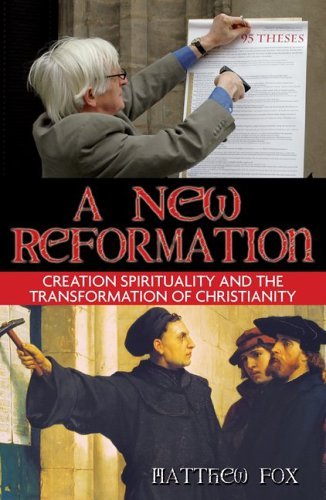
Matthew Fox wrote a book a few years ago entitled A New Reformation: Creation Spirituality and the Transformation of Christianity. Fox included his own 95 theses and posted them on the Wittenberg door!

Take time to look these over. I included all 95 in this post as they are all gems. If I had one of those church signboards, I would put these 95 theses up one at a time for the benefit of the good folks in Carter County, Tennessee.

In regards to my theme of vows for membership and leadership, I especially like theses 8, 25, 28, 30, 34, 39 & 69.

I am thrilled that Matthew Fox is going to be in Asheville, North Carolina in a couple of weeks for the third annual Creation Spirituality Communities Event, Breathing Compassion, July 16-20. It begins with a "Hot and Holy" Cosmic Mass on the 16th at 7 p.m.

I plan on taking in the entire conference as a continuing education week. There is space for you, too! If you think the church is in for Reformation, come join us!

Here are my posts from last year's conference:
Via Positiva in Greencastle
Dangerous and Deviant
I Want to be an Ancestor


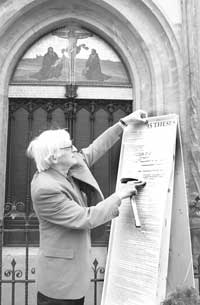
Matthew Fox pictured at right posting his 95 theses at Wittenberg. Martin Lu
ther was the original radical who started the Protestant Reformation in 1517 with his 95 Theses.


The following is from Yes! Magazine.

Like Luther, I present 95 theses or in my case, 95 faith observations drawn from my 64 years of living and practicing religion and spirituality. I trust I am not alone in recognizing these truths. For me they represent a return to our origins, a return to the spirit and the teaching of Jesus and his prophetic ancestors, and of the Christ which was a spirit that Jesus’ presence and teaching unleashed.
1. God is both Mother and Father.

2. At this time in history, God is more Mother than Father because the feminine is most missing and it is important to bring gender balance back.

3. God is always new, always young and always “in the beginning.”

4. God the Punitive Father is not a God worth honoring but a false god and an idol that serves empire-builders. The notion of a punitive, all-male God, is contrary to the full nature of the Godhead who is as much female and motherly as it is masculine and fatherly.

5. “All the names we give to God come from an understanding of ourselves.” (Eckhart) Thus people who worship a punitive father are themselves punitive.

6. Theism (the idea that God is ‘out there’ or above and beyond the universe) is false. All things are in God and God is in all things (panentheism).

7. Everyone is born a mystic and a lover who experiences the unity of things and all are called to keep this mystic or lover of life alive.

8. All are called to be prophets which is to interfere with injustice.

9. Wisdom is Love of Life (See the Book of Wisdom: “This is wisdom: to love life” and Christ in John’s Gospel: “I have come that you may have life and have it in abundance.”)

10. God loves all of creation and science can help us more deeply penetrate and appreciate the mysteries and wisdom of God in creation. Science is no enemy of true religion.

11. Religion is not necessary but spirituality is.

12. “Jesus does not call us to a new religion but to life.” (Bonhoeffer) Spirituality is living life at a depth of newness and gratitude, courage and creativity, trust and letting go, compassion and justice.

13. Spirituality and religion are not the same thing any more than education and learning, law and justice, or commerce and stewardship are the same thing.

14. Christians must distinguish between God (masculine and history, liberation and salvation) and Godhead (feminine and mystery, being and non-action).

15. Christians must distinguish between Jesus (an historical figure) and Christ (the experience of God-in-all-things).

16. Christians must distinguish between Jesus and Paul.

17. Jesus, not unlike many spiritual teachers, taught us that we are sons and daughters of God and are to act accordingly by becoming instruments of divine compassion.

18. Ecojustice is a necessity for planetary survival and human ethics and without it we are crucifying the Christ all over again in the form of destruction of forests, waters,
species, air and soil.

19. Sustainability is another word for justice, for what is just is sustainable and what is unjust is not.

20. A preferential option for the poor, as found in the base community movement, is far closer to the teaching and spirit of Jesus than is a preferential option for the rich and powerful as found in, for example, Opus Dei.

21. Economic Justice requires the work of creativity to birth a system of economics that is global, respectful of the health and wealth of the earth systems and that works for all.

22. Celebration and worship are key to human community and survival and such reminders of joy deserve new forms that speak in the language of the twenty-first century.

23. Sexuality is a sacred act and a spiritual experience, a theophany (revelation of the Divine), a mystical experience. It is holy and deserves to be honored as such.

24. Creativity is both humanity’s greatest gift and its most powerful weapon for evil and so it ought to be both encouraged and steered to humanity’s most God-like activity which all religions agree is: Compassion.

25. There is a priesthood of all workers (all who are doing good work are midwives of grace and therefore priests) and this priesthood ought to be honored as sacred and workers should be instructed in spirituality in order to carry on their ministry effectively.

26. Empire-building is incompatible with Jesus’ life and teaching and with Paul’s life and teaching and with the teaching of holy religions.

27. Ideology is not theology and ideology endangers the faith because it replaces thinking with obedience, and distracts from the responsibility of theology to adapt the wisdom of the past to today’s needs. Instead of theology it demands loyalty oaths to the past.

28. Loyalty is not a sufficient criterion for ecclesial office—intelligence and proven conscience is.

29. No matter how much the television media fawn over the pope and papacy because it makes good theater, the pope is not the church but has a ministry within the church. Papalolotry is a contemporary form of idolatry and must be resisted by all believers.

30. Creating a church of Sycophants is not a holy thing. Sycophants (Webster’s dictionary defines them as “servile self-seeking flatterers”) are not spiritual people for their only virtue is obedience. A Society of Sycophants — sycophant clergy, sycophant seminarians, sycophant bishops, sycophant cardinals, sycophant religious orders of Opus Dei, Legioneers of Christ and Communion and Liberation, and the sycophant press--do not represent in any way the teachings or the person of the historical Jesus who chose to stand up to power rather than amassing it.

31. Vows of pontifical secrecy are a certain way to corruption and cover-up in the church as in any human organization.

32. Original sin is an ultimate expression of a punitive father God and is not a Biblical teaching. But original blessing (goodness and grace) is biblical.

33. The term “original wound” better describes the separation humans experience on leaving the womb and entering the world, a world that is often unjust and unwelcoming than does the term “original sin.”

34. Fascism and the compulsion to control is not the path of peace or compassion and those who practice fascism are not fitting models for sainthood. The seizing of the apparatus of canonization to canonize fascists is a stain on the church.

35. The Spirit of Jesus and other prophets calls people to simple life styles in order that “the people may live.”

36. Dancing, whose root meaning in many indigenous cultures is the same as breath or spirit, is a very ancient and appropriate form in which to pray.

37. To honor the ancestors and celebrate the communion of saints does not mean putting heroes on pedestals but rather honoring them by living out lives of imagination, courage and compassion in our own time, culture and historical moment as they did in theirs.


The cover of Matthew Fox's lastest book: A New Reformation: Creation Spirituality and the Transformation of Christianity


38. A diversity of interpretation of the Jesus event and the Christ experience is altogether expected and welcomed as it was in the earliest days of the church.

39. Therefore unity of church does not mean conformity. There is unity in diversity. Coerced unity is not unity.

40. The Holy Spirit is perfectly capable of working through participatory democracy in church structures and hierarchical modes of being can indeed interfere with the work of the Spirit.

41. The body is an awe-filled sacred Temple of God and this does not mean it is untouchable but rather that all its dimensions, well named by the seven chakras, are as holy as the others.

42. Thus our connection with the earth (first chakra) is holy; and our sexuality (second chakra) is holy; and our moral outrage (third chakra) is holy; and our love that stands up to fear (fourth chakra) is holy; and our prophetic voice that speaks out is holy (fifth chakra); and our intuition and intelligence (sixth chakra) are holy; and our gifts we extend to the community of light beings and ancestors (seventh chakra) are holy.

43. The prejudice of rationalism and left-brain located in the head must be balanced by attention to the lower charkas as equal places for wisdom and truth and Spirit to act.

44. The central chakra, compassion, is the test of the health of all the others which are meant to serve it for “by their fruits you will know them” (Jesus).

45. “Joy is the human’s noblest act.” (Aquinas) Is our culture and its professions, education and religion, promoting joy?

46. The human psyche is made for the cosmos and will not be satisfied until the two are re-united and awe, the beginning of wisdom, results from this reunion.

47. The four paths named in the creation spiritual tradition more fully name the mystical/prophetic spiritual journey of Jesus and the Jewish tradition than do the three paths of purgation, illumination and union which do not derive from the Jewish and Biblical tradition.

48. Thus it can be said that God is experienced in experiences of ecstasy, joy, wonder and delight (via positiva).

49. God is experienced in darkness, chaos, nothingness, suffering, silence and in learning to let go and let be (via negativa).

50. God is experienced in acts of creativity and co-creation (via creativa).

51. All people are born creative. It is spirituality’s task to encourage holy imagination for all are born in the “image and likeness” of the Creative One and “the fierce power of imagination is a gift from God.” (Kaballah)

52. If you can talk you can sing; if you can walk you can dance; if you can talk you are an artist. (African proverb and Native American saying)

53. God is experienced in our struggle for justice, healing, compassion and celebration (via transformativa).

54. The Holy Spirit works through all cultures and all spiritual traditions and blows “where it wills” and is not the exclusive domain of any one tradition and
never has been.

55. God speaks today as in the past through all religions and all cultures and all faith traditions none of which is perfect and an exclusive avenue to truth but all of which can learn from each other.

56. Therefore Interfaith or Deep Ecumenism are a necessary part of spiritual praxis and awareness in our time.

57. Since the “number one obstacle to interfaith is a bad relationship with one’s own faith,” (the Dalai Lama) it is important that Christians know their own mystical and prophetic tradition, one that is larger than a religion of empire and its punitive father images of God.

58. The cosmos is God’s holy Temple and our holy home.

59. Fourteen billion years of evolution and unfolding of the universe bespeak the intimate sacredness of all that is.

60. All that is is holy and all that is is related for all being in our universe began as one being just before the fireball erupted.

61. Interconnectivity is not only a law of physics and of nature but also forms the basis of community and of compassion. Compassion is the working out of our shared interconnectivity both as to our shared joy and our shared suffering and struggle for justice.

62. The universe does not suffer from a shortage of grace and no religious institution is to see its task as rationing grace. Grace is abundant in God’s universe.

63. Creation, Incarnation and Resurrection are continuously happening on a cosmic as well as a personal scale. So too are Life, Death and Resurrection (regeneration and reincarnation) happening on a cosmic scale as well as a personal one.

64. Biophilia or Love of Life is everyone’s daily task.

65. Necrophilia or love of death is to be opposed in self and society in all its forms.

66. Evil can happen through every people, every nation, every tribe, and every individual human and so vigilance and self-criticism and institutional criticism are always called for.

67. Not all who call themselves “Christian” deserve that name just as “not all who say ‘Lord, Lord’ shall enter the kingdom of heaven” (Jesus).

68. Pedophilia is a terrible wrong but its cover-up by hierarchy is even more despicable.

69. Loyalty and obedience are never a greater virtue than conscience and justice.

70. Jesus said nothing about condoms, birth control or homosexuality.

71. A church that is more preoccupied with sexual wrongs than with wrongs of injustice is itself sick.

72. Since homosexuality is found among 464 species and in 8 percent of any given human population, it is altogether natural for those who are born that way and is a gift from God and nature to the greater community.

73. Homophobia in any form is a serious sin against love of neighbor, a sin of ignorance of the richness and diversity of God’s creation as well as a sin of exclusion.

74. Racism, Sexism and militarism are also serious sins.

75. Poverty for the many and luxury for the few is not right or sustainable.

76. Consumerism is today’s version of gluttony and needs to be confronted by creating an economic system that works for all peoples and all earth’s creatures.

77. Seminaries as we know them, with their excessive emphasis on left-brain work, often kill and corrupt the mystical soul of the young instead of encouraging the mysticism and prophetic consciousness that is there. They should be replaced by wisdom schools.

78. Inner work is required of us all. Therefore spiritual practices of meditation should be available to all and this helps in calming the reptilian brain. Silence or contemplation and learning to be still can and ought to be taught to all children and adults.

79. Outer work needs to flow from our inner work just as action flows from non-action and true action from being.

80. A wise test of right action is this: What is the effect of this action on people seven generations from today?

81. Another test of right action is this: Is what I am doing, is what we are doing, beautiful or not?

82. Eros, the passion for living, is a virtue that combats acedia or the lack of energy to begin new things and is also expressed as depression, cynicism or sloth (also known as “couchpotatoitis”).

83. The Dark Night of the Soul descends on us all and the proper response is not addiction such as shopping, alcohol, drugs, TV, sex or religion but rather to be with the darkness and learn from it.

84. The Dark Night of the Soul is a learning place of great depth. Stillness is required.

85. Not only is there a Dark Night of the Soul but also a Dark Night of Society and a Dark Night of our Species.

86. Chaos is a friend and a teacher and an integral part or prelude to new birth. Therefore it is not to be feared or compulsively controlled.

87. Authentic science can and must be one of humanity’s sources of wisdom for it is a source of sacred awe, of childlike wonder, and of truth.

88. When science teaches that matter is “frozen light” (physicist David Bohm) it is freeing human thought from scapegoating flesh as something evil and instead reassuring us that all things are light. This same teaching is found in the Christian Gospels (Christ is the light in all things) and in Buddhist teaching (the Buddha nature is in all things). Therefore, flesh does not sin; it is our choices that are sometimes off center.

89. The proper objects of the human heart are truth and justice (Aquinas) and all people have a right to these through healthy education and healthy government.

90. "God” is only one name for the Divine One and there are an infinite number of names for God and Godhead and still God “has no name and will never be given a name.” (Eckhart)

91. Three highways into the heart are silence and love and grief.

92. The grief in the human heart needs to be attended to by rituals and practices that, when practiced, will lessen anger and allow creativity to flow anew.

93. Two highways out of the heart are creativity and acts of justice and compassion.

94. Since angels learn exclusively by intuition, when we develop our powers of intuition we can expect to meet angels along the way.

95. True intelligence includes feeling, sensitivity, beauty, the gift of nourishment and humor which is a gift of the Spirit, paradox, being its sister.

A New Reformation, Part 1: Funk

Wednesday, June 24, 2009

A New Reformation Part 1: Funk

July 10th is the 500th anniversary of the birth of John Calvin. Calvin was the 16th century reformer who is considered the father of Presbyterianism. On Saturday the Johnson City Press featured an article on Calvin:
Born into a middle-class Roman Catholic family in the little French town of Noyon, north of Paris, Calvin became a lawyer, but soon came to sympathize with the anti-papal theses of Martin Luther that had rapidly spread to France.
Calvin broke with his Catholic past. His great rhetorical talents earned him quick prominence as an evangelical teacher, but religious turmoil forced him to go into exile in Basel, Switzerland.
He was 26 when he began writing the
“Institutes of the Christian Religion,” the first compendium of Reformed doctrines, much more profound than Luther’s theses of 1517. They won him an invitation from newly Protestant Geneva. But Calvin was soon banished again because authorities found his ideas were too radical.
He returned in 1541 after receiving assurances of official support for his plans to complete a Reformation based on his teachings. He introduced a revolutionary church constitution based on the democratic principles of division of powers.
In celebration of his birthday, I thought I would devote a few posts to the reformation of the church. I will present a few folks who also think we are due for a reformation as well as offer a few of my own ideas.

Why a reformation? Our denomination has lost members every year since the 60s with a whopping 69,000 net loss in 2008. We cannot blame this loss on one thing. But it is worth reflection on why so many people are part of the church alumni association. At least for the people I hang out with, the church's official beliefs and vows of membership and ordination are out of touch with reality.

In part, it is personal. I wish I had five bucks every time someone on this blog or on another blog has accused me of breaking my ordination vows. In my previous presbytery I was even officially "investigated" because one of my colleagues, a true believing busybody, thought something I wrote was is in violation of my ordination vows.

So is it me? Or the busybodies? Or is the problem the vows? Of course I play the game and tell the busybodies that I affirm my ordination vows (and I do so by interpreting them loosely). The very fact that I have to do that shows there is something wrong with the language in the first place. So I will devote a few posts to the vows that deacons, elders, and clergy in my denomination are required to affirm. My hope is that you will see that we are requiring duplicity among our church's leaders and that cannot be productive for our denomination's survival let alone relevance.

Larger than denominational or personal issues, we need a reformation because the world and its needs have changed. Believe it or not, I think that the church could and sometimes does say something good and worthwhile. We are facing huge threats to the survival of humanity and Earth. We need the best thinking available to interpret and respond to these crises. But our official church dogmas are still otherworldly and locked into a pre-modern system of thought.


I devote my first post to the founder of the Jesus Seminar, Robert W. Funk. Here are his twenty-one theses for the reformation of the church.


These 21 theses are found in his 1996 book, Honest to Jesus: Jesus for a New Millenium. They were also printed in The Fourth R in 1998.


Theology
  1. The God of the metaphysical age is dead. There is not a personal god out there external to human beings and the material world. We must reckon with a deep crisis in god talk and replace it with talk about whether the universe has meaning and whether human life has purpose.
  2. The doctrine of special creation of the species died with the advent of Darwinism and the new understanding of the age of the earth and magnitude of the physical universe. Special creation goes together with the notion that the earth and human beings are at the center of the galaxy (the galaxy is anthropocentric). The demise of a geocentric universe took the doctrine of special creation with it.
  3. The deliteralization of the story of Adam and Eve in Genesis brought an end to the dogma of original sin as something inherited from the first human being. Death is not punishment for sin, but is entirely natural. And sin is not transmitted from generation to generation by means of male sperm, as suggested by Augustine.
  4. The notion that God interferes with the order of nature from time to time in order to aid or punish is no longer credible, in spite of the fact that most people still believe it. Miracles are an affront to the justice and integrity of God, however understood. Miracles are conceivable only as the inexplicable; otherwise they contradict the regularity of the order of the physical universe.
  5. Prayer is meaningless when understood as requests addressed to an external God for favor or forgiveness and meaningless if God does not interfere with the laws of nature. Prayer as praise is a remnant of the age of kingship in the ancient Near East and is beneath the dignity of deity. Prayer should be understood principally as meditation—as listening rather than talking—and as attention to the needs of neighbor.

Christology

  1. We should give Jesus a demotion. It is no longer credible to think of Jesus as divine. Jesus' divinity goes together with the old theistic way of thinking about God.
  2. The plot early Christians invented for a divine redeemer figure is as archaic as the mythology in which it is framed. A Jesus who drops down out of heaven, performs some magical act that frees human beings from the power of sin, rises from the dead, and returns to heaven is simply no longer credible. The notion that he will return at the end of time and sit in cosmic judgment is equally incredible. We must find a new plot for a more credible Jesus.
  3. The virgin birth of Jesus is an insult to modern intelligence and should be abandoned. In addition, it is a pernicious doctrine that denigrates women.
  4. The doctrine of the atonement—the claim that God killed his own son in order to satisfy his thirst for satisfaction—is subrational and subethical. This monstrous doctrine is the stepchild of a primitive sacrificial system in which the gods had to be appeased by offering them some special gift, such as a child or an animal.
  5. The resurrection of Jesus did not involve the resuscitation of a corpse. Jesus did not rise from the dead, except perhaps in some metaphorical sense. The meaning of the resurrection is that a few of his followers—probably no more than two or three—finally came to understand what he was all about. When the significance of his words and deeds dawned on them, they knew of no other terms in which to express their amazement than to claim that they had seen him alive.
  6. The expectation that Jesus will return and sit in cosmic judgment is part and parcel of the mythological worldview that is now defunct. Furthermore, it undergirds human lust for the punishment of enemies and evildoers and the corresponding hope for rewards for the pious and righteous. All apocalyptic elements should be expunged from the Christian agenda.

God's Domain according to Jesus

  1. Jesus advocates and practices a trust ethic. The kingdom of God, for Jesus, is characterized by trust in the order of creation and the essential goodness of neighbor.
  2. Jesus urges his followers to celebrate life as though they had just discovered a cache of coins in a field or been invited to a state banquet.
  3. For Jesus, God's domain is a realm without social boundaries. In that realm there is neither Jew nor Greek, male nor female, slave nor free, homosexual nor heterosexual, friend nor enemy.
  4. For Jesus, God's domain has no brokers, no mediators between human beings and divinity. The church has insisted on the necessity of mediators in order to protect its brokerage system.
  5. For Jesus, the kingdom does not require cultic rituals to mark the rites of passage from outsider to insider, from sinner to righteous, from child to adult, from client to broker.
  6. In the kingdom, forgiveness is reciprocal: individuals can have it only if they sponsor it.
  7. The kingdom is a journey without end: one arrives only by departing. It is therefore a perpetual odyssey. Exile and exodus are the true conditions of authentic existence.

The canon

  1. The New Testament is a highly uneven and biased record of orthodox attempts to invent Christianity. The canon of scripture adopted by traditional Christianity should be contracted and expanded simultaneously to reflect respect for the old tradition and openness to the new. Only the works of strong poets—those who startle us, amaze us with a glimpse of what lies beyond the rim of present sight—should be considered for inclusion. The canon should be a collection of scriptures without a fixed text and without either inside or outside limits, like the myth of King Arthur and the knights of the roundtable or the myth of the American West.
  2. The Bible does not contain fixed, objective standards of behavior that should govern human behavior for all time. This includes the ten commandments as well as the admonitions of Jesus.

The language of faith

  1. In rearticulating the vision of Jesus, we should take care to express ourselves in the same register as he employed in his parables and aphorisms—paradox, hyperbole, exaggeration, and metaphor. Further, our reconstructions of his vision should be provisional, always subject to modification and correction.