Shuck and Jive


Showing posts with label theology. Show all posts

Wednesday, August 22, 2012

A Universe From Nothing

I just interviewed Lawrence Krauss, physicist and author of A Universe From Nothing: Why There Is Something Rather Than Nothing.    I enjoyed both the book and the conversation and you can hear the interview in a few weeks on Religion For Life.  

This is a book about cosmology and the universe and how wild it is.  He takes a few well-deserved and necessary pokes at theologians who want to fit "God" in there somewhere.   He shows convincingly to me at least that there is not much place for "supernatural shenanigans" as he puts it.   He writes:
A universe without purpose or guidance may seem, for some, to make life itself meaningless.  For others, including me, such a universe is invigorating.  It makes the fact of our existence even more amazing, and it motivates us to draw meaning from our own actions and to make the most of our brief existence in the sun, simply because we are here, blessed with consciousness and with the opportunity to do so.   p. 181

I have been blathering for six years on this blog.  I have expressed my doubts about God, life after death, and what have you from the vantage point of a minister.   I like religion.  I embrace its social aspect.  I regard its mythologies as poetry.   When religion is honest it is good.  But it is hardly ever literal for me.   

In doing this, I have felt a little guilty.  Perhaps I was writing from the perspective of a person born sucking a silver spoon.  Perhaps if I suffered more I would more readily accept the teachings of the orthodox faith and bow to the wisdom of Mother Church and her guardians.  If I was more acquainted with pain I would embrace the truth of the bodily resurrection and the reality of a personal God.

Now with the death of my son, I think I am a legitimate member of the "sufferer's club."   If that isn't a pitiful club to join I don't know what might be.

Yet even after this experience, I cannot say I am more willing to embrace orthodoxy.   I am pretty much the same as far as all of that goes.  I recognize the impermanence of life more.   Some of the theologians got that right.  I do love church.  I love the hymns and the scriptures, but more importantly I love the people.    I am fiercely proud and in awe of anyone who does and believes in whatever they need to do or believe in in order to cope with the excruciating fragility of life.

But after all of this, I am, at the end of the day, no more and no less than I was before, still in the camp of Krauss, who writes about the universe's future thusly:
Our universe will then recollapse inward to a point, returning to the quantum haze from which our own existence may have begun.  If these arguments are correct, our universe will then disappear as abruptly as it probably began.

In this case, the answer to the question, "Why is there something rather than nothing?" will then simply be:  "There won't be for long."  p. 180

Oddly enough, I am OK with that.


Thursday, August 09, 2012

Sarah Sentilles, Encore Presentation, Breaking Up With God: A Love Story on Religion For Life, August 9-13

Sarah Sentilles broke up with the Creator of the Universe just as she was about to be ordained as a priest in the Episcopal Church. She tells all in her book, Breaking Up With God: A Love Story.


In this interesting and thought-provoking interview on Religion For Life, Dr. Sentilles shares her theological journey and demonstrates why if the church is going to have any relevancy to educated and inquiring minds, it is going to need to challenge its patriarchy and its outdated images of God.


I wrote about her book on my blog here and here and posted an excerpt from her book here.

Listen...

Thursday, August 9th at 8 pm on WETS, 89.5.
Sunday, August 12th, at noon on WEHC, 90.7.
Sunday, August 12th, at 2 pm on WETS, 89.5.
Monday, August 13th at 1 pm on WEHC, 90.7.
Via podcast.

Monday, July 23, 2012

James Cone, The Cross and the Lynching Tree on Religion For Life, July 26-30

In the late 19th and early 20th centuries between three and five thousand African-Americans were lynched in the South. They were lynched by white Christians. My guest, Dr. James Cone, the Charles Augustus Briggs Distinguished Professor of Systematic Theology at Union Theological Seminary in the City of New York, in his latest book, The Cross and the Lynching Tree makes the connection between the lynching of African-Americans and the execution of Jesus.  Listen to this important conversation about race and religion in America on Religion For Life.   Dr. Cone is the author of 12 books including Black Theology and Black Power and A Black Theology of Liberation.


Listen via livestream…

Thursday, July 26th at 8 pm on WETS, 89.5.
Sunday, July 29th, at noon on WEHC, 90.7.
Sunday, July 29th, at 2 pm on WETS, 89.5.
Monday, July 30th at 1 pm on WEHC, 90.7.
Via podcast beginning July 31st

Thursday, April 26, 2012

Nancy Ellen Abrams and Joel Primack on Religion For Life, April 26-30

My guests on Religion For Life are Nancy Ellen Abrams and Joel Primack, authors of a new book, The New Universe and the Human Future: How a Shared Cosmology Could Transform the World. Dr. Primack is professor of physics at the University of California at Santa Cruz and Nancy Ellen Abrams is a cultural philosopher. Together they find a way of integrating our cosmology with meaning and offer a hopeful vision for our human future on Earth.


Listen via livestream…

Thursday, April 26th at 8 pm on WETS, 89.5.
Sunday, April 29th, at noon on WEHC, 90.7.
Sunday, April 29thd, at 2 pm on WETS, 89.5.
Monday, April 30th at 1 pm on WEHC, 90.7.
Via podcast beginning May 1st.

Wednesday, February 22, 2012

Who's Got the Power?

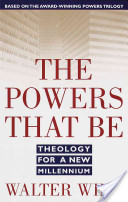
Our Thursdays With Jesus group is taking on The Powers That Be.


Beginning March 1st we will read Walter Wink's book, The Powers That Be:  Theology for a New Millennium.


Here is a review from Spirituality and Practice:
The author, who is Professor of Biblical Interpretation at Auburn Theological Seminary in New York City, presents an ethically challenging reframing of angels, demons, principalities, and powers. He writes: "Every business corporation, school, denomination, bureaucracy, sports team — indeed, social reality in all its forms — is a combination of both visible and invisible, outer and inner, physical and spiritual." These systems, institutions, and structures can do good and evil at the same time: "They form a complex web that we can neither ignore nor escape."

One of the challenges for Christian churches in our time is to discern the spirits of institutions and structures. If they are organized around idolatrous values and what Wink calls "the Domination System," they must be recalled to their divine vocation — the well-being of all individuals. With great clarity and clout, the author attacks the myth of redemptive violence and proclaims Jesus's path of practical nonviolence as its antidote ("It is the way God has chosen to overthrow evil in the world.")

Wink ends with a clarion call to seek God in our enemies, to practice justice in prayer, and to work every day for the "freeing of the Powers." Reading this watershed book will open your eyes afresh to the significance of spirituality, evil, politics, and redemption in our world.
Good stuff from an important thinker who acts for justice as well.
Join us Thursday from 10:30 until noon at FPC Elizabethton!


Monday, February 06, 2012

Religion For {this} Life

I like to switch religions every now and then just to keep things fresh.  Here is my latest.  I call it a Religion For {this} Life.   The astute observer will notice that the title of my new religion echoes the title of my new radio program.   Here are a few of its non-doctrines.

It comes from Christianity.  I call it Christian Naturalism.  It is a religion.  It is not science.  It is not atheism or agnosticism.   It has beliefs.  The basic belief of my version of Christian Naturalism is that this universe is cool enough for me.   I have no care to speculate about what is outside the universe.   My belief is that there is probably nothing outside of it at least that can affect me (or the universe for that matter).   I am sure that thinkers who speculate on these things will keep me informed.

I cannot prove this belief is true.  My religion operates by trust.  I trust that this universe is fine for me.  My religion believes that the scientific method is pretty good and that public knowledge is more trustworthy than private revelation. 

I think human beings are special and unique.  We are the only beings we know of so far that exhibit a level of consciousness that can comprehend the universe.   I think it is good for humans to stay around and it would be wise if we learned to live compatibly with our environment so that we can do so for millions of years into the future.

God and the gods function in my religion as human creations.  They are products of the human imagination which is a product of the universe as is consciousness, love, art, and everything else.   Of course, I like to read and reflect on the Bible as a human creation and to reflect on other human works as well.  

Jesus is there.  He plays a large role in my religion.  He is an historical person that I have reconstructed with the help of others.  He is also a fictional character.  When I see him as a fictional character, I am mostly interested in the authors who created him.   I love Jesus.  I love Buddha, too, and Krishna, even Gilgamesh.   But at the end of the day, Jesus is my man.   That is probably because I feel at home with him. 

I love church.   My religion is happy with church, even with Presbyterians.  I like Presbyterians as on the whole they are pretty tolerant and they do have that freedom of conscience thing going for them.   Presbyterians have changed for the better.  They used to be pretty intolerant.   Now, rather than burn heretics and witches they prefer to form committees to study the issue.

I believe in goodness.  I believe in justice.  I like the concept of what Joanna Macy calls The Great Ball of Merit.  That gives me hope. 

I think religion has important tasks.  One of which is to help people cope with the contingencies of life.  Another task is to provide permission and resources so people can create their own religion.  Yet another task is to help people develop an internal moral compass in order to live well and to engage the powers.   And potlucks.  Always potlucks.

My religion also affirms the Great Peace.  I trust that after my brain ceases to function I will drop into unconsciousness like I experienced before birth (which was no experience at all).  There is nothing I need to do to earn the Great Peace or anything I can do to miss out on the Great Peace.   I don't have to worry about being good enough.  I do not need to fear hell.    I learned this oddly enough from Presbyterians.  It is my understanding of justification by grace.   Knowing that one day I will experience the Great Peace whenever that time comes gives me the freedom to live and love today. 

My religion even has a hymn.  There are other hymns in my loose-leaf hymnbook.  This one is delightful and sung beautifully by Iris Dement.


I could change my religion again next week.

So...stay tuned.

Friday, February 03, 2012

What Presbyterians Believe (Except Me) Part 4


A recent post, Doing My Best to Undermine the Authority of Scripture, apparently raised an eyebrow or two.  I think I hit a nerve.    If our denomination is not splitting, it is at least flaking off at the right edge.      There are a significant number of congregations leaving.   I think a question to ask is,
"Why?  Why are these congregations leaving?"
A second question to ask is,
"What can we learn from this?"
The congregations that are leaving are telling us why.    This is from the Layman about the First Presbyterian Church of Orlando:
The 2011 approval of Amendment 10A and the passage of the new Form of Government (nFOG) topped the list of factors leading to FPCO’s departure in what many similar churches see as symptoms of a serious underlying problem in the denomination: variant views of the authority of Scripture.
 You saw what I saw, right?  
...a serious underlying problem in the denomination: variant views of the authority of Scripture.
Yeah, that is what I saw, too.  Authority of Scripture.

We all know that we are supposed to affirm, at least by vow and theory, that the Bible is authoritative, the Word of God.   But what does that mean?   Is it communication from a divine being?   Those leaving the church complain that the PC(USA) doesn't believe this anymore. The liberals and moderates complain that that isn't the case.  They say they believe in the authority of scripture.  

I am nobody's judge, but I would have to side with the conservatives on this one.   Now I know I am the 1% (See this chart).    In 2008 1% of pastors checked this box, "The Bible is not the word of God."   That would be me.  I am a proud one-percenter. 

I am one of the few PC(USA) clergy (at least that I know about), who admits publicly that the Bible is not a communication from a divine being.  I can play with metaphors, like "Word of God" like the rest of my colleagues to get through the vows, but there is nothing in the Bible, nor is the Bible as a whole, special revelation.  

Now I cannot prove that a divine being, spirit, or presence didn't hover over, blow upon, or otherwise inspire the various authors, but, is it necessary to think so?   Isn't it interesting enough that human beings came up with it?

I know we are not supposed to say that.   In fact, we clergy in particular are supposed to work our tails off and tie ourselves in knots to find a way to affirm the authority of scripture.   But it is getting tedious, isn't it?  It is getting harder and harder to defend the incredible.   

I cannot think of one good thing that comes from this notion.   I can certainly name a number of harmful things that have come from it.  This is not an abstract theological point I am bringing up.

Churches are splitting over this.   Gay and lesbian people have been denied ordination because of the authority of scripture.    For many, the Bible trumps science regarding how humans arrived.   The authority of scripture gives people a pass to do things or say things that they could never do or say if they had to rely on reason and logic to make their case. 

There is a reason for the doctrine of biblical authority.  That reason is power.  It is the power to control access to institutional goods. I think it might be a good time for us to admit to what we don't believe or do believe.  There is reason for the institution to seek clarity on this.

I think it is time for the PC(USA) to revisit all of its beliefs, but this is a good place to start.   The churches are telling us that they are leaving because of "variant views of the authority of scripture."  I think we should believe them when they say that.    

I think that people on the left have been leaving the church for a lot longer.  These are the folks who in decades past might have been part of a mainline church such as the PC(USA) but no longer find it credible.  Bishop Spong calls them the church alumni association.    If you want a snapshot of who these folks are, listen to my interview with Sarah Sentilles. 

What can we learn from this?

I am going to ask some questions and write some posts about the authority of scripture.  I want to know:
  1. What is meant by the phrase, "the authority of scripture"?
  2. How is the Bible authoritative?
  3. Why should the PC(USA) continue to affirm this doctrine?
  4. What is lost or gained if we let it go?
Please give me your best reasons, colleagues.   If you know of articles, books, or blog posts, that you find convincing, please let me know.    Make your own case.  At the very least, the Presbyterian Church website could include an article in the "What Presbyterians Believe" section that might address the above questions.

I still stand by what I wrote in 2005:
I believe that many clergy are overdue for a heart to heart with their congregations about the metaphor “Word of God” especially as it applies to the Bible. I have found that this metaphor more often stops creative thought than inspires it. The question we might ask our congregations is, “If the Bible is the Word of God, what makes it so?”

Modern scholarship has eroded the foundations for this metaphor. We have come to a time in which it is incredible to assert that our canon of scripture is objectively true or authoritative for all of humanity. Appeals to the Bible’s historical or scientific accuracy are naive. The claim that our canon has been dictated or inspired by supernatural revelation amounts to little more than special pleading. There is no magic power that makes the Bible or any text within it superior, truer, or more divinely inspired that any other human writing, religious or secular. The hands of human beings through their own imaginative power made every jot and tittle of carving and of script. The Bible is a collection of the writings of humans for humans. Once we dismiss the assumption that our book or library of books is more authoritative than any other collection, we can finally take our seat around the table of humanity.

When faith communities begin demythologizing the Bible, some interesting things will happen. The Bible’s authority will shift away from the text and toward the individual interpreter or community of interpreters. No longer will the Bible be considered an authoritative source of truth that contains infallible propositions about God or the human condition. Rather, it will become a resource for wisdom. Since authority is earned by the truth it tells, the Bible will have whatever authority the individual or community gives to it. People may find through its narratives, poetry, and song, an oasis of spiritual refreshment. Or they may not. It will be up to the people (both collectively and individually) to draw out what is meaningful and good and to discard what is not meaningful and good.

The preacher’s task will be to offer permission and encouragement for the congregation to engage in this discipline of freedom. The preacher can no longer assume that within a biblical text is a Word from God that needs to be teased out through exegesis and delivered to the waiting faithful. The preacher can no longer assume that just because a text is in the Bible that it is from God or is even valuable. A preacher can, however, provide information about a text using such tools as literary and historical criticism. The preacher can also provide an opinion regarding the text’s value for the community of faith. The preacher may even use the text as an impetus to speak about a contemporary concern. But I believe it is unethical for a preacher to make the claim that what s/he is saying is true, good or of God because it is based on his or her interpretation of a biblical text. In other words, a preacher cannot use a biblical text to prove a point. Anything a preacher says must stand on its own terms. This ethic will free both the biblical text and the preacher. The text will be freed from the preacher’s misuse of it. The preacher will be freed from the constraints of needing to “preach from the Bible” or to have everything s/he says to be backed by scripture.

Preaching can do a great deal of good in a community of faith. It can inspire, comfort, challenge, and inform for the betterment of humanity. Preaching can also do a great deal of harm. The harm results not so much on the content of the message or its style of delivery as on the implied authority of the preacher because s/he supposedly preaches the Word of God. I believe that Word of God is not only a meaningless metaphor; it is also a harmful metaphor for both the Bible and the preaching act. I recommend that preachers discontinue its use and have this conversation with their congregations.
To be clear, I am not so concerned about keeping the people on the right who are leaving.  Those on the right see the issue as the authority of scripture.  It is time for the rest of us to admit that, dismiss the doctrine, and move into the future.


Saturday, September 18, 2010

Jesus Seminar in Elizabethton


I received word from Westar that we have about 30 signed up so far for our Jesus Seminar on the Road, October 29-30. I am anticipating we might triple that number. This is the third time our congregation has hosted a JSOR. We are very excited to welcome Bernard Brandon Scott and Arthur Dewey.


When I was in seminary we used Bernard Brandon Scott's book on the parables,


Hear Then the Parable, as the text for our intro to the New Testament. I still use it when preaching on the parables as I have been lately.


Arthur Dewey is a poet and wordsmith and is the co-author of a new book just released by Westar, The Authentic Letters of Paul.

This particular seminar is entitled, Jesus: Teller of Parables. Here is the synopsis and schedule:


LECTURE
Friday, 7:30–9 P.M.

What is a Parable?
Jesus played upon the stereotypes and tensions in his world and wove explosive stories, called parables, that called into question the everyday assumptions of his audience. For centuries, these parables have been routinely misread and largely underestimated. Now scholars are attempting to recover their irony, edginess, and effrontery. This lecture will describe parables, and show how they can destabilize their listeners' world even today.

WORKSHOPS

Morning:
Saturday, 9:30 A.M.-Noon

The History and Craft of Parables
To understand Jesus' parables one must begin with an overview of the art of story-telling and the several methods involved in the interpretation of stories, ancient and modern. Participants will examine the ancient craft of parable-making side-by-side with modern examples of transparent poetry and creative songwriting. This workshop will explore not only what a parable might mean, but also how it means to be taken.

Afternoon:
Saturday, 1:30-4 P.M.

Parables and the Kingdom
Jesus' parables are both a door and a mirror to the kingdom of God. But does the kingdom illuminate the parables (Matthew) or do parables illuminate the kingdom (Mark)? Better yet, do we unravel the parables, or do they unravel us? The parables of the Banquet and Unjust Steward, the Prodigal Son, the Good Samaritan, the Leaven, and the Mustard Seed will serve as the primary texts for this presentation.
Go to the Westar site for information on how to register. It is $60 for the lecture and the two workshops if you register by October 8th! It will be well worth it to hear these top scholars and excellent teachers present the parables of Jesus.

This is great continuing education and fodder for sermons for clergy. Seminary students and college students will enjoy this. More importantly, this is primarily for non-specialists, that is interested laypeople.

The Jesus Seminar exists in a large part because scholarly information about the New Testament and the historical Jesus was not reaching the pew. Either clergy were afraid of challenging their parishioners' "faith" or they couldn't figure out how to pass this information on or they were afraid of getting written up in the LayMAN (it's actually more fun than you might think!) or...well, you could ask your minister why.


Anyway, wear a disguise if you must, but come and hear the parable!

This is not something you get everyday in East Tennessee.

Sunday, September 05, 2010

What I Don't Believe


My post entitled, If there is no life after death are we to be pitied? gathered 175 comments. That is a record for Shuck and Jive. Thanks for playing! For a while the conversation got a little testy in the comments section but it improved near the end.

I have been pretty clear on Shuck and Jive (in fact since my first blog post) that I don't think/believe/hope/trust/have faith that Jesus rose from the dead. Nor do I think that "I" will survive my death. Whenever I write on the topic, it sparks conversation.

One commenter said that my "hunches correspond to Enlightenment thinking." He made it sound like a bad thing. So I wrote something that clarified things (at least for me). It was a direct reply to Pastor Bob, but I meant it as an overview of what I have been thinking.

I know it is a shade narcissistic to quote myself, but dang, it was pretty good! : )

Bob asked me if I read Hegel or Wittgenstein. Here is what I said (with just a couple grammatical adjustments):

Hey Bob,

No I haven't read Hegel or Wittgenstein or remember them if I did.

I don't know if what I am saying is that complicated that we need a lot of philosophers to talk about it.

Belief in Resurrection is a matter of faith. Right? Only through the gift of faith can we affirm it, right? So by definition, you can't get there (or not get there) through reason (Enlightenment or otherwise). You have faith that Jesus rose from the grave or you don't.

No matter how much Enlightenment philosophy I am tainted with or not, I cannot prove or disprove what is taken on faith. I am really not out to disprove anyone's faith. I don't care. I am out to say what I think about things.

The more I look back and read whatever it is I have ever written, I find that I am probably a naturalist. At least a pragmatic one. Most of us are. We work from assumptions that events and so forth are explained by natural causes. Otherwise, we would be constantly taken in by anyone's claims to the supernatural.

When I hear a story of someone rising from the dead, I think that is a bit unusual. It sounds made up to me. It would sound made up to you as well and it does, unless it is the story of Jesus rising from the dead. That one many Christians take on faith as being true. Other miraculous stories from other religious traditions, not so much.

As I understand the Christian claim that some folks on this thread call orthodox, it isn't miracles in general that are being defended, but this particular one (and others more or less associated with Christianity).

The beef with me isn't about the Enlightenment and whether or not it allows for the supernatural, it is about whether some certain supernatural events occurred or not. Their occurrence is a matter of faith.

The issue with me is whether or not I have faith in these supernatural events occurring.

I don't.

Further, my "heretical" strand of Christianity doesn't require these supernatural events to have happened. I read them as stories (perhaps thought to be true at the time, perhaps not, hard to know) but stories that are interesting.

Now I still claim that I have faith in the Resurrection. But I don't mean it in the way many folks on this thread want me to mean it. It is not (for me) belief/faith/hope/trust in a miracle--a supernatural event--Jesus literally coming back to life, as the first fruits of the general resurrection of the saints in the new creation.

Again, for folks who believe that, great. Go for it.

For me, faith in the resurrection has to do with more mundane, life in the present, kinds of things. I argue that that is not such a bad philosophy.

Some don't like my view. What really bugs them is that I have this view while I am a Christian minister. I should give up the title Christian (and certainly minister) if I don't believe in the resurrection the way I am "supposed" to believe it. They think I am not a Christian.

I have no argument, except here I am anyway. And...I am not alone. Christianity always changes, reforms, splits, combines, finds new allies, makes new enemies and on and on we go...
Pretty good, huh?

Since I think it is time to stir the nest, here is another thing I don't believe.


I don't believe that the
911 Commission Report came anywhere close to telling the truth of what happened and who was responsible for the earth-changing events that occurred nine years ago this week.

Stay tuned, more on that to come!