Shuck and Jive


Showing posts with label wink. Show all posts

Sunday, April 29, 2012

A Cheeky Response--A Sermon

A Cheeky Response
John Shuck

First Presbyterian Church
April 29, 2012

As you know, we once were told, ‘An eye for an eye’ and ‘A tooth for a tooth.’ But I tell you, don’t react violently against the one who is evil; when someone slaps you on the right cheek, turn the other as well. If someone is determined to sue you for your shirt, let him have your coat along with it. Further, when anyone conscripts you for one mile, go along an extra mile.
Matthew 5:38-41

When the Jesus Seminar searched through the Jesus tradition to determine what deeds and words might be part of the voice print of the original historical Jesus, they decided that witty aphorisms and parables were more likely to belong to Jesus than long speeches. What was remembered from Jesus was more likely to be little nuggets of wisdom rather than long theological discourses.

These three “case studies” (turn the cheek, give your coat, go the second mile) are found in Matthew with a parallel in Luke. The theory is that they go back to an earlier source, scholars call Q, the first letter of the German word Quelle, which means source. That is material is common to Matthew and Luke not found in Mark.

These three “case studies” turn the cheek, give your coat, and go the second mile, seem to belong to Jesus. They were all voted “red” as in “Yep, sounds like Jesus.” They are non-literal, comic, surprising, and transformative for those with ears to hear.

It is also likely to be true that the primary audience for Jesus would have been peasants. These would be people who would know first-hand the indignities of being in debt, of losing land and livelihood, of being occupied by a foreign army, humiliated by superiors, and having nothing more than the shirts on their backs.

It is likely that Christianity was not at its beginning a movement of the rich and famous. It was of the poor and infamous. In the second century a man named Celsus criticized Christianity. He ridiculed it because of the company it kept. We know of Celsus’ writings because early Church father, Origin wrote a treatise called Against Celsus. He quotes Celsus remarks about the early Christian movement. Celsus is speaking sarcastically from the first person as if he were a Christian inviting people to join:
Let no one educated, no one wise, no one sensible draw near. For these abilities are thought by us to be evils. But as for anyone ignorant, anyone stupid, anyone uneducated, anyone who is a child, let him come boldly. By the fact that they themselves admit that these people are worthy of their God, they show that they want and are able to convince only the foolish, dishonorable and stupid, and only slaves, women, and little children.

Later he says:
In private houses also we see wool-workers, cobblers, laundry-workers, and the most illiterate and bucolic yokels, who would not dare to say anything at all in front of their elders and more intelligent masters. But whenever they get hold of children in private and some stupid women with them, they let out some astounding statements as, for example, that they must not pay attention to their father's and school-teachers, but must obey them; they say that these talk nonsense and have no understanding, and that in reality they neither know nor are able to say anything good, but are taken up with mere empty chatter.

What Celsus noticed is that these early Christians upset the social order. Slaves, women, and children are worthy of the Christian god. That is not a good thing from the point of view of Celsus. The Jesus’ movement earliest appeal was to those who had been left out and marginalized by the dominant social order.

We should remember that the founding narrative of Christianity is that its hero, Jesus, was executed and tortured as a common criminal by established, legitimate authority. In elevating this person to son of god like Caesar, the earliest communicators of the Jesus’ message were making radical statements about life, life’s meaning, the meaning of justice and peace, and whose side they thought God was really on.

“Let no one educated, no one wise, no one sensible draw near,” said Celsus.

From the point of view of the slaves, women, children, and day-laborers who did draw near, the educated, wise and sensible of Celsus’ class were part of the problem. It was that class who were backhanding them on the cheek, taking their coats in payment of debt, and conscripting them to carry their military packs.

These three case studies of Jesus that were preserved could have been just a snippet, headlines of longer teachings and conversations that Jesus would have had with people about dignity and resistance. One could imagine all kinds of arguments, a lot of back and forth with Jesus and others about what to do and how to respond to the oppression and humiliation. One can imagine the arguments would have been heated and passionate:
“What do we do with these Romans? What do we do about these landowners? What do we do about these priests and accountants who side with them over us? Do we have an armed revolution? Do we just take it and let them abuse us, starve us, and kill us?”

These are serious questions. I can imagine that Jesus was in the thick of it. The choice as we know was armed revolution in 66 CE that was crushed by the Romans. It resulted in the destruction of the temple and the burning of Jerusalem. This is the context of Mark’s Gospel.

Historical Jesus scholar, Dominic Crossan, thinks that Mark’s gospel account of the execution of Jesus is a parable not about Jesus’ own time and life, but about the destruction of Jerusalem in 66-70. The choice of the people to release Barabbas the revolutionary rather than Jesus was the choice the Jews made to choose armed revolt rather than non-violent revolt. It was a choice that the author of Mark’s gospel thought was a bad idea.

It is after this failure of the Jewish War from 66-70 that the gospels are written. It is as though the gospels are written looking back and through the revolt and war of 66-70 to Jesus 40 years on the other side and saying, “What if we had listened to him? What was he saying again?”

What was Jesus saying? Was he saying, “Armed revolt! Take up the righteous cause of God!”

Or was he saying, “Be passive. Just take it. Your reward is in heaven. God will take care of all of it.”

Or was he saying something else?

These three case studies provide the clue. Jesus offered a third way. These case studies, these three sayings are remembered not by any means as his complete teaching but the briefest of outlines for a program of resistance to oppression that is non-violent with the emphasis on non-violent and resistance.

According to Dominic Crossan, the kingdom of God is participatory. We can’t do it without God. God won’t do it without us. It isn’t a violent intervention by supernatural power. It is non-violent and takes over like leaven in bread and a mustard weed in a field. It transforms all, including enemy, to friend. The evil is the violence. You are simply not going to get peace through violent means. Peace comes through justice not through victory. The way to peace is not violence. Peace is the way.

Jesus is speaking to people who are humiliated. His first lesson to them is:

You are a human being.
You are the light of the world.
You are the salt of the earth.
You are a child of God.
Do not participate or cooperate in your own humiliation.

Jesus is not to be interpreted as saying, “Allow yourself to be a punching bag. If your spouse hits you just go back and submit. Turn the other cheek.” That is a misreading. That is what happens when bullies get control of the Bible. The Bible does not belong to the bullies.

Notice the detail. “When someone slaps you on the right cheek, turn the other.” The setting here is a backhanded slap from the superior’s right hand to the right side of the face. What do you do when that happens to you? When a slave-owner, a person in authority, a father, or a husband does that, what do you do? Do you hit back? That would result in death, a severe beating, or imprisonment? Do you cower? That is what the superior wants. The bully wants you to be humiliated.

No, says Jesus. You neither hit back nor cower. You stand there and turn the other cheek. You are making a communication that you are a human being. It is an act of defiance. You might get whipped for it. But you are showing yourself and the other that you are a human being. The invitation is for the other to recognize you as a human being as well. It is not an aggressive act. It is assertive.

If someone takes you to court and takes one of your garments, give them your other garment. To survive people had two garments. The outer garment served as a blanket at night. The law was that in payment for a debt you could take a person’s garment but you had to give it back to them at night. It is a setting of humiliation in which people lost everything to burdensome debts. The owners have nothing left to take from you except your coat. What do you do?

The first principle is that you do not participate or cooperate in your own humiliation. You make a public spectacle. You not only give them your coat, but you take off your undergarment too. You stand before them naked. Rather than receive this injustice passively and cower with humiliation, you stand up and act. Your nakedness shames the oppressor.

This has become a technique in modern non-violent movements. This is from ABC News:
Nigerian villagers who have long clashed with oil companies doing business in their backyards are trying a creative protest tactic. They've dropped their guns, and some have even threatened to drop their clothes.
Hundreds of unarmed women from local tribes in the oil-rich but desperately poor Niger Delta region brought production to a halt recently at pipeline facilities owned by ChevronTexaco by merely occupying the sites. Several dozen village women are still holed-up today.
To make their point, the women threatened to disrobe — a strong local shaming symbol — and managed to strike a deal with ChevronTexaco that will bring jobs and funding for schools, hospitals and other services into their struggling community.

Check out The Righteous Mothers and their song “Old Fat Naked Women for Peace” as they sing about this non-violent resistance tactic.

The inspiration for Ghandi and King for non-violent resistance came from Jesus. Jesus was not about passivity. He was about transformation.

The third test case is if “someone conscripts you for a mile, go a second mile.”

This isn’t just someone. This is a Roman soldier. Soldiers were allowed to grab civilians and force them to carry their gear. In a similar vein, in the gospel of Mark, the story is that Simon of Cyrene was conscripted to carry Jesus’ cross.

The law was that Roman soldiers could only force someone to carry their pack for one mile. Jesus says, “So when this happens to you, don’t give the pack back. Offer to continue to carry it. Force the soldier to break the law and see what happens!” Imagine the soldier and the peasant fighting over the pack. Rather than be humiliated, you take the upper hand.

Some of the principles of non-violent resistance are found in the gospels and in these case studies of Jesus. Thanks to Walter Wink, author of The Powers That Be for interpreting these sayings in the light of non-violent resistance. These principles are in general:
  1. You are a human being with dignity and so is your opponent.
  2. Do not cooperate with your own oppression or humiliation.
  3. Do not return violence with violence.
  4. Find creative ways to assert to transform relationships from “power over to power with”.
These are principles that can be used in interpersonal relationships, at work, at home, in communities, perhaps even between nations.

It is the third way.

The way of transformative peace.

Amen.

Sunday, April 08, 2012

Easter and the Powers That Be--A Sermon

Easter and The Powers That Be
John Shuck

First Presbyterian Church
Elizabethton, Tennessee

April 8, 2012
Easter Sunday

I Corinthians 2:6-8

Now of course I do have something to say about wisdom, when I am with those who can fully comprehend it, but it’s not a wisdom of this age nor of those who rule it at present, all of whom are destined to be deposed. I am talking about a hidden and mysterious wisdom of God which God intended before time began: to raise us to the glory of God’s presence. None of the rulers of this age knew anything about this. If they had known, they would not have crucified the one who has become our exalted lord.


I want to speak today of the phrase, the concept, and the reality of “The Powers That Be.” You know that phrase. The Apostle Paul in the scripture I just read from I Corinthians uses the phrase, “the rulers of this age.” I am pretty sure that is the same thing as the phrase we know as “The Powers That Be”.

“The Powers That Be” or “the rulers of this age” are not particular people. They are the unseen forces that determine how the world works. “The Powers That Be” make up the personality of institutions. They consist of the ideology, the mythology, the structures and the rules. If you want to get ahead in an institution you play by the rules. You learn those rules that are unwritten. Everyone knows the rules.

When we speak of things like the “mainstream media” or “Wall Street” or “corporations” or “the government” or “the church” we are not speaking of particular individuals, except as those individuals participate in their role as agents for “The Powers That Be” of the institution in question. The individuals, the managers, the executives, and so forth are interchangeable. Sometimes when speaking of “The Powers That Be” we use the phrase “they”. That is what “they” say. That is what “they” do.

The Grapes of Wrath by John Steinbeck told of the story of a family migrating from Oklahoma to California during the Great Depression. In the telling of this family’s journey Steinbeck painted for us a portrait of the times. He wrote about how people lost the land and how bewildered they were in how it all happened. Unseen forces and powers were at work that were beyond their control and comprehension.

This is an excerpt from Steinbeck’s Grapes of Wrath. It describes what happened when the bank repossessed the land from those who had worked it, in some cases for generations:
The owners of the land came onto the land, or more often a spokesman for the owners came….if a bank or finance company owned the land, the owner man said, The Bank—or the Company—needs—wants—insists—must have—as though the Bank or the Company were a monster, with thought and feeling, which had ensnared them. These last would take no responsibility for the banks or the companies because they were men and slaves, while the banks were machines and masters all at the same time….


You see, a bank or a company…those creatures don’t breathe air, don’t eat side-meat. They breathe profits; they eat the interest on money. If they don’t get it, they die….the bank—the monster has to have profits all the time. It can’t wait. It’ll die. No, taxes go on. When the monster stops growing, it dies. It can’t stay one size…we have to do it. We don’t like to do it. But the monster’s sick. Something’s happened to the monster….
Sure, cried the tenant men, but it’s our land. We measured it and broke it up. We were born on it, and we got killed on it, died on it. Even if it’s no good, it’s still ours….


We’re sorry. It’s not us. It’s the monster. The bank isn’t like a man.


Yes, but the bank is only made of men.


No, you’re wrong there—quite wrong there. The bank is something else than men. It happens that every man in a bank hates what the bank does, and yet the bank does it. The bank is something more than men, I tell you. It’s the monster. Men made it, but they can’t control it. Pp. 42-45

I don’t repeat this quote in my sermon to pick on banks. It is just that Steinbeck’s The Grapes of Wrath happens to be one of the finest illustrations of “The Powers That Be” in literature.

It is important to say that institutions and the powers that be that are the driving forces within these institutions are not necessarily bad. They simply are. In fact when they uphold the good they are good. Theologian Walter Wink writes that the powers are simultaneously good, fallen, and redeemable. All three all at once.

There are times when the powers become like monsters as in the excerpt from The Grapes of Wrath. That is when the institutions lose sight of wisdom, that is, of their intended vocation, and instead become ends in and of themselves. This is the situation in The Grapes of Wrath. The banks lost sight of their intended purpose. Instead of enabling people to stay on their land, by means of sharing capital, they made their own profits their purpose. This story is being played out before our eyes every day in the present.

“The Powers That Be” have their effects on us individually as well. When we become self-absorbed, cynical, and despairing, that is a sign that we are beaten down by the powers. The work of engaging and transforming “The Powers That Be” is the work of Easter. That work is both within and without.

All the images, symbols, and themes associated with Easter such as resurrection, rebirth, a new day, dying to an old way of being and rising to a new way of being, are part of this engagement and transformation of the powers within us and outside of us.

Easter is a shift. Easter is a shift in consciousness. It is what Paul called the wisdom of God “that raises us to the glory of God’s presence.”

That is why we say liturgically that we are invited to live the Easter faith in the present. Christ is risen today, in the present. Today is Resurrection Day and so forth. Today is the new day. Today you are a new person. That is the spirit of the poem from Mary Oliver that I included in the bulletin:

What I want to say is
that the past is the past,
and the present is what your life is,
and you are capable
of choosing what that will be,
darling citizen.


So come to the pond,
or the river of your imagination,
or the harbor of your longing,

and put your lips to the world.
And live
your life.

That is I think the wisdom of God that Paul speaks about. Had the powers that be, or the rulers of this age, known that wisdom, “they would not have crucified the one who has become our exalted lord” writes Paul. They wouldn’t have felt they needed to do so. Had they known that wisdom they would not have seen Jesus as a threat.

Regardless of “The Powers That Be” we, that is you and I, have the capability of choosing what we will be at the deepest level of our self. That is the wisdom of meditation, for instance. Through the practice of meditation or through the practice of participating in the life of a conscientious community we experience ourselves free, liberated from thoughts, feelings, beliefs, and powers.

This individual liberation that is part of the Easter experience is very important especially for those who engage the powers of the institutions. Our congregation is an activist church in many respects. While we try not to tell people what to think or do, we nevertheless do engage issues of importance. Whether those issues include our environment, working for peace, for healthcare, for civil rights for LGBT people, or for science and religious literacy, we engage the powers. It can be discouraging work. The powers are called powers for a reason. They are powerful. At times intractable.

If we don’t have a center, if we aren’t careful, we can take many paths that are going to be dead ends. I am not speaking hypothetically, I am speaking from experience. We can be discouraged or cynical, even immobilized. We can be self-righteous or aloof. We can even become what we hate and return violent speech or actions with the same.

Paul knew this. Jesus knew this. Krishna and the Buddha knew this. The wisdom is not to avoid engagement but to engage with awareness. Krishna spoke of it as doing one’s duty without being attached to the results. The Christian way of saying it is to live and act with integrity and leave the results up to God.

Easter is a celebration and an acknowledgment that the wisdom of God has been around for a while. As Paul writes, “I am talking about a hidden and mysterious wisdom of God which God intended before time began: to raise us to the glory of God’s presence.” That is poetic and metaphorical language. What other language can we use? It is language that speaks about the glory of being human as God created us. We are now in God’s presence. We are human beings created with and for dignity. Nothing can take that away.

That is why I think the original followers of Jesus did not give up when Jesus and thousands of others were tortured and executed by “The Powers That Be”. Rather than give up in despair and rather than return evil for evil, they found inner strength and became creative. They said,
“Every time we gather for a meal of bread and wine we will remember. We are Christ's body. Christ is alive with us. We will continue to remember and to resist. We will show hospitality to those who are victims of imperial bullying, to the outcast, to the slave, to the stranger. We will lean on and support each other. We will remember and tell the stories of the victims. When we get self-righteous or discouraged and when we lose hope, we will remember who we are and whose we are. And we will dream, hope, and work for the day in which the kingdom of God, the empire of God, the empire of justice and peace, the wisdom of God which God intended before time began, will be realized on Earth.”

That is what the original acclamation, “Christ is risen” meant.

Christ was risen in them.
Christ is risen in us.
Christ is risen in you.

Today is a new day.
Our past is past.
Kiss it goodbye.
The old has gone,
the new has begun.

You who hunger and thirst for justice, wisdom, peace…
Come to the table.

As Mary Oliver writes:
So come to the pond,
or the river of your imagination,
or the harbor of your longing,
and put your lips to the world.
And live
Your life.

Amen.


Wednesday, February 22, 2012

Who's Got the Power?

Our Thursdays With Jesus group is taking on The Powers That Be.


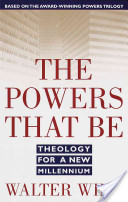
Beginning March 1st we will read Walter Wink's book, The Powers That Be:  Theology for a New Millennium.


Here is a review from Spirituality and Practice:
The author, who is Professor of Biblical Interpretation at Auburn Theological Seminary in New York City, presents an ethically challenging reframing of angels, demons, principalities, and powers. He writes: "Every business corporation, school, denomination, bureaucracy, sports team — indeed, social reality in all its forms — is a combination of both visible and invisible, outer and inner, physical and spiritual." These systems, institutions, and structures can do good and evil at the same time: "They form a complex web that we can neither ignore nor escape."

One of the challenges for Christian churches in our time is to discern the spirits of institutions and structures. If they are organized around idolatrous values and what Wink calls "the Domination System," they must be recalled to their divine vocation — the well-being of all individuals. With great clarity and clout, the author attacks the myth of redemptive violence and proclaims Jesus's path of practical nonviolence as its antidote ("It is the way God has chosen to overthrow evil in the world.")

Wink ends with a clarion call to seek God in our enemies, to practice justice in prayer, and to work every day for the "freeing of the Powers." Reading this watershed book will open your eyes afresh to the significance of spirituality, evil, politics, and redemption in our world.
Good stuff from an important thinker who acts for justice as well.
Join us Thursday from 10:30 until noon at FPC Elizabethton!


Sunday, October 10, 2010

Myth of Redemptive Violence


I referred to the Myth of Redemptive Violence in today's sermon. For those unfamiliar with the concept, here is Walter Wink, Facing the Myth of Redemptive Violence.


The belief that violence “saves” is so successful because it doesn’t seem to be mythic in the least. Violence simply appears to be the nature of things. It’s what works. It seems inevitable, the last and, often, the first resort in conflicts. If a god is what you turn to when all else fails, violence certainly functions as a god. What people overlook, then, is the religious character of violence. It demands from its devotees an absolute obedience- unto-death. This Myth of Redemptive Violence is the real myth of the modern world. It, and not Judaism or Christianity or Islam, is the dominant religion in our society today....

....In short, the Myth of Redemptive Violence is the story of the victory of order over chaos by means of violence. It is the ideology of conquest, the original religion of the status quo. The gods favour those who conquer. Conversely, whoever conquers must have the favour of the gods. The common people exist to perpetuate the advantage that the gods have conferred upon the king, the aristocracy, and the priesthood.

Religion exists to legitimate power and privilege. Life is combat. Any form of order is preferable to chaos, according to this myth. Ours is neither a perfect nor perfectible world; it is theatre of perpetual conflict in which the prize goes to the strong. Peace through war, security through strength: these are the core convictions that arise from this ancient historical religion, and they form the solid bedrock on which the Domination System is founded in every society....

....The Myth of Redemptive Violence is the simplest, laziest, most exciting, uncomplicated, irrational, and primitive depiction of evil the world has even known. Furthermore, its orientation toward evil is one into which virtually all modern children (boys especially) are socialised in the process of maturation. Children select this mythic structure because they have already been led, by culturally reinforced cues and role models, to resonate with its simplistic view of reality. Its presence everywhere is not the result of a conspiracy of Babylonian priests secretly buying up the mass media with Iraqi oil money, but a function of values endlessly reinforced by the Domination System. By making violence pleasurable, fascinating, and entertaining, the Powers are able to delude people into compliance with a system that is cheating them of their very lives.

(Read More)