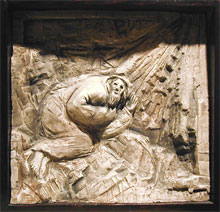
The Myth of the Call
John Shuck
First Presbyterian Church
Elizabethton, Tennessee
October 16, 2011
Genesis 12:1-9
Now the Lord said to Abram, ‘Go from your country and your kindred and your father’s house to the land that I will show you. I will make of you a great nation, and I will bless you, and make your name great, so that you will be a blessing. I will bless those who bless you, and the one who curses you I will curse; and in you all the families of the earth shall be blessed.’
So Abram went, as the Lord had told him; and Lot went with him. Abram was seventy-five years old when he departed from Haran. Abram took his wife Sarai and his brother’s son Lot, and all the possessions that they had gathered, and the persons whom they had acquired in Haran; and they set forth to go to the land of Canaan. When they had come to the land of Canaan, Abram passed through the land to the place at Shechem, to the oak of Moreh. At that time the Canaanites were in the land. Then the Lord appeared to Abram, and said, ‘To your offspring I will give this land.’ So he built there an altar to the Lord, who had appeared to him. From there he moved on to the hill country on the east of Bethel, and pitched his tent, with Bethel on the west and Ai on the east; and there he built an altar to the Lord and invoked the name of the Lord. And Abram journeyed on by stages towards the Negeb.
 The myths in the first eleven chapters of Genesis cover huge swaths of time. It is almost as though they are outside of time. Creation, the garden, the expulsion of Adam and Eve, Cain and Abel and Cain's exile, Noah’s flood, his nakedness and curse, and the tower of Babel are broad stories, and from the point of view of the ancient world, cosmic. The stories were as large as creation was thought to be. Elohim and Adonai are the two names for God in these early chapters. Peter Pitzele in his book, Our Father’s Wells: A Personal Encounter with the Myths of Genesis, calls these first stories, “Tales of a Lonely God.” Elohim is lonely. He does nothing for eternity but brood over the deep. Creation appears to be an act of longing. He is bored. Finally he speaks and light becomes. Both creation stories regard the human as special even created in the divine image. But God doesn’t seem to really know what to do or how to relate to this new creation of human beings. There is a longing on the part of God for a relationship. There is a desire to relate but there is a fear on the part of God. In the garden scene Elohim is concerned that the human will become like God by eating from the tree of life. In the tower of babel, Adonai sees that human beings have one language and will. Adonai sounds paranoid. He is afraid of these humans. He is concerned for his territory:
 “This is only the beginning of what they will do; nothing that they propose to do will now be impossible from them.”
He confuses their language and scatters them around the earth. He creates. He destroys. He scatters. Still he is a lonely God. Finally, he calls. “Now Adonai said to Abram, ‘Go from your country and your kindred and your father’s house to the land that I will show you.’”
Adonai chooses and calls one human being. With Abram’s story we shift to the ancestral tales. Time narrows to one life span. Through Abram, Adonai announces a destiny.“To your offspring I will give this land.”
This is from Peter Pitzele:From a certain point of view Genesis must be seen as propaganda. Like myth-theology the world over, it propagates the idea of a national destiny divinely favored that will in time rule the world. Signs of this agenda are scattered throughout Genesis and the Bible; it is the agenda of men, the fathers of the tribe, the priesthood, and later of the church. The fathers pass it on to the inheriting sons, those men called and chosen by God and by one another to carry on this dream of a divine destiny. P. 10
A Pitzele points out, patriarchal spirituality is about hearing, obeying, and following the call, the divine summons. I struggle with this. I struggle with it in my relationships, my sense of vocation, the meaning I seek to discover and create for my life. This partriarchal spirituality is in my bones. As we look further into the Abraham saga we are going to be confronted with the shadow, even the terror of this spirituality. “Take your son, your only son Isaac, whom you love, and go to the land of Moriah, and offer him there as a burnt offering on one of the mountains that I shall show you.”
I cringe when I hear that. I also cringe when read these opening verses in the saga of Abraham. I wanted to leave out verses 6 and 7 of chapter 12:“Abram passed through the land to the place at Shechem, to the oak of Moreh. At that time the Canaanites were in the land. Then the Lord appeared to Abram, and said, ‘To your offspring I will give this land.’”
The Canaanites were collateral damage on the way to fulfilling Abram’s destiny. Growing up in Montana, the Big Sky Country, gave me perspective on the people who lived there long before Europeans arrived. They had their own gods and myths. Now these native peoples are sequestered on six reservations around the state, placed there by those who followed the God of Abram. For them, the dream of Abram’s destiny has been a nightmare.I want to make sure that I don’t judge and dismiss this spirituality before we look into it. I don’t want to judge it prematurely for two reasons. The first is that if I judge it as bad and seek to dismiss it, I won’t be honest. Abraham lives deeply in the marrow of the bones of our civilization, in the lives of women and men alike. If I say that I will refuse Abraham and substitute the name of a goddess for him, or a native shaman, I may discover I have really changed little. I will have given Abraham a woman’s name or a shaman’s name, but he is the same guy. The project, the destiny, the myth is the same. So I don’t want to judge patriarchy prematurely because I don’t want to deceive myself that I have moved beyond it when I haven’t. The second reason I want to hold off judgment is that there is much that is appealing to patriarchal spirituality. The great people whom we admire and seek to emulate are rooted in it. Think of Martin Luther King. His sermons, his speeches, his demonstrations and marches were filled with patriarchal images. King himself followed a voice calling him to dream and to build the beloved community. King’s spirituality was driven by the myth of patriarchy: by call, sacrifice, and destiny. The protesters occupying Wall Street and those standing and marching and dreaming in solidarity with them around the country are following a call. This call is vague. It isn’t clear. It lacks specifics. But that is exactly what a call is. “Go from your country and your kindred and your father’s house to the land that I will show you…and in you all the families of the earth shall be blessed.”
Novelist, Barbara Kingsolver, who lives just up the road in Meadowview, Virginia, was at the demonstration in Johnson City yesterday. She was quoted in the Johnson City Press:“It is a movement in its early stages that’s getting on its feet,” she said. “If you look at the signs here everyone agrees on certain principles of mercy for people, principles about distributing the wealth of this country more fairly and principles of humanitarian kindness.”
I am not sure if Barbara Kingsolver would agree that she is following the myth of the patriarchal imagination. But she did describe it well. I want to point out that the myth of patriarchy, the spirituality of Abram, is not self-absorbed. He is not about finding personal peace or going to find a home on a little hideaway on an island. Abram is called for a purpose, for service, for vocation. Nor does he follow this call to build a dynasty for himself. He isn’t called to build skyscrapers and have “Abraham Incorporated” emblazoned on his business cards. He isn’t called to use people for his own corporate greed. That would be Odysseus. Pitzele compares Odysseus with Abram. While Homer’s Odysseus has many adventures and does many heroic deeds, he does not do it to become a blessing, nor does he become a blessing. It is all about him. His story ends when he comes back home. He has been successful, defeated the enemies, and now he will enjoy his own kingdom. The spirituality of building a dynasty or the spirituality of finding oneself (a spiritual narcissism) is not Abram’s. Abram’s story does not end with the end of his life. It does not end with the building of his own dynasty or kingdom. His dream is the beloved community, if you will, that is passed on to his offspring. They also must hear and follow the call. That call is also kind of crazy. The Voice speaks:Leave everything of value and go. I’ll tell you where you are going when you get there.
Would you do it? Do you follow that voice? Why not? You have one life. Follow the call and be a blessing. Be crazy. Be a holy fool.Occupy Wall Street? Really? That is kind of crazy isn’t it? The opposition is powerful and ruthless. They control everything. But, Barbara Kingsolver is quoted in the paper today:“I think it’s a very exciting moment in political history. I think this is going to be a force to be reckoned with.”
She is talking about this broad movement for economic and social justice and its particular expression in these demonstrations. It is a movement to be a blessing. The call of Abram. In the 1930s Reinhold Niebuhr wrote Moral Man, Immoral Society. This is the last paragraph. We can no longer buy the highest satisfactions of the individual life at the expense of social injustice.
He wrote that in the 1930s. Is it even more true in 2011?We cannot build our individual ladders to heaven and leave the total human enterprise unredeemed of its excesses and corruptions.
That is the call we are hearing today. Niebuhr continues:In the task of that redemption the most effective agents will be men who have substituted some new illusions for the abandoned ones. The most important of these illusions is that the collective life of mankind can achieve perfect justice.
Abram operates under the illusion that he will be a blessing to the world. This is the illusion of the demonstrators, that they will change this world. One sign yesterday read: “Corporate Greed” and had a slash through it. Can we end corporate greed? Can we really build a beloved community that values education over prison, people over profits, and that protects Earth from our savage exploitation? Yes, it is an illusion, but listen to Niebuhr:It is a very valuable illusion for the moment; for justice cannot be approximated if the hope of its perfect realization does not generate a sublime madness in the soul. Nothing but such madness will do battle with malignant power and ‘spiritual wickedness in high places.’ The illusion is dangerous because it encourages terrible fanaticisms. It must therefore be brought under the control of reason. One can only hope that reason will not destroy it before its work is done. P. 277
 That is how Niebuhr concludes his book, Moral Man, Immoral Society. It is hard for me to imagine a more relevant work for today. His book is a commentary not only on the events of today, on the sublime madness that is being expressed by those who are answering a call to social justice. His book is also an illustration of the myth of the call itself, the call of Abram, the call of a spirituality that is not afraid to go into uncharted areas, to boldly speak to the powers for a new order, to be a blessing. There is madness. There is fanaticism. There are delusions of grandeur. There is carelessness. There is a dark shadow on patriarchy’s project. While Niebuhr says this illusion needs to be tempered by reason, I think it might need to be tempered and embraced by the feminine as well as the masculine. Abram doesn’t have to hear this call alone. Our movements for justice need to incorporate the spirituality of companionship, relationship, diversity, partnership, mutuality, equality, compassion, and wisdom. We need the spirituality of the feminine or the matristic equal to that of the masculine and the patristic. Here is what to take home:The myth of the call is rooted in patriarchal spirituality. The figure is Abraham. He gets the divine summons to leave what is familiar, to leave his comfort zone, and to be a blessing. The call to be a blessing is a source of power that we can tap into in our contemporary movements for justice and peace, such as the movement taking place around the country. That call to go out and demonstrate, to dream of change, and to act is a powerful and necessary thing. The shadow of the call is fanaticism. Abram’s call involved a displacement of the Canaanites and the willingness to kill his own son for this vision. There is delusion, fanaticism, carelessness, and ruthlessness associated with this call. Abram needs a partner. He needs a strong Sarai. Before going off to sacrifice their son, he might ask her opinion first. If there is a call, it is to all of us. It is a call to be as well as to do. The values of relationship, companionship, diversity, wisdom, partnership, nurturing, and compassion will make our movement for social and economic justice stronger, more sustainable, and will enlarge that circle of blessing. Amen.