Shuck and Jive


Sunday, April 08, 2012

Easter and the Powers That Be--A Sermon

Easter and The Powers That Be
John Shuck

First Presbyterian Church
Elizabethton, Tennessee

April 8, 2012
Easter Sunday

I Corinthians 2:6-8

Now of course I do have something to say about wisdom, when I am with those who can fully comprehend it, but it’s not a wisdom of this age nor of those who rule it at present, all of whom are destined to be deposed. I am talking about a hidden and mysterious wisdom of God which God intended before time began: to raise us to the glory of God’s presence. None of the rulers of this age knew anything about this. If they had known, they would not have crucified the one who has become our exalted lord.


I want to speak today of the phrase, the concept, and the reality of “The Powers That Be.” You know that phrase. The Apostle Paul in the scripture I just read from I Corinthians uses the phrase, “the rulers of this age.” I am pretty sure that is the same thing as the phrase we know as “The Powers That Be”.

“The Powers That Be” or “the rulers of this age” are not particular people. They are the unseen forces that determine how the world works. “The Powers That Be” make up the personality of institutions. They consist of the ideology, the mythology, the structures and the rules. If you want to get ahead in an institution you play by the rules. You learn those rules that are unwritten. Everyone knows the rules.

When we speak of things like the “mainstream media” or “Wall Street” or “corporations” or “the government” or “the church” we are not speaking of particular individuals, except as those individuals participate in their role as agents for “The Powers That Be” of the institution in question. The individuals, the managers, the executives, and so forth are interchangeable. Sometimes when speaking of “The Powers That Be” we use the phrase “they”. That is what “they” say. That is what “they” do.

The Grapes of Wrath by John Steinbeck told of the story of a family migrating from Oklahoma to California during the Great Depression. In the telling of this family’s journey Steinbeck painted for us a portrait of the times. He wrote about how people lost the land and how bewildered they were in how it all happened. Unseen forces and powers were at work that were beyond their control and comprehension.

This is an excerpt from Steinbeck’s Grapes of Wrath. It describes what happened when the bank repossessed the land from those who had worked it, in some cases for generations:
The owners of the land came onto the land, or more often a spokesman for the owners came….if a bank or finance company owned the land, the owner man said, The Bank—or the Company—needs—wants—insists—must have—as though the Bank or the Company were a monster, with thought and feeling, which had ensnared them. These last would take no responsibility for the banks or the companies because they were men and slaves, while the banks were machines and masters all at the same time….


You see, a bank or a company…those creatures don’t breathe air, don’t eat side-meat. They breathe profits; they eat the interest on money. If they don’t get it, they die….the bank—the monster has to have profits all the time. It can’t wait. It’ll die. No, taxes go on. When the monster stops growing, it dies. It can’t stay one size…we have to do it. We don’t like to do it. But the monster’s sick. Something’s happened to the monster….
Sure, cried the tenant men, but it’s our land. We measured it and broke it up. We were born on it, and we got killed on it, died on it. Even if it’s no good, it’s still ours….


We’re sorry. It’s not us. It’s the monster. The bank isn’t like a man.


Yes, but the bank is only made of men.


No, you’re wrong there—quite wrong there. The bank is something else than men. It happens that every man in a bank hates what the bank does, and yet the bank does it. The bank is something more than men, I tell you. It’s the monster. Men made it, but they can’t control it. Pp. 42-45

I don’t repeat this quote in my sermon to pick on banks. It is just that Steinbeck’s The Grapes of Wrath happens to be one of the finest illustrations of “The Powers That Be” in literature.

It is important to say that institutions and the powers that be that are the driving forces within these institutions are not necessarily bad. They simply are. In fact when they uphold the good they are good. Theologian Walter Wink writes that the powers are simultaneously good, fallen, and redeemable. All three all at once.

There are times when the powers become like monsters as in the excerpt from The Grapes of Wrath. That is when the institutions lose sight of wisdom, that is, of their intended vocation, and instead become ends in and of themselves. This is the situation in The Grapes of Wrath. The banks lost sight of their intended purpose. Instead of enabling people to stay on their land, by means of sharing capital, they made their own profits their purpose. This story is being played out before our eyes every day in the present.

“The Powers That Be” have their effects on us individually as well. When we become self-absorbed, cynical, and despairing, that is a sign that we are beaten down by the powers. The work of engaging and transforming “The Powers That Be” is the work of Easter. That work is both within and without.

All the images, symbols, and themes associated with Easter such as resurrection, rebirth, a new day, dying to an old way of being and rising to a new way of being, are part of this engagement and transformation of the powers within us and outside of us.

Easter is a shift. Easter is a shift in consciousness. It is what Paul called the wisdom of God “that raises us to the glory of God’s presence.”

That is why we say liturgically that we are invited to live the Easter faith in the present. Christ is risen today, in the present. Today is Resurrection Day and so forth. Today is the new day. Today you are a new person. That is the spirit of the poem from Mary Oliver that I included in the bulletin:

What I want to say is
that the past is the past,
and the present is what your life is,
and you are capable
of choosing what that will be,
darling citizen.


So come to the pond,
or the river of your imagination,
or the harbor of your longing,

and put your lips to the world.
And live
your life.

That is I think the wisdom of God that Paul speaks about. Had the powers that be, or the rulers of this age, known that wisdom, “they would not have crucified the one who has become our exalted lord” writes Paul. They wouldn’t have felt they needed to do so. Had they known that wisdom they would not have seen Jesus as a threat.

Regardless of “The Powers That Be” we, that is you and I, have the capability of choosing what we will be at the deepest level of our self. That is the wisdom of meditation, for instance. Through the practice of meditation or through the practice of participating in the life of a conscientious community we experience ourselves free, liberated from thoughts, feelings, beliefs, and powers.

This individual liberation that is part of the Easter experience is very important especially for those who engage the powers of the institutions. Our congregation is an activist church in many respects. While we try not to tell people what to think or do, we nevertheless do engage issues of importance. Whether those issues include our environment, working for peace, for healthcare, for civil rights for LGBT people, or for science and religious literacy, we engage the powers. It can be discouraging work. The powers are called powers for a reason. They are powerful. At times intractable.

If we don’t have a center, if we aren’t careful, we can take many paths that are going to be dead ends. I am not speaking hypothetically, I am speaking from experience. We can be discouraged or cynical, even immobilized. We can be self-righteous or aloof. We can even become what we hate and return violent speech or actions with the same.

Paul knew this. Jesus knew this. Krishna and the Buddha knew this. The wisdom is not to avoid engagement but to engage with awareness. Krishna spoke of it as doing one’s duty without being attached to the results. The Christian way of saying it is to live and act with integrity and leave the results up to God.

Easter is a celebration and an acknowledgment that the wisdom of God has been around for a while. As Paul writes, “I am talking about a hidden and mysterious wisdom of God which God intended before time began: to raise us to the glory of God’s presence.” That is poetic and metaphorical language. What other language can we use? It is language that speaks about the glory of being human as God created us. We are now in God’s presence. We are human beings created with and for dignity. Nothing can take that away.

That is why I think the original followers of Jesus did not give up when Jesus and thousands of others were tortured and executed by “The Powers That Be”. Rather than give up in despair and rather than return evil for evil, they found inner strength and became creative. They said,
“Every time we gather for a meal of bread and wine we will remember. We are Christ's body. Christ is alive with us. We will continue to remember and to resist. We will show hospitality to those who are victims of imperial bullying, to the outcast, to the slave, to the stranger. We will lean on and support each other. We will remember and tell the stories of the victims. When we get self-righteous or discouraged and when we lose hope, we will remember who we are and whose we are. And we will dream, hope, and work for the day in which the kingdom of God, the empire of God, the empire of justice and peace, the wisdom of God which God intended before time began, will be realized on Earth.”

That is what the original acclamation, “Christ is risen” meant.

Christ was risen in them.
Christ is risen in us.
Christ is risen in you.

Today is a new day.
Our past is past.
Kiss it goodbye.
The old has gone,
the new has begun.

You who hunger and thirst for justice, wisdom, peace…
Come to the table.

As Mary Oliver writes:
So come to the pond,
or the river of your imagination,
or the harbor of your longing,
and put your lips to the world.
And live
Your life.

Amen.


Friday, April 06, 2012

Good Friday? A Reflection

Good Friday?
John Shuck

First Presbyterian Church
Elizabethton, Tennessee
April 6, 2012
Good Friday
Mark 15:1-47

A few years ago a poster advertising Mel Gibson's movie, The Passion, featured an image of Christ wearing a crown of thorns. The caption read:
Dying was his reason for living.

The movie itself was about his supposed last hours cobbled together from the various accounts in the gospels and other traditions. It was an incredibly violent and bloody film, typical of a Mel Gibson film.

Why are we so obsessed with the death of Jesus?
Dying was his reason for living.

Really?

Much of Christian theology has been used to induce guilt and shame. You are so bad that Jesus had to die on the cross. The bloodier and more painful the death serves to demonstrate the depth of your depravity. You deserve all that beating. But Jesus took it for you. That is default Christianity. I call it spiritual abuse.

Jesus had a life before he died. The things he did and the things he said were provocative enough to put him on the wrong side of the authorities. From the things people remembered that he did and said, he was critical of the authorities. He was critical of the religious authorities and of the political authorities.

That is what got him killed.

He challenged systems of authority that took advantage of widows, of the poor, and of the outcast. He created a movement. And it was threatening enough that those in power felt the need to stop him. Perhaps to make of him an example.

That is what got him killed.

He was on the side of people who were oppressed by the economic policies of the temple. He was on the side of people considered unclean and sinners by the religious.

That is what got him killed.

He is remembered for telling parables and stories that upset people. He used a phrase "kingdom of God." That phrase means little to us because we have tamed it. Most folks thanks to the theologians think it is another phrase for heaven, a place the true believers go when they die.

It is likely that it was a political statement. It was a social statement. It was a statement of hope. As opposed to the kingdom of Caesar, imagine what the kingdom of God is like. It wasn't just a fantasy, a story. It was a movement. This is the kingdom to live for, to work for, perhaps even to die for. It is a kingdom of justice and compassion. In this kingdom, in this political economy the hungry are filled with good things. Now let's make it so. That was Jesus’ message.

Jesus was about making changes in this world.

That is what got him killed.

He talked about compassion. He talked about moving beyond ethnic boundaries and divisions. He talked about forgiveness. Not something you go to the priest for or even to God for, but your neighbor. The neighbor is who we hurt, not God. The neighbor is the one from whom we need forgiveness. We get it as we give it.

Jesus worked to bring people together: Samaritan and Jew, Greek and Roman. He practiced an open table, rich and poor, male and female. He challenged unjust boundaries and rules.

That is what got him killed.

Dying was not his reason for living.
Living was his reason for dying.

For life, he died. For integrity, he died. For compassion, he died. For justice, he died. For change, he died.

He was in the way. He was in the way of progress. He was in the way of Rome. He was in the way of the religious authorities who had sold out their people to Rome. He was killed as were many just like him.

Jesus didn’t die of old age. He didn’t die of cancer. He didn’t get trampled accidentally by a runaway horse. Jesus was bullied to death. Not only Jesus, but thousands of people were tortured and executed methodically in a spectacle of brutality and control. Jesus was a victim of imperial terrorism.

There was and is nothing sacred and holy about the execution and torture of Jesus or of anyone.  If anything, remembering the death of Jesus should summon us to honor life not death. It should give us the courage and commitment to speak out and not remain silent in the face of torture, execution, violence, injustice, and needless suffering around the world.

The Easter acclamation, “Christ is Risen!” meant what? I think it meant that they, the people, those who told and wrote the stories about Jesus had had enough. They had had enough of Rome’s bullying. They said,
“Every time we gather for a meal of bread and wine we will remember. We are Christ's body. Christ is alive with us. We will continue to remember and to resist. We will show hospitality to those who are victims of imperial bullying, to the outcast, to the slave, to the stranger. We will lean on and support each other. We will remember and tell the stories of the victims. And we will dream, hope, and work for the day in which the kingdom of God, the empire of God, the empire of justice and peace will be realized on Earth.”

Obviously, Christianity evolved and moved in all kinds of directions and embraced many different mythologies and interpretations, and some of them quite good and helpful. But it is important not to lose sight of our roots. The earliest interpretation of the death and resurrection of Jesus is this:
In Christ, Empire’s brutality is overcome by God’s justice.

I wear this cross around my neck to remind me whose side I need to be on.

Jesus' life was fast. Like Martin Luther King, they both died before reaching forty. But their lives burned with passion and fire. They burned out for compassion and justice.

Apparently, they believed that it is better to have burned out than never to have burned at all.

Whenever any of us stands up for those who are abused or put down or who suffer injustice from bullies big and small, we practice true religion.

We live in the example and spirit of Jesus.

Only if today helps us to live a life that matters can we dare call it Good Friday.

Amen.

Thursday, April 05, 2012

Janet and Me to Rule General Assembly

After nearly twenty years in the ministry, I finally get to go to the PC(USA) General Assembly.  

The LayMAN broke the story.
Shuck has been elected by Holston Presbytery to serve as a voting commissioner to the PCUSA’s 2012 General Assembly.

That is the truth.  Even though there may be a thousand other commissioners (or however many there are) what is important is that I am going.  As we all know Beloveds, it is all about me.   

Well it is about me and Janet.
Shuck is not alone. At the General Assembly, he will find allies who are equally dismissive of God’s Word. The Rev. Janet Edwards, a self-identified “bisexual” whose officiating at lesbian wedding ceremonies have made the news in recent years, will also be there as a voting commissioner, promoting her bid to become moderator of the General Assembly.
Me and Janet the bisexual are going to occupy GA.   Because of that...
Biblically faithful Presbyterians by the tens of thousands are heading for the exit. That massive migration has so seriously enervated the few evangelical Christians remaining that Edwards may now campaign for the once-esteemed office of moderator while Shuck parades with impunity his unbelief.
I couldn't pay an advertising company to create a better endorsement.  Thank you, Parker!   He is my SuperPac Daddy!   Janet and I also received endorsements from his disciples:
"I am always amazed that leaders such as John Shuck are permitted to continue to minister within the PCUSA with their heretical teachings."  Rev. Soto
I am amazed too now and again.  But not all are amazed:
I cannot believe that anyone is surprised by the heresy and apostasy running absolutely rampant in the PCUSA.  With enormous hubris and arrogance, Shuck has been trumpeting his heresy in his blog and pulpit for years, aided and abetted by fellow travelers and non-believers in his "congregation" and his presbytery. 

"That he and Edwards ("... who calls herself a prophetess. By her teaching she misleads my servants into sexual immorality...") and others like them will be allowed to pollute and poison the processes and activities of the upcoming GA, and is a completely foreseeable result of the capture of our hierarchy by liberal progressives who are hostile to, and dismissive of, the Word of God.  The orthodox believers remaining in this denomination should be prepared for even more apostasy in July.  Shame on Pittsburgh and Holston for even sending these people to GA."  Rev. Yearsley 
There you have it.

But you don't know the latest.   Janet is "standing for moderator" for GA.  What that means is that all the candidates for moderator stand there and the one who pulls the sword from the stone gets to be queen.   I am certain that Janet, as prophetess and anointed bisexual, will receive this divine honor.  

When Janet becomes Queen of Presbyteriandom she will in turn, crown me as Duke.


I already have the hat.


Together we will parade with impunity and pollute and poison the General Assembly with apostasy.  

Here is our platform:  
Free ice cream for everyone every Friday.
We learned our lesson from history.  It is not enough to let them eat cake as the fated Marie Antoinette learned too late.   

Let them eat cake and ice cream!


Wednesday, April 04, 2012

Is Jesus Christ a Myth? A Review of Robert Price's, "The Christ Myth Theory and Its Problems"

Dr. Robert Price is a fellow of the Jesus Seminar. From his perspective the Jesus Seminar was far too conservative regarding the voice print of the historical Jesus.  Dr. Price doesn’t think anything in the gospels goes back to an historical person. Jesus is not the son of God, the Christ, the son of man, a deluded apocalypticist, a clever cynic, or even just a dude in the wrong place at the right time. He is a creative fiction from start to finish. The gospels are works of fiction. The biography of Jesus is not biographical at all but pieced together from stories in the Greek Old Testament and Greek literature.


Dr. Price is one of the “mythicists” Dr. Ehrman warned you about.  Who are these mythicist bad boys?  What are they saying? Do they have a case? Do they have a partial case?


If I knew nothing about the Bible or Jesus and were to channel surf and see the Gospel of Luke (or any of the gospels) acted out on the Dish Network, I might ask myself, "What am I watching?"  Is this more like a PBS documentary on early Roman history or is it more like Xena: Warrior Princess?   Is this the Biography Channel or is it Masterpiece Theater?  Given those choices, the answer is, "Xena and Masterpiece."

It begins with a bucolic scene with poor shepherds and a stable.  The camera focuses on the face of a baby who is a "son of god" born of a virgin and "the holy spirit" to the accompaniment of singing angels.  As a precocious adolescent he astonishes his parents in the temple doing "his father's business" (wink, wink).  He speaks to and casts out demons, raises people from the dead, cures blindness with his spit, feeds five thousand people with five bagels and a can of sardines, walks on water, calms the sea by command, outwits his adversaries with clever aphorisms, dies for the sins of the world, rises from the dead, and then ascends bodily to heaven.   What are we watching?

Let's be like Judas' opening number in Jesus Christ Superstar and "strip away the myth from the man."   This has been the project of higher criticism for centuries.  Rudolf Bultmann called it demythologizing.  He thought that the gospels made a myth of the man.  The mythicists see the gospels as historicizing a myth.   It is six of one and one half dozen of another to me.    A case could be made for either direction.  As Robert Price writes:
There may once have been an historical Jesus, but for us there is one no longer. If he existed, he is forever lost behind the stained glass curtain of holy myth.  p. 23.
Certainly we know that the gospels are in some degree fictional. Only the truest believer would suggest that Jesus did and said everything that the gospels said he did and said.   Yet even most believers, I would think, would recognize that some of the activities attributed to Jesus are exaggerated.  They might even say, legendary.   Dare we say, fiction?   Go ahead, say it.  Fiction.  Jesus is at least in part a fictional character.   Be careful.  Once you go down that slippery slope you might next be asking yourself, "Is he mostly fiction?"   And that is just a short slide to smoking cigarettes and listening to jazz in a back alley barroom with the local hoodlums, er mythicists.


The Christ Myth Theory and Its Problems is a fine introduction to “The Quest of the Mythical Jesus” as Dr. Price puts it. The book is a collection of nine articles written by Robert Price on the various themes of the Christ Myth Theory.


I have not tried to amass every argument I could think of to destroy the historicity of Jesus. Rather, I have summarized the series of realizations about methodology and evidence that eventually led me to embrace the Christ Myth Theory.  P. 23
He does a fine and thorough job of it in this collection of essays.

First things first.  Dr. Price in addition to being an incredibly bright guy (he has two Ph. D's), is a hoot.  He is entertaining in person, on the radio, and in print.    He is especially clever with titles, such as the title of one of his books, The Incredible Shrinking Son of Man.   One of my favorite books of his is The Reason Driven Life which is his response to Rick Warren's multi-zillion dollar best seller A Purpose Driven Life.    I think the world would be far less goofy if more people bought Price's book over Warren's.   

On to business.

The basic thrust of the Christ Myth Theory as I understand it is that Jesus Christ is a mythical figure in the pattern of the dying and rising God mytheme.  This mythical figure became "historicized" in the gospels and the later Christian tradition.   For Paul, Jesus Christ is crucified and risen.  Paul cares not about Jesus the person, but Christ Jesus, in whom we have salvation.  Paul knows Jesus through mystical visions.   By the time we get to the gospels, Jesus takes on the archetype of the hero and has attached to him stories mostly from the Old Testament.

Dr. Price's book is 397 pages and 200 of those pages are in a section entitled, "New Testament Narrative as Old Testament Midrash."  In this section, he attempts to find literary antecedents to many of the stories in the gospels and in Acts.   For instance, does this story sound familiar?
A man came from Baal-shalishah, bringing the man of God bread of the first fruits, twenty loaves of barley, and fresh ears of grain in his sack.  And Elisha said, "Give to the men, that they may eat."  But his servant said, "How am I to set this before a hundred men?"  So he repeated, "Give them to the men, that they may eat, for thus says the Lord, 'They shall eat and have some left.'"  So he set it before them.  And they ate, and had some left, according to the word of the Lord."  p. 93
That is from 2 Kings 4:42-44.  We know this story in the gospels as Jesus doing even better than the "man of God" by feeding 5,000 men (plus women and children) with five loaves and two fish.  Twelve baskets were left over.  That is but one example of midrash.   As Dr. Price explains:
We must now envision proto-Christian exegetes "discovering" for the first time what Jesus the Son of God had done and said "according to the scriptures" by decoding the ancient texts.  Today's Christian reader learns what Jesus did by reading the gospels; his ancient counterpart learned what Jesus did by reading Joshua and 1 Kings.  It was not a question of memory but of creative exegesis.  p. 61
This is not a new insight in scholarship.  Those who think Jesus was an historical person also show that Jesus had legends attached to him by the authors of the gospels who went back to their scriptures and re-wrote the old stories with Jesus as hero.   The difference with Dr. Price is that 
"...the result is a new perspective according to which we must view the gospels and Acts as analogous with the Book of Mormon, an inspiring pastiche of stories derived creatively from previous scriptures by a means of literary extrapolation."  p. 61
It's midrash all the way down.   According to Dr. Price, when you try to separate the myth from the man you are left with myth and no remainder.   OK, but aside from the miracle stories, what about the sayings and deeds of Jesus that the Jesus Seminar colored red or pink?   In his chapter, "Dubious Database:  Second Thoughts on the Red and Pink Materials of the Jesus Seminar," Dr. Price finds that none really makes the cut:
I have more than once drawn attention to D.F. Strauss's critical axiom that, once we expose the mythical Tendenz of a gospel story, we have no right to try to salvage specifics, secondary details, from it.  That is just a lame attempt to try to make bad evidence into good, and it partakes of a kind of Euhemerism, arbitrarily positing a more modest, possibly original version underlying that which we can in good conscience no longer accept.  If we can no longer affirm as historians that Jesus walked on water, we cannot pretend that the story in which he did is still good as evidence that knew where the stepping stones were.  There is no reason to insist that that secondary details, there just to background or advance the story, have an independent historicity when the main story dissolves under critical scrutiny.  p. 313
Or to put it more directly:
The story wants to preach to us a divine savior who entered this world from heaven and shortly returned there, betrayed, repudiated, martyred, but  vindicated.  We are having none of that.  We can tell that is myth, pure and simple.  So we ask what bits would make sense if we abstracted them from their familiar context and made them mean something else, as if the Atheist should take the Psalm verse out of context, stripping away the introduction, "The fool has said in his heart," then triumphantly quoting what is left:  "There is no God!"  p. 314
In other essays, Dr. Price addresses other thorny issues, such as Jesus' family members (ie. Paul's claim that James was "the brother of the lord").   That would make Jesus real, unless of course, "brother of the lord" means something other than biological kin.   

If you are going to read Dr. Ehrman's book as you should, I recommend this one by Dr. Price as well.  Even if you reject the arguments by Dr. Price and reject the Christ Myth Theory, you will gain insight into how the gospels were shaped.

I majored in English literature in college.  To this day, I remember my professor, Roger Sale of the University of Washington, telling us that when we read casually we care about the characters.  But reading literature critically requires us to care about the authors.   This may be especially true when we are reading stories about Jesus.  We care about Jesus.  We care so much that we have forgotten that he was created (or at least mightily shaped) by his authors.    The genius of Jesus might not have been in Jesus but in his creators.  In his chapter "The Abhorrent Void," Dr. Price writes:
There is just no reason Christian writers could not have composed the Sermon on the Mount if they created The Dialogue of the Savior.  If they could have fabricated Pistis Sophia, they could much more easily have fabricated the Gospel of John.  Whether they did is another matter, the discussion of which starts here, not stops.  p. 331

What is at stake in all of this?    Does the very edifice of Christendom rise or fall on the historicity of Jesus?   For some of course it does.  But that doesn't mean much.   Some require the foundation of Christianity to be built on an inerrant Bible.   If Jonah wasn't swallowed by a big fish then our faith is futile and we are still in our sins.

But for most thoughtful people who are taken by the Jesus Romance, we recognize that the mythical character of Jesus is the way the "mystery" has been revealed.   It takes a myth to tell this marvelous truth.   Ask Episcopalians, they get holy myth (at least many of them do).   The question is which myth?   Paul's myth or the myth of those who forged letters in Paul's name?  Mark's myth?  Luke's?  Mathew's?  John's?  Q's?   The myth of The Gospel of Judas or The Gospel of Mary Magdalene?  The myth of the Nicene Creed?  They are all different.   Take your pick or invent your own.  If there was a guy, he was framed immediately by everyone in a different way. 

I say, "Let the framing continue!"  I frame Jesus, too.   I think of him as a smart-mouthed critic of the world who loved to challenge convention.   He lived his life by standing up for what he believed in, inspired the marginalized, and lampooned the authorities.   Did that guy exist?  In my mind.  It is my myth of the historical Jesus.  And I can color a number of his sayings red or pink that go along with that myth.   I like to think he was real.  I can make a case that he is credible.  He is my Jesus.   He is my ishta deva and he's just all right with me.   If my views change and he fades into fiction, that's all right too.  He's still a great story.

What I find weird is the certainty over something that doesn't seem certain to me at all.   Either way.   If you insist he is a myth from start to finish, that's fine.  You may be right.  If you want to tell me beyond a shadow of a doubt that the historical Jesus existed and did this, said that, and believed in whatever, well, that's fine, too.  But unless I thrust my hand into his side I [probably] will not believe. 


Monday, April 02, 2012

Parker Lays an Egg

It must be getting close to Easter.

Parker Williamson of the LayMAN loves to celebrate Holy Week by attacking those who use biblical literacy in their sermons.   In so doing he demonstrates his lack of same.

This was his post about me two years ago at Easter.

I am one of the LayMAN's poster children for how bad the PC(USA) has become. I think I am useful for the LayMAN's fundraising appeals.  I am also happy to be useful in emptying pews.

This is his most recent, Unbelief Unveiled.

Shuck continues with accolades for the Jesus Seminar, a project by a handful of academics to discredit any passage of Scripture that portrays Jesus as divine. Supporting the seminar’s view of Scripture, Shuck said, “The Bible is not always what it seems. It was created by numerous human authors. Every one of them had an agenda. They created these stories and these images for a variety of reasons. Reasons that we may never know.”

Williamson thinks it is big, heretical news that the authors of the gospels each shaped Jesus. Where would anyone possibly get an idea like that? Perhaps at any one of our Presbyterian seminaries. Scholars carefully conceal this knowledge in books.   Maybe Parker will read one someday.  It is Easter.  Miracles do happen.

One would also think that an editor of a magazine might actually provide a source for documents from which the editor takes quotations. In the digital age it is as easy as a link.  What is Parker demonstrating by refusing to engage in this obvious practice?  Vote for one:
  1. Ignorance
  2. Lack of journalistic integrity
If you are curious about my sermons on the Gospel of John, check them out.

I do look forward to General Assembly!!

Who knows? Maybe I'll even meet Parker!

Landon Whitsitt, Open Source Church on Religion For Life, April 5-9

Rev. Landon Whitsitt is the Vice Moderator of the Presbyterian Church (U.S.A.) He is the author of Open Source Church: Making Room for the Wisdom of All. Drawing his metaphor from open source software, he suggests the church of the future would do well to consider being "open source" regarding welcoming new people and new ideas. He was the Theologian In Residence at Tusculum College in February 2012. He graciously agreed to visit the WETS studio and talk with me on Religion For Life.

He blogs at landon whitsitt (dot) com


Listen via livestream...

Thursday, April 5th at 8 pm on WETS, 89.5.
Sunday, April 8th, at noon on WEHC, 90.7.
Sunday, April 8th, at 2 pm on WETS, 89.5.
Monday, April 9th at 1 pm on WEHC, 90.7.
Via podcast beginning April 10th.

Wednesday, March 28, 2012

Let Your Light Shine: An Important New Film

Thanks to More Light Presbyterians for pointing out a new film project, Let Your Light Shine.   The film explores the intersection of religion and homophobia:
Why are religion and the Bible used against homosexuals?  Why are evangelical Christians especially condemning of LGBTQ people and feel free to call us "sinful"?  "Let Your Light Shine" will probe the intersecting circles of evangelical Christianity, the gay civil rights movement and activism by queer alumni from Billy Graham's alma mater, Wheaton College!  This kaleidoscopic lens will shine a light on the deeply historical and discriminatory roots of evangelical Christianity, and the growing visibility of queer liberation which challenges Bible-based homophobia.  The testimonies of LGBTQ survivors from Christian colleges and religious upbringings reveal both the damaging impact of evangelicalism and a spirited resistance to continued religious oppression.  Please view our trailer and help us any way you can!  Even a mustard seed . ..

Here is a preview:


While the focus is Wheaton College, similar stories are found on college campuses all over the country.

To get this project started they are looking for funding. They are almost to their goal of $50,000. Yours could be the dollar that puts them over the top!

WETS Fundraiser (the shortest ever!)

WETS is in the midst of its Spring fundraiser. This is an editorial about it from today's Johnson City Press:
Public radio may be free, but the same can’t be said of the programming heard on WETS-FM. Shows like “Wait, Wait ... Don’t Tell Me,” “Car Talk” and “A Prairie Home Companion” don’t come cheap. That’s why WETS — which kicks off its spring fundraising drive today — asks its listeners to dig deep into their pockets twice a year to help pay the bills for these programs. It’s often a struggle for the station to collect the donations needed to cover its programming costs. Too many fans of WETS have been content to let someone else carry the financial load. Some mistakenly believe the federal government will take up the slack. That’s not the case. More than half the funding for WETS comes from listener support. The rest comes from other sources, including state and federal grants. It was those grants and listener support that has allowed WETS to add three HD channels to its programming. The station now broadcasts channels that offer news, classical music and bluegrass. Contributing to WETS is a worthy investment in a broadcast outlet that enriches our lives daily. The public radio station is operated as a partnership between East Tennessee State University and its listeners. And it’s listeners who pay the costs for most of the programming heard on the air. Contributions to WETS can be made online at www.wets.org   or by calling 888-895-9387. Donations also can be made by using a Visa or MasterCard, or listeners can ask to be billed later. The sooner you make your pledge, the quicker it will be for the station to reach its fundraising goal and return to its normal programming schedule.
Here is how you can make it the shortest fundraiser ever! Oh, and by the way, when you make your pledge, let them know you listen to Religion For Life!

Tuesday, March 27, 2012

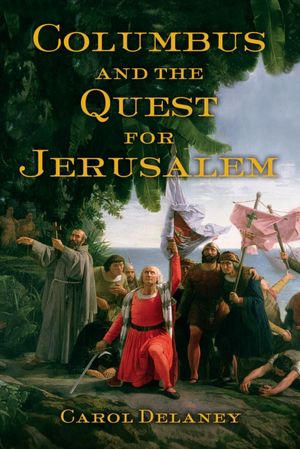
Carol Delaney: Columbus and the Quest for Jerusalem on Religion For Life, March 29 through April 1

Cultural anthropologist, Carol Delaney, returns to Religion For Life to discuss her latest book, Columbus and the Quest for Jerusalem. We know the children's rhyme: "In 1492 Columbus sailed the ocean blue." But why? Because he wanted to find gold in order to start a crusade to conquer Jerusalem for the Christians so that Christ would return. Professor Delaney takes us into the medieval mindset and helps us understand Columbus in his time and place. I discussed her book in a recent sermon and you can hear her provocative thesis on Religion For Life.

Image

Listen via livestream...

Thursday, March 29th at 8 pm on WETS, 89.5.
Sunday, April 1st, at noon on WEHC, 90.7.
Sunday, April 1st, at 2 pm on WETS, 89.5.
Monday, April 2nd at 1 pm on WEHC, 90.7.
Via podcast beginning April 3rd.

Saturday, March 24, 2012

The Psychology of Peak Oil

This is an excellent film on facing the emotions of Peak Oil. Janaia Donaldson of Peak Moment speaks with the founder of Peak Oil Blues, Kathy McMahon.