Shuck and Jive


Showing posts with label Six E's. Show all posts

Friday, September 08, 2006

Empire, Paul, Silas, Jesus, and Us


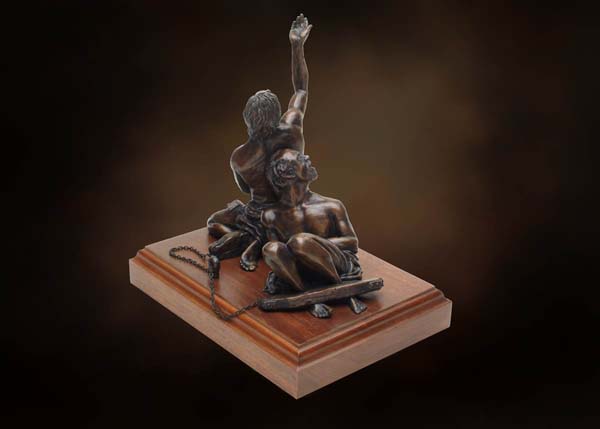
Paul and Silas in Prison


Hi Friends!

(I sure love to read and respond to your comments on this blog. Most of them that is. However, some of the comments read like this:

“You are violating your ordination vows!”

And

“How can you possibly be a Presbyterian Minister!?”

And

“Where is your confessional integrity?!”

I find comments like these tiresome, boorish and always off topic. How to respond? I certainly want to acknowledge the folks who write them and note their sacred worth even though I have no further intention of engaging in that line of conversation.

I have been introduced to a delightful phrase while living in the South. It seems perfect for this and almost any occasion. It goes like this:

“Bless your heart.”

Isn’t that marvelous!)


You may be saying to yourself, “John, you are really bummin’ me with all of this discussion about oil, ecology, empire and what not.”

I hear ya. That is why I like to play the Galaxy Song every now and then!

But you know. Reality is reality. Preparation is 90% mental. We are going to work our way through this with our heads held high and a sparkle in our eye. We are going to make a difference. You are going to make a difference. You have the divine light in you. So get that light out from under that bushel and let’s deal with this!

You know what the Apostle Paul and his pal, Silas did to pass the time when they were put in a prison cell together?

You guessed it! They sang happy tunes! Confident that nothing (not even their own deaths) could separate them from Divine Love, they put feathers in their caps, a whistle on their lips, springs in their steps, and smiles on their little plump faces.

It is a good anti-Empire story.

We are going to sing happy tunes as well. We are going to wake up and live authentically. The first step is to seek and to speak the Truth.

Here is a great film. It will take you 45 minutes to watch it on your computer. It will go by fast. It is funny and smart and to the point. You can watch it alone or with someone you love. It is Robert Newman’s “History of Oil.”

Let’s talk about Jesus. Do you know what his favorite phrase was? I think it was his favorite because he said it a lot.

Basileia tou Theou

“Looks Greek to me, John,” you say. Very good. It is Greek. It has been translated as
Kingdom of God, Realm of God, Divine Realm, Domain of God, Commonwealth of God, and Empire of God.

I think that Jesus used this phrase to counter the Empire of Rome. Through his parables and his teachings and by his example of open table fellowship he gave his disciples of glimpse of what the Empire (or Commonwealth) of God is like.

We need to talk about Empire such as American Empire so we can seek an alternative. Tell me about the Commonwealth of God. What would life be like if we lived out the vision of Jesus?

A new book has been published by Westminster John Knox Press. It is entitled: The American Empire and the Commonwealth of God: A Political, Economic, Religious Statement.

The authors David Ray Griffin, John B. Cobb, Jr., Richard A. Falk, and Catherine Keller offer their analysis of the American Empire, speak of alternatives to it, and offer religious reflections.

I am impressed with it. It gives those of us who don’t like the way Jesus, God, and the Church have been co-opted by the religious and political right hope and direction. I will be talking about some ideas raised in it in future posts as well as other things!

Bless your heart!

John

Thursday, September 07, 2006

The Sixth “E”: Empire

Several posts ago, I made the claim that three issues (ecology, energy, and economy) need attention. I stated that our nation is failing at all three. Industrialized nations, (including the U.S.) cannot sustain their current standards of living. We will face either an ecological collapse or an economic one due to Peak Oil.


Part of our failure in dealing with this globally threatening issue is that we have grown accustomed and even feel entitled to our current standard of living. As George H. W. Bush said in 1992: “Our American way of life is non-negotiable.”


Not only do we feel entitled we also think we are exceptional. No nation is better or more god-blessed than America. Christian Fundamentalism links itself with American Exceptionalism. The missionary emphasis of Christian Fundamentalism often connects with American Imperialism. An evangelical in the White House (or at least one who speaks the language) really packs a one-two punch.


In a sermon I preached during Lent entitled, Tempted by Empire, I quoted a former United States Senator from Tennessee:


“We’re the strongest nation on Earth militarily. We’re the most moral nation on Earth. We are an example to the rest of the world, even that part of the world that doesn’t like us much. …You realize that even our most vocal adversaries really in a way are expressing an envy for America, for our ability to create wealth and distribute it as equitably as has ever been known in history….We are the greatest nation on Earth, but we have the greatest obligations of Earth.”

(Former U.S. senator Howard Baker. Net News service, Johnson City Press, Wednesday, March 1st, 2006, p. 1.)


“The most moral nation on Earth.” That is American Exceptionalism.


I wonder if our friends in Spain would agree? Or Canada? Or Egypt? It is an absurdly arrogant statement, really. That statement is not meant for people in other countries. It is for us to believe about ourselves. We are not like any other nation or empire or military power. We engage in preventive-preemptive wars in order to spread morality.


Baker is correct to say that we have the strongest military. We spend more on our military than the next 20 nations combined. We have over 700 military bases in 130 countries. Why? To spread morality?


There could be another reason. We make up four percent of the world’s population yet consume 25% of the world’s oil. If Peak Oil has arrived or will arrive shortly, and the global supply of oil will rapidly diminish, then we will need more than 25% of the world’s oil if we wish to continue our non-negotiable American way of life. We will need 30% then 40%, 50%, 75%, even 100% just to maintain our standard of living.

Other nations might want some of that oil, too.

So…we need to secure it for ourselves.


Enter the Project for the New American Century (whose membership includes Donald Rumsfeld, Dick Cheney, Jeb Bush, and Paul Wolfowitz, among others. This is their mission statement:


The Project for the New American Century is a non-profit educational organization dedicated to a few fundamental propositions: that American leadership is good both for America and for the world; and that such leadership requires military strength, diplomatic energy and commitment to moral principle.

There is that “moral principle” again. You see, Americans don’t like to think that their government is simply so rude as to go to war over worldly things like oil. After all, we put Native Americans on reservations and enslaved Africans in order to civilize and Christianize them. You know, make them moral.


But the hard truth is that economy drives war. We are engaged in a long-lasting war for the world’s remaining oil reserves. This will not be good for America or the world. It could end in a nuclear war. No one will win this war including most higher forms of life.


But Americans do not like to think that, especially an America that has a Bible-believing good Christian man in the White House. If we admitted the truth, we would lose the self-perception of our innocence. We are exceptional, right?


So our leaders (and we let them do it) are engaging us (on our behalf—the American way of life—our standard of living) in a war for the remaining oil reserves while at the same time we let them convince us that we are “spreading democracy” and fighting evil-doers.


American Empire is the short-term answer. It is not a good answer. What we need is global cooperation. That means every head of state recognizing the problem and working together to power down and to focus on the basic needs of all people as we face the coming energy crisis.


We can do this. The people when we wake up can demand it.


I will offer alternatives to Empire next time.


Blessings,
John

Tuesday, September 05, 2006

The Fifth "E": Exceptionalism

American Exceptionalism is difficult to define. But it has to do with the sense that Americans are qualitatively different from other people. We think of ourselves as especially blessed or chosen. In some way, God has called us to be the "city on the hill" the "light to the nations" and so forth.

God blesses us, uniquely. God might bless Argentina, too, but God really blesses us. God has a plan for America.

That exceptionalism has always been part of our collective mythos, but no one has exploited that mythos for political gain better than our current administration.

Why do evangelicals vote for him? It seems that he speaks their language. Does he really believe what evangelicals believe, or is he taking them for a ride? What is it that evangelical Christians believe anyway?

The linked document does not speak for all evangelicals but a particular camp within the PC(USA) called New Wineskins. These essential tenets describe their evangelical faith. Here is a list of basic beliefs from the webpage of the Southern Baptist Convention. There are differences but they all affirm the infallibility or inerrancy of the Bible (that somehow this collection of writings has supernatural origin). Both creeds affirm exalted language for Jesus and that salvation comes only through him. Both creeds affirm that Jesus will return at some point in history to straighten things up.

I am curious. Is it good or bad for a president to have these beliefs? Many evangelicals believe that unless you are a Christian you will spend eternity in hell. I would be uncomfortable if the President of the United States really believed that. Many evangelicals believe that the Bible is more authoritative than the U.S. Constitution. I would be uncomfortable if the President of the United States really believed that. Many evangelicals believe that Jesus will return to set up his kingdom on Earth. They don't believe that this language is metaphorical but is something that will really happen and soon. I would be uncomfortable if the President of the United States really believed that.

Evangelicals have some very specific beliefs. I wonder if they think that the President of the United States shares these beliefs. I wonder what the President of the United States really believes. I don't, of course, care about what he believes as an individual, but as the leader of a country with the most sophisticated military technology on Earth (including a nice little collection of nuclear warheads), those beliefs do matter.

Does our President get his mandate from the Bible or the Constitution?
Are Muslims going to hell?
Will current wars in the Middle East usher in the Second Coming of Christ?

What do you believe, Mr. President?

Are you just faking it to get the vote or do you really believe what evangelicals believe?

Your evangelical constituents and I would like to know.

Monday, September 04, 2006

The Fourth "E": Entitlement


I realize there are a lot of words that begin with "E" that fit this topic! This could go on for a while!
"Entitlement" is one of the E-words that fit our situation. For instance, to what are we entitled as Americans? Are we entitled to cheeseburgers, steaks, cars, large lawns, fruit out of season, a 3,000 mile Caesar salad, and cheap oil?

We are four percent of the world's population yet we consume 25% of the world's oil. Are we entitled to that? In 1992, then President George H. W. Bush said that "The American way of life is non-negotiable." When I see "the American way of life" I read "the American standard of living." Are we entitled to that?

More disturbing, to what ends will we go (or allow our political leaders to go on our behalf) for the sake of our way of life?

Perhaps one of the reasons we find it difficult to change our way of living even in the face of emerging energy and ecological demands, is that we feel we deserve this way of life. We think it is normal and non-negotiable. This entitlement can lead to exceptionalism. Or perhaps exceptionalism leads to entitlement. Either way, both words inhibit our ability to adapt to change. Change is what we must do. More on exceptionalism next time!

Thursday, August 31, 2006

The Third "E": Economy


Why are we in such a pickle in regards to ecology and energy? It has to do with the way we manage our house.

The word "economics" is from the Greek words οἶκος [oikos], meaning "family, household, estate," and νόμος [nomos], or "custom, law," and hence means "household management" or "management of the state."

Simply put: our economic system does not fit our ecological and energy realities. We are doing a bad job of managing our house, which is Earth.

Our economic system is based on unlimited growth and consumption of goods. “Unlimited” growth requires “unlimited” energy.

Thomas Berry put it better than anyone. In speaking about our current North American way of life he writes:

“The ideal is to take the greatest possible amount of natural resources, process these resources, put them through the consumer economy as quickly as possible, then on to the waste heap. This we consider as progress.”
Thomas Berry. The Great Work: Our Way into the Future. (New York: Bell Tower, 1999), p. 76.

Our economic system is not sustainable. It will be dismantled by one of two events:

1) a decrease in the supply of energy or
2) ecological collapse.


Unless, of course, we drastically make conscious changes in the way we understand and practice economy. We need a new way to manage our house. Earth is our house. So when one country bombs another one, the destruction caused and the resources wasted affect the same house. It is like two brothers brawling in the living room and destroying furniture. They only hurt themselves.

What we need is an ecological economy. The realities of energy and ecology need to come before corporate interests. Theologian Sallie McFague speaks of it as rules of the household:

1) Take no more than your share.

2) Clean up after yourselves.

3) Keep our space in good repair for future generations.

Our space is Earth. We are all members of one house. Our world economy needs to reflect that reality. Currently, if everyone on Earth consumed at the rate of the average American, we would need four planets of resources. Take the quiz to see how big of an ecological footprint you make.

Americans are not following household rule number 1. But we can. Actually, we have to do so. Eventually, we will whether we do so willingly or not.

In March I preached a sermon entitled: “The American Way of Life or Life for All?” in which I shared some of these ideas including these paragraphs:

“That way of life—that economic model has no long-term future. The demands that way of living places on both the environment and energy resources are too great to sustain. At some point, by necessity, endless consumption will break down. We will transition into a new way of living. What will this new way of living look like? A positive vision will consist of some of the following elements:

“In this new way of living the food we produce will be produced locally not three thousand miles away. We will walk or bike from where we live to where we work to where we shop and to where we go to school. Public transportation will be the way we move from place to place. Our sources of energy will be clean from the sun and the wind and from places and through creative technologies we are currently discovering and developing. We will focus production on things of value such as food (mostly vegetables), medicine and clean water. Energy resources for our communities will be local and small scale. As Sallie McFague puts it: We will take our share and no more than our share, clean up after ourselves, and keep our space in good repair for future generations.

“That is our future. The sooner we become aware of the necessity of transitioning to that future the better. The hope is that we can transition into this way of living before necessity requires us to do so.”

Economy is the third E. However, there is one more "E" to come. Unless we are honest about that, our future could be nuclear winter.

On that cheery note, remember to always look on the bright side of life!

John

Monday, August 28, 2006

The Second "E": Energy


Hi Friends,

It is time for part two!

What makes stuff go? Energy, baby. As Eric Idle has shown us in song, the sun “is the source of all our power.” You might want to listen to him again to put yourself in the right frame of mind!

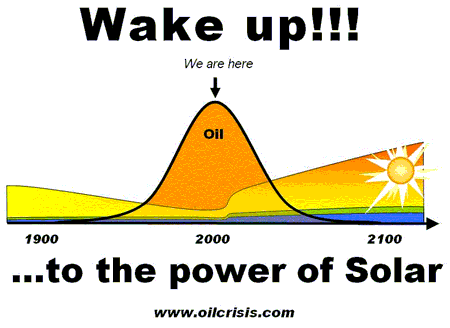
However, that darn sun is difficult to harness. For the last 150 years or so, we have found our energy source by digging. What makes stuff go? Oil, baby.

We are so addicted to oil that we can barely imagine other sources of energy. As much as I would like to hope that oil is in endless supply, it does not appear to be so.

A gentleman by the name of Dr. M. King Hubbert predicted way back in 1956 that the oil supply was limited. He predicted that U.S. oil would peak in 1970 and that our world’s oil supply would peak in 1995. He was right on in terms of U.S. oil, but missed by a few years on world oil.

But he may not have missed by much. Many really smart folks have suggested that world oil supply has already peaked or will peak soon.

The concept I learned just a few months ago is “Peak Oil”. If you search “Peak Oil” on Google this site will appear first.

One of the primary spokespersons for Peak Oil is Matthew Simmons. He is no left-wing Cassandra. He served as energy advisor to President George W. Bush.

I am not saying I agree. I am not saying I disagree. I advise you to check it out.

Wondering why gas prices are now $3.00 per gallon?

What does this mean?

It means we had better get our acts together.

The U.S. used to export oil. We had so much of the cheap stuff that we sent it away. Now, we import it. We import it from some countries that are not too friendly toward us. This site will provide much information regarding oil imports.

To get a scope on how much we import: The U.S. has four percent of the world’s population yet we use 25% of the world’s oil.

Oil is not our only source of energy. We still have a lot of coal. The Scientific American
has devoted its September 2006 issue to energy. The editor is confident that we have the energy we need. You can hear a podcast regarding this.

Yet even the editor of SA is concerned. Are we headed for a hard or soft landing? Can we make the transition?

I am no expert. Yet, I cannot imagine any of us not taking this seriously.

In Charles Dickens’ A Christmas Carol, our hero, Ebeneezer Scrooge, is confronted by the Ghost of Christmas Future. Scrooge asks him if the shadows the ghost presents are certain to happen or if they may happen. The Ghost does not answer. The answer is up to Ebeneezer.

The answer is up to us.

The first step is to get real about what is happening.

When I first learned of Peak Oil six months ago, I became really depressed. I watched the film, The End of Suburbia with several others in my congregation. It is an important film and a copy is in our church library.

It has taken me awhile to process this. I found help on a site dedicated to those who are aware and reeling. It is a place to talk about the feelings and the impact of Peak Oil.

Again, I am not saying that their conclusions are what will happen. But like Ebeneezer Scrooge after his revelation...

I am ready to get active.

We do not need to move from not being aware immediately to despair.
The middle step is action.

Conservation certainly would help. We could use less energy. However, if that is all we do, the prices would simply go down and we would use more. What if we added a dollar tax to every gallon of gasoline and then used that tax to fund R&D for alternative sources of energy?

I do not have the answers. But we do. We, together, the people, have answers. We need to put our heads together. We need to make our voices heard. And we need to demand of our elected officials (and those desiring to be elected) that they regard this issue as a top priority.

Here is an interview by Jim Puplava with Richard Heinberg entitled, “The Party’s Over.” Heinberg has the hope that “if we keep cool heads, remain optimistic and make good choices, our grandchildren could be living in a very beautiful world…”

Your thoughts?

Next time, I will talk about the major difficulty regarding change.

It is the third “E” Economy.

Blessings,
John

Sunday, August 27, 2006

The First “E”: Ecology


Hi Friends,

In my next three posts, I am going to speak about the things that most concern us as inhabitants of Earth. The three “E’s” are ecology, energy, and economy. I do not pretend to think that my way is the only way or the right way to conceive of our challenges. I really do not have a clue! But I am dumb enough or bold enough to say, "Hey! Isn't there a problem here?!?!?!" So here it is as I see it.

The first “E” is Ecology.

Before we jump right in, you need to watch and listen to the Galaxy Song by Eric Idle. It is good to have a perspective!

OK. Now, you are ready...

There are many definitions of ecology and I am not an expert. I am a simple country preacher. I gladly appreciate your responses. But I will take a stab at it. I am going to speak of ecology as an understanding of life systems. I am interested in how human beings participate in their understanding of ecology. In other words, to what extent are we self-aware of our participation in the life-systems of Earth.

“Man against nature” has been one way of understanding our relationship to Earth. Conquer, dominate. and control have been verbs used to describe our activity. However, man [sic] is Earth. We are not apart from Earth. We part of it. We are nature. We cannot disconnect except in our own fantasies that we are different from Earth and its life-systems. We are born of Earth and to Earth we return. As goes the squirrel, the worm, the elephant, and the poison ivy plant, so go we.

I am not interested (nor am I disinterested) in metaphysical theories about humanity such as an immortal soul, reincarnation, or other views. I am simply bracketing those in order to focus on the human species as a species of Earth.

Ecology has to do in part with populations and their relationship to their environment. Squirrels eat nuts. Therefore, if there are less nuts, soon there will be less squirrels. Increase the nuts, and then there are more squirrels until there are too many squirrels for the nuts, then less squirrels. And on it goes. In its most basic, simplistic form, that is how it works. Populations increase and decrease relative to the food or energy supply of their environment. Of course we need to consider predators and other environmental considerations. In the end, that is all part of the mix. A predator is another’s prey. We participate in a system.

I simply assert the obvious: populations increase and decrease in response to the energy that is available to them and to their ability to adapt to changes in energy and their environment. So what of human beings?

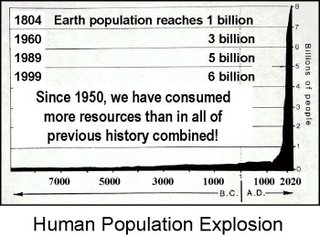
The population of human beings has increased exponentially in the 19th and 20th centuries. Check out this graph.

In 1970, when I was nine, humans numbered 3.9 billion. Today in 2006, our population is 6.6 billion. What is the reason for this increase? Let’s go back:

At the time of Jesus, the world’s population is estimated to be 170 million.

At the height of the middle ages, the world’s population was about 360 million.

When Martin Luther started the Protestant Reformation in 1500, the population was 425 million.

At the time of the French Revolution in 1800, the population was 813 million.

Just before the Civil War in 1850, we passed the one billion mark to 1.1 billion.

When my father was born around 1920, we were up to 1.86 billion.

When my brother was born in 1951, the population was 2.4 billion.

When I was born in 1961, we were at 3 billion.

When I graduated high school in 1980, 4.4 billion.

When I graduated seminary in 1992, 5.4 billion.

At the turn of the century, 6.1 billion.

Today, 6.6 billion.

Between 1992 and 2006, by the time I graduated from seminary until today, the world’s population increased by 1.4 billion people. This is a larger increase in 14 years, than the increase in population from the time of Jesus to the Civil War. For reference check here and for a cool population clock watch this.

"So what?" you ask?

My question is why? What is the cause of such a rapid increase in the population of human beings from the late 19th to the early 21st centuries?

One could say: "We increased in population 'cause we are really smart."
I think there is truth there. Because of our intelligence we learned how to manipulate fire.

One could say: "God has blessed us." I have no argument except to say, "What??"

Perhaps many factors play into this, but it seems to me that the
key reason is that we have in the last 150 years discovered a source of energy that we have been able to utilize. That source of energy is found beneath Earth. We discovered fossil fuels. Think of what we can do because of oil and other fossil fuels. This animated film from the 1950’s describes it well. Take time to watch Destination Earth. This clever cartoon produced by the petroleum industry describes the philosophy which has driven our economy. The film ends on the hopeful note that because of oil and competition our destination is now unlimited!

Yup, oil has made life grand. I can hardly imagine life without it. However, the side effects include pollution, namely carbon dioxide emissions that are creating havoc with the environment. Global Warming appears to be one of the results. Al Gore’s new film, “An Inconvenient Truth” describes what the future could hold for Earth.

And there is another problem. “Destination Unlimited” isn’t exactly accurate. Our oil reserves are not unlimited. An economic system based on unlimited growth which is based in turn on unlimited energy (oil and other fossil fuels) is a fantasy. But hey, who wants to spoil the party?

Ecology is not simply about preserving wildlife. It is about becoming aware of all of life including human life in the balance with all of Earth. As go the squirrels, so go us. Yes, it is sobering. But there are alternatives. We are not toast yet. Al Gore reminds us in his film that many people jump from unawareness to despair. There is a middle step. That is action.

I invite and encourage you to share positive ideas and steps for action! I will share what I know as well. Next time a sober look at energy.

But you should hear the Galaxy Song one more time first!

Blessings,
John
Tuesday, August 22, 2006

The Three E's: Ecology, Energy, Economy

Tennessee has on its ballot an amendment to the constitution to keep gay and lesbian couples from obtaining marriage rights. Probably 7 of 10 voters in East Tennessee support such an amendment. This is a wonderful thing for the political and religious right. We have big elections this November, including Bill Frist's Senate seat. What better way to get out the vote than to put unexamined prejudices on the ballot.

Eric Watson, a state representative from Cleveland, TN said: "It’ll be a sad day when queers and lesbians are allowed to get married ... and kiss in front of the courthouse."

There you have it.

So off we go to the polls, thinking that the most important issue facing us is gay marriage.

It will be a far sadder day when our environment becomes uninhabitable, when we are burning candles for light, and when our economy is in a shambles. The major issues facing the United States and the world are the three e's: ecology, energy, and economy. Our nation is failing at all three.

For the next three blogs, I am going to give my view of why I think that these are three most important issues and why if we fail to address them (that is elect political leaders who will seriously address them) we are in for a dark, dark age.

This is a religious issue. Sharing resources of Earth and sustaining life is about as spiritual as you can get!

Blessings,
john