Shuck and Jive


Tuesday, May 05, 2009

Hunt them down for Jesus

I am going to post a review later today on a book I read over the last couple of days, The Family: The Secret Fundamentalism at the Heart of American Power by Jeff Sharlet. Check this interview with Sharlet in the Rolling Stone and his 2003 article in Harper's.

His book may help make sense of the following video produced by a U.S. soldier and broadcast on Al Jazeera showing what some American troops are really up to in Afghanistan. Read the post in the Quaker Agitator.


"The special forces guys, they hunt men, basically. We do the same thing as Christians. We hunt people for Jesus. Hunt 'em down. Get the hound of heaven after them. So we can get them in the kingdom! Right? That's what we do! That's our business!" --Lt. Col. Gary Hensley, Army Command Chaplain
General Order Number One forbids "proselytizing of any religion, faith, or practice." Afghanistan has an overwhelmingly Muslim population.

In The Family, Jeff Sharlet reports on his visit to New Life Church (Ted Haggard's Church) in Colorado Springs, CO. On the big screens (The WorldPrayerCenter) are prayer requests. Sharlet writes:

The Iraqis come up often, particularly with regard to their conversion: Despite the efforts of the news media, believing soldiers and others testify to the effective preaching of the Gospel, and the openness of so many hear of Jesus. Pray for continued success!

Another prayer request puts numbers to that news: 900,000 Bibles in the Arabic language distributed by Christians in Iraq. And one explicitly aligns the quest for democracy in Iraq with the quest for more Christians in Iraq: May the people stand for their rights and open to the idea of making choices, such as studying the Bible. p. 303.
American evangelicals think their prime directive is to convert Muslims and others to "Jesus." They feel it is perfectly legitimate to have our soldiers and military be the vessels for this conversion whether in Iraq or Afghanistan.

On one hand we can excuse popular evangelicals. They don't know any better. They don't know or don't care that the military specifically prohibits proselytizing. The real issue is with the military personnel and chaplains as well as government officials who look the other way or even encourage this behavior.

As Sharlet uncovers in The Family it is bigger than that. He is not talking about any kind of conspiracy. He is writing about his research regarding fundamentalist elites involved behind the scenes, networking, and through these networks financing activities all over the world. To what end? The kingdom. A kingdom ruled by Jesus and those who are intimately connected with Jesus, godly men. Jesus is power. America is the city on the hill calling all soldiers of the cross to submit to his authority through his command structure.

By the way, Jesus really likes free market capitalism unhindered by the inconveniences of any government interference including democracy. It is a kingdom.


Monday, May 04, 2009

Piglet and Pooh


bad madpriest

Conversations on Pluralism

Adam Walker Cleaveland at Pomosmusings has been hosting a guest blogger series on religious pluralism. Here is a schedule and an introduction to the series. I for one am thrilled that these 20 and 30 something ministers, authors, bloggers, and thinkers are talking about this stuff.

Many of them were probably in high school, college, or seminary when the fundamentalist fury was launched against Rev. Dirk Ficca for a speech he gave a PCUSA Peacemaking conference on pluralism. It is still a darn good speech, Uncommon Ground: Living Faithfully in a Diverse World.

As I look back on that, I shake my head regarding how much the denomination allowed the busybodies to control the conversation.

Times have changed since August of 2000.

More and more thoughtful people are talking about religious diversity and the importance of inter-faith dialogue for the peace of our planet and for the enrichment of our own spiritual journeys.

Kudos to Adam for hosting this series. As I mentioned yesterday in my sermon, coming to terms with religious diversity is one of the most important tasks we face as a species.


Swine Flu in Knoxville

This from Tricities.com

The Tennessee Department of Health has announced the first confirmed case of the H1N1 flu virus in the state.

At the same time, the Knox County Health Department announced a probable case of the H1N1 flu virus in a 15-year-old middle school student, prompting school officials to close the student’s school for one week.

The state health department says the Centers for Disease Control and Prevention confirmed as positive the Williamson County case that had been sent there for testing late last week. That case was reported to involve a school-age child who was not seriously ill.

The state health department says that, including the Knox County case, there are now eight probable cases of H1N1 in Tennessee.

North Carolina reports one confirmed case of the H1N1 virus, while Virginia says they have three confirmed cases.

.

Sunday, May 03, 2009

One River, Many Wells: A Sermon

One River, Many Wells
John Shuck

First Presbyterian Church
Elizabethton, Tennessee
May 3rd, 2009
Pluralism Sunday

I am the good shepherd. I know my own and my own know me, just as the Father knows me and I know the Father. And I lay down my life for the sheep. I have other sheep that do not belong to this fold. I must bring them also, and they will listen to my voice. So there will be one flock, one shepherd.
John 10:14-16

The first Sunday in May is designated as Pluralism Sunday by The Center for Progressive Christianity. On its website is written:
Progressive Christians thank God for religious diversity! We don’t claim that our religion is superior to all others. We recognize that other religions can be as good for others as ours is for us. We can grow closer to God and deeper in compassion—and we can understand our own traditions better—through a more intimate awareness of the world’s religions.
In our own mission statement we affirm that one of our tasks as a community is to
Honor our Christian heritage while we explore the knowledge and wisdom of multiple religions, science, philosophy, humanities and psychology to deepen and enrich our spiritual journeys.
Pluralism Sunday is right up our alley.

Celebrating and honoring religious diversity is one of the most important tasks we face as a species. I am going to offer two reasons for that statement. One is a negative reason (what happens if we do not honor religious pluralism) and the other is a positive reason (what can happen when we do honor religious pluralism).

I will begin with the negative.

In 2005 Catholic Theologian Hans Kung delivered a speech at the opening of the Exhibit on the World’s Religions at Santa Clara University. He said:
"There can be no peace between the nations until there is peace between the religions. There can be no peace between the religions until there is dialogue between the religions.”
In a time in which religious convictions can lead people to do violence, and in a time in which humanity has the technology that allows violence to be catastrophic, we have an important task in front of us.

Professor of Religion at Wake Forest, Charles Kimball, wrote a book a few years ago, When Religion Becomes Evil. I recommend it. He writes:
Whatever religious people may say about their love of God or the mandates of their religion, when their behavior toward others is violent and destructive, when it causes suffering among their neighbors, you can be sure the religion has been corrupted and reform is desperately needed. When religion becomes evil, these corruptions are always present. P. 39
Kimball lists five warning signs that a religion has been corrupted. When one or more of these signs are present, religion has the potential to become evil. Here are the five warning signs:

1) Absolute Truth Claims
2) Blind Obedience
3) The Establishment of an “Ideal” Time
4) The Ends Justify Any Means
5) Declaring Holy War

The common thread of these five warning signs is paranoia. It is us against them or us against the world. “We” as opposed to “them” become the chosen vs. the unchosen or the believers vs. the unbelievers or the righteous vs. the unrighteous.

The fruit of inter-religious dialogue is the recognition that the corruptions of religion are corruptions not their essence. We recognize our common humanity. We are one human family sharing one planet. We also recognize that people are more complex and ambiguous and frankly a lot more fun and interesting than what we think are the beliefs of their respective religions. Finally we recognize that the heart of another’s religious tradition is remarkably similar to our own in its most basic ways. These corruptions are exactly that—corruptions.

For instance, all of our religions teach that

1) As opposed to absolute truth claims, we are to be humble in regards to truth rather than think we possess it.
2) As opposed to blind obedience, we are to use discernment and respect our own and others’ freedom of conscience.
3) As opposed to the establishment of an ideal time, we recognize that the times and seasons are known by G-d. If there is such a thing as a divine blueprint none of us has access to it.
4) As opposed to the ends justify any means, we recognize that the ends and the means must be congruous and reciprocal. If we want forgiveness we must forgive. If we want peace we must be peaceful.
5) As opposed to declaring holy war, we recognize that war is a failure and a tragedy, and is never holy, beautiful, or sacred.

All of our religions teach these things. Only when they are corrupted by fear, paranoia, or greed do they teach these other things. The celebration of religious diversity and the practice of inter-religious dialogue can help us disarm the violence of religious corruption in all religion.

If the first reason for religious pluralism is to disarm non-violently religious corruption, the second reason is to draw out that which is beautiful, true, and empowering from all of our various religions and create something new.

For this I turn to another book, One River, Many Wells by Matthew Fox. In this metaphor, the wells are the individual religions or wisdom traditions. The River is the Source into which the various religions dip. Different wells, same river. To quote the medieval mystic, Meister Eckhart:
God is a great underground river that no one can dam up and no one can stop.
Matthew Fox invites us to practice Deep Ecumenism. He invites us also to remythologize our species by creating new myths. His book, One River, Many Wells, draws from the mystics, prophets, sages, and poets of all of the wisdom traditions.

He discovers 18 themes of deep ecumenism and weaves them into four chapters and a conclusion.

1) Relating to Creation
2) Relating to Divinity
3) Relating to Ourselves: Paths to Encounter and Enlightenment
4) Relating to the Future: What the Divine is Asking of Us
5) Conclusion: Where Do We Go From Here? How Deep Ecumenism Explodes our Imaginations with Eighteen New Myths and Visions

Myth-making is about engaging our imagination. He writes:
Remember that myths are not stories that are not true; myths are stories that are too true and too large for facts alone, for the left hemisphere of the brain alone. A myth is not primarily about analysis but about seizing imagination. (p. 436)
For instance, take this familiar phrase that begins the Bible:

When God began creating the heavens and the earth…

That is a myth. It is True not at the factual level but at the mythical level. All wisdom traditions have creation mythologies. They tell us who we are and how we might navigate our way. Fox discovered that the 18 themes he had woven throughout his book could be expressed as modern myths. I won’t list all 18 that he mentions, but a few, such as
The myth that all our spiritual traditions can learn from each other and offer something fresh from their experiences and teachings. That is, the myth of Deep Ecumenism. (All are enumerated pp. 436-438)
That is a myth that is true and it wants expression. It is as true as ‘God created the heavens and the earth.’ Here is another:
The myth that all Creation is sacred and we humans are part of it, integral to it, though late on the scene. Ecological care and concern is part of being here.
What might it mean for us to live that true myth? Here is another:
The myth that whatever name we give the Source of sources, the Artist of artists, the Creator of Creation, all are accurate and none are sufficient.
Let us write stories and paint pictures and sing songs of that myth as we engage with all of our sisters and brothers in their name naming.

As we have inherited a religion in which G-d has been spoken of mostly in male language, here is a myth for our time:
The myth that the Divine has a feminine as well as a masculine side. And so do we, made in her image.
There we have a few of modern myths for Creation and for Divinity. How about myths regarding personal transformation? Here is my favorite:
The myth that joy is possible even daily—and that we have a right to it as well as a responsibility to search it out, prepare for it, and pass it on.
On the flip side…
The myth that suffering, while it is everywhere, is real yet endurable. That suffering comes as a teacher of wisdom and compassion and rather than fleeing it, we ought to sit at is feet and learn what it wants to teach us.
How do we do that? Here is another myth:
The myth that we experience mindfulness, a state of being more and more fully present to the “I Am” and to our deepest self through meditations of various kinds.
How about myths for relating to each other?
The myth that compassion is the imitation of the Divine and compassion includes celebration and relief of pain and suffering and the active struggle against injustice. That service is something we can commit ourselves to that is worthy of full commitment.
What of our future? What myth do we need to face the tasks ahead of us?
The myth that we are all spiritual warriors (prophets) as well as lovers (mystics). And this means that we struggle with self and not just with outside enemies when we struggle for social transformation; it also means that we work from the heart not just from reaction.
Pluralism Sunday is remythologizing Sunday. It is myth-making Sunday. It is the invitation to creatively engage our wisdom traditions and all that is available to us. I really cannot say it better than how it has been put in the mission statement of our community:
Honor our Christian heritage while we explore the knowledge and wisdom of multiple religions, science, philosophy, humanities and psychology to deepen and enrich our spiritual journeys.
My sermon had two points:
1) We need inter-religious dialogue so we don’t kill each other, literally.
2) We need inter-religious dialogue so we can gather what wisdom we can to create mythologies that the 21st century demands of us.

And now a final point:

Our traditional religions have carried us like ships on the sea for millennia. But they can’t get us to where we need to go as a species. These ships when they are not crashing into each other are sinking under their own weight. Yet, we aren’t sure how to get where we are going without them. We need to take what is valuable from all of them. We also need to discover the poet within each of us and among all of us and create some new verses.

I’ll leave you with this bit of provocation from the great poet and Sufi Mystic, Hafiz. Those who have ears, let them hear:

The great religions are ships,
Poets the life boats.
Every sane person I know
Has jumped overboard!
That is good for business,
Isn’t it,
Hafiz?


Minnesota Valleys Flips!

This just in from Covenant Network:
The Presbytery of Minnesota Valleys (Southwestern Minnesota) became the 31st to switch from opposition in 2001-2 to support this year, 44-37-1!

And the Presbytery of Southern New England (Connecticut, Rhode Island, and parts of Massachusetts) maintained and strengthened its commitment to ordination equality, as reported by Ralph Jones from Presbyterian Promise:

"I'm writing to report that today the Presbytery of Southern New England voted in favor of Proposed Amendment 08-B. The announced vote was 97 yes, 50 no, with no abstentions. This was our largest percentage vote against G-6.0106b or for change since we've been debating this, although 34 more people voted back in 2001."
The score is 73-89.

It is good to see these positive votes coming in demonstrating that while not this year the PCUSA is ready for change.

How long?
Not long.

Here are the presbyteries yet to vote:

  • May 7 - Middle Tennessee, Northern Waters
  • May 9 - Utah
  • May 12 - East Iowa, Kiskiminetas, Pacific, Savannah
  • May 19 - Missouri River Valley
  • ?? - Noroeste, Suroeste, Dakota

Saturday, May 02, 2009

The Meaning of Life, Part 24


The great religions are ships,
Poets the life boats.
Every sane person I know
Has jumped overboard!
That is good for business,
Isn’t it,
Hafiz?


The Gift: Poems by Hafiz the Great Sufi Master, trans. Daniel Ladinsky

Friday, May 01, 2009

Christians: Thumbs Up on Torture


A poll by religion and public life reports that Christians are more likely to support torture than other people.

WASHINGTON (CNN) -- The more often Americans go to church, the more likely they are to support the torture of suspected terrorists, according to a new survey.

More than half of people who attend services at least once a week -- 54 percent -- said the use of torture against suspected terrorists is "often" or "sometimes" justified. Only 42 percent of people who "seldom or never" go to services agreed, according to the analysis released Wednesday by the Pew Forum on Religion & Public Life.

White evangelical Protestants were the religious group most likely to say torture is often or sometimes justified -- more than six in 10 supported it. People unaffiliated with any religious organization were least likely to back it. Only four in 10 of them did.

At least the stated clerk of the PCUSA is against torture.

As one increasingly-embarrassed-to-call-myself-Christian church goer, I am against torture as well. If you are an embarrassed Christian or even a proud one, you still might want to sign the statement of conscience from the National Religious Campaign Against Torture.

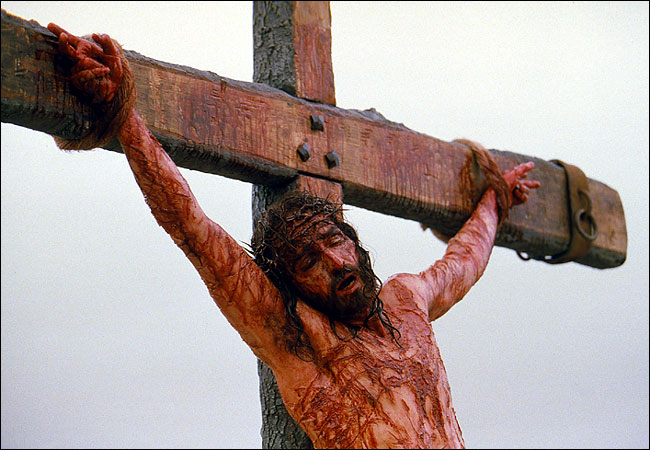
Here is a wild thought. Do you think the sacralizing, worshiping, and relishing in the gory bloodbath of abominable atonement theories surrounding the torture of Jesus might have something to do with Christians cheering torture in our time?


Photo from Mel Gibson's Passion gorefest.


Jesus and Buddha are Friends

Here is our theme song for Pluralism Sunday. Sing along, it's catchy!


Here are the lyrics.


You might also enjoy Marcus Borg's book, Jesus and Buddha: The Parallel Sayings.


See? They're friends!

A good thing, right?


Oh Jesus, I love You
And I love Buddha too
Ramakrishna, Guru Dev
Tao Te Ching and Mohammed

Why do some people say
That there is just one way
To love You, God, and come to You?
We are all a part of You

You are un-nameable
You are unknowable
All we have is metaphor
that´s what time and space are for

Is the universe Your thought?
You are and You are not
You are many, You are one
Ever ending, just begun

Alright, alright, alright
I love You and Buddha too

Poverty in Appalachia


Presbyterian Bloggers Unite is a new forum created by PCUSA Moderator Bruce Reyes-Chow for bloggers to address particular issues. In May it is poverty.


On the first day of each month, in order to build awareness, strengthen community and spark action Presbyterian Church (USA) bloggers will post their thoughts and musings addressing the following questions:
- how would you define describe POVERTY and its impact in your community?
- how has or has not your community of faith addressed issues of POVERTY?
- what are the greatest hopes and challenges that you think face your community, larger church and the greater society in dealing with issues of POVERTY?
This is an opportunity to highlight the Appalachia Service Project.

This year marks the 40th anniversary of Appalachia Service Project (ASP)!

It all began with one man's simple vision: to match high school youth groups with families in need so their homes could be made warmer, safer and drier. In this first issue of The Front Porch for 2009, you'll read how that man -- Rev. Glenn "Tex" Evans -- founded ASP and helped its roots grow deep during the first decade from 1969 to 1979.

Our theme for this momentous anniversary year is Putting Faith Forward -- because even now, as we look back and rejoice at the amazing work accomplished by Tex and ASP over four decades of sweat and toil -- and love and compassion, we realize there is still much to do!

The communities we serve here in Central Appalachia have poverty rates that are three times the national average ... and today we can only afford to help ONE out of every 10 families that apply to us for home repair assistance.

This program enables youth groups and other volunteers to learn about poverty in Appalachia, to connect with people who experience it, and to make the connections between faith and poverty.
Fundamentally, Central Appalachia's problems stem from the fact that in an eighty-county area, 72% of the surface acreage and 89% of the mineral rights are absentee-owned. Historically much of this land has been greatly underassessed and undertaxed. As a result of this undertaxation, local municipalities have had very little revenue to finance adequate educational systems, construct and maintain water and sewage treatment facilities, provide for county landfills, roads, and basic health care....

....Hunger and malnutrition are a hidden disaster for many of the region's poor. Rural residents pay up to 30% more for their food from local merchants who cannot offer the prices found in most major supermarkets. Pride and physical isolation coupled with lack of public transportation keep many people from applying for food stamps. In a ten-county area in southwestern Virginia, 90,197 families qualified for food stamps in February 1992; however only 51,649 received food stamp assistance.

The people of Appalachia are rallying to preserve the beauty of their land and to provide future generations with stable employment, public utilities, strong educational systems, safe housing, and affordable medical care. Mountain pride runs deep. Love of the land is what brought people here and love of the land is what brings those who have left back. We encourage you to come to Appalachia to enjoy the grandeur of the majestic mountains, to listen to the people who live here, to share their joys and struggles, and to experience first-hand the work of the Appalachia Service Project.

This year ten of our youth and four adults will be going to Mingo County, West Virginia, to participate in a week-long workcamp. This is the first time our congregation has been involved and I hope it will be a yearly event.

ASP is headquartered in Johnson City, TN and we are incredibly fortunate in that the director of ASP, Rev. Susan Crow, and her family attend our church. Two ASP staff members, Michael Clark and Becca Knight will join our congregation this Sunday. The pressure is on for us to do a good job!

Check our photos of the auction for which our congregation raised $4000 to send our work team! Scroll down to ASP Auction.

My hope is that this experience will make an impact on our youth (and through them our congregation) regarding poverty in our own backyard.