Shuck and Jive


Friday, February 17, 2012

Jane Spahr's Day in Court is Today

A person for whom I have great respect has her trial before the highest court in Presbyland today.  Rev. Jane Spahr, who happens to be lesbian, uses her calling as a PC(USA) minister to celebrate at weddings including the weddings of same-sex couples.   


It is all part of the "homosexual agenda", of course.

By the way, here is the GAY AGENDA in two points:

1)  Equality.
2)  See point 1.

On Friday, February 17, the Rev. Dr. Jane Adams Spahr goes before the highest court of the Presbyterian Church (U.S.A) for a final appeal of her conviction for marrying 16 same-gender couples during the time it was legal in California. The General Assembly Permanent Judicial Commission (GAPJC) appeal hearing will be held at the Drury Plaza Hotel (Riverwalk, 105 S. St Mary’s Street) in San Antonio, Texas (Presbyterian Church (U.S.A.) through the Presbytery of the Redwoods v. Rev. Spahr). The commission’s decision is expected on Tuesday, February 21, 2012.

As increasing numbers of states permit same-gender weddings and civil unions, Rev. Spahr hopes her appeal hearing will clarify how the denomination’s ministers can pastorally participate in such celebrations. “To send these couples away from the church would be going against what I believe about God and God’s welcome. It would go against my faith and my call,” she says. “I believe we are given a sacred responsibility to help be a part of a couple’s journey toward a life of deep loving and commitment.”

Rev. Janie rocks.

I am grateful for her courage and commitment to what is right and what is joyful.   It is because of people like her that the rest of us can drum up the courage to do what is right and joyful in our own settings.  As she said:
“I believe the church should be the best place to help and support couples to have a healthy, mutual and life-giving relationship. But for many LGBT people because of the myths, prejudice and judgment, it is the last place they think of to celebrate their marriages.”
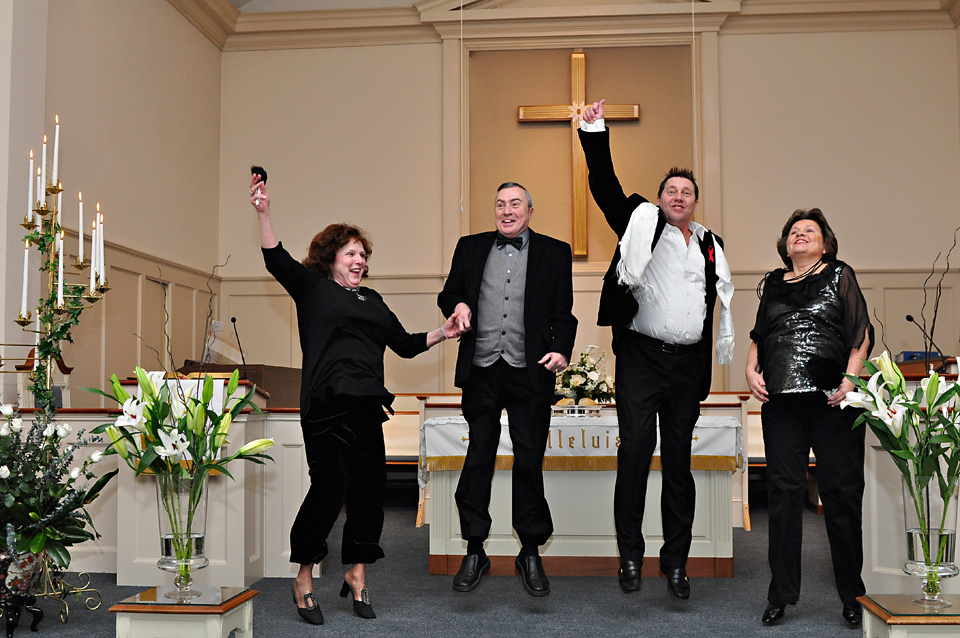
It will be a while yet before we have marriage equality in Tennessee.  Though we aren't there yet, legally, we do know how to celebrate the spirit and love that is already present.   Last week, Glenn and Tony celebrated 25 years together.   Thanks to Becca Davis Photography for capturing the event! 


We did it up right with a renewal of vows, communion, and a party.  


Because that is what love deserves.  In thanking Glenn and Tony, I said at their service:
For 25 years, Tony and Glenn, you have given yourselves to each other and stood by each other, laughed with and cried with each other, in plenty and in want, in joy and in sorrow, in sickness and in health.      

That is what the Gospel is about.

There is a subtext that I am going to make very clear.
Every time we have a big gay wedding in church, or in this case a renewal of 25 years of vows, with all the music, communion, flowers, vows, and rings, we are making the path easier for those who follow.   The world can be mean because it is fearful.  But you have shown that perfect love casts out fear.

Justice and joy is a good combination.  


Rev. Jane Spahr, thanks to you for showing the rest of the church what it means to be a Minister of Word and Sacrament.  She gets the last word:
 “To turn my back on the love and lifelong commitments of these wonderful couples would have gone against the lifetime of dedication I’ve shown to my faith, the guiding principles of my church, and especially those I have served in my ministry.”

Thursday, February 16, 2012

Keith Frederick is the president of PFLAG Tri-Cities (Parents, Families, and Friends of Lesbians and Gays). Joseph Rhymer is the chair of the Tennessee Equality Project Tri-Cities. Both gentlemen are my guests on Religion For Life

They will speak about the work of these two organizations in the Tri-Cities on behalf of Lesbian, Gay, Bisexual, and Transgender persons and their families. Be assured that religion has a role in all of this as well!


Listen via livestream...

Monday, February 20th at 1 pm on WEHC, 90.7.
Thursday, February 23rd at 8 pm on WETS, 89.5.
Sunday, February 26th, at noon on WEHC, 90.7.
Sunday, February 26th, at 2 pm on WETS, 89.5.
Via podcast beginning February 28th.

Tuesday, February 14, 2012

Time For A Rebellion

On Sunday I preached what I think was my most important sermon.   At least I think I said what was most heartfelt.   The future (at least in the coming decades and perhaps the next couple of centuries) looks to be very rough for humanity.   If you wonder why I say that, I refer you to a common theme on this blog, the problem with "growth".   

Here is a film that captures in 34 minutes the basics of the problem.  It is produced by Incubate Pictures in cooperation with The Post-Carbon Institute.  It is your midnight movie.


The next couple of centuries will be rough. We are currently at the beginning but in the zone of this major change, which is overshoot due to exponential growth. Whatever happens to me is no big deal. I plan on dying. That is a darn good plan since I will die at some point regardless of my plans.

Given death, or to put a positive spin on it, given that one day I will enter The Great Peace, I would like to live this life in a way that matters. I would like to be, in the words of Nancy Abrams, an "honorable" ancestor.

I am not completely sure what "honorable" might mean. I have no idea what I should do or what I should say. I think at least I should care. The best epitaph I can think of for my tombstone is:
Well, at least he gave a shit.
I do care. I care about the twenty-somethings and younger who will inherit this mess in the immediate future and will have to roll with the crumbling of industrial civilization however that cookie happens to crumble. Their offspring will be born into a very different world than the one most of us know today.

I care that human beings will somehow manage to survive all the catastrophes ahead and preserve enough knowledge and hope to keep eating, breeding, and surviving, so that a remnant may start again in a few centuries and be the green shoot that will flourish for millions of years.

Joel Primack and Nancy Ellen Abrams who will be my guests on an upcoming radio program compare this burst of human growth in the last two centuries with cosmic inflation in the first second of the universe. It is an analogy of course. But the idea is that after the cosmic inflation, the universe grew steadily and slowly. In alike manner, after this industrial inflation in which the human population shot up from a billion to seven billion (and growing), it too, will settle into a long, slow period of growth.

I don't know. I find that interesting and hopeful.

What I think is my task, and perhaps you have thought along similar lines, is to encourage each other to talk about that which we don't talk about much, our future, our long-term future, our thousands of generations in the future future. Not only talk about it, but imagine it. And then, maybe get our politicians to imagine it. 

Fossil-fuel powered growth is a dead end.  A. literal. dead. literal. end.   They talk incessantly about continuing it.   Not one tells us the truth.   Let us tell the truth they cannot yet tell.

It is time for everyone, the whole world, to care about our long-term future and to plan together for it. This past Sunday I used this passage from the book written by Nancy Ellen Abrams and Joel Primack, The New Universe and the Human Future. I found it inspiring. Maybe you will as well.
Here is a hypothetical fragment of an origin story from the distant future.
“Everyone in the Galaxy came from one little planet called Earth. The cooperative genius of a small group of ancient earthlings made them rebel against the robotic march to death that the majority was on—to use up the planet with no plan for the future. It was the acquisition in the early twenty-first century of the ability to see into the cosmically distant past and thus project far into the future that allowed the rebels to grasp the meaning of their own evolution from the first available scientifically cosmic perspective. The rebels saw the implications of what a few scientists were already suggesting but had not yet fully appreciated: that intelligent beings on Planet Earth were cosmically central, living at a pivotal moment in time, and had a potential destiny as vast as the cosmic past if they would only protect it. This awakening led to the great conversion from short-term fragmented identities to the first serious long-term species identity. Those early rebels changed the course of history and led to the Galactic community of our time.”

Let’s keep that story possible.
Be a rebel.


Sunday, February 12, 2012

Laura Hartman, author of The Christian Consumer, on the next Religion For Life

My guest on the next Religion For Life is Dr. Laura Hartman, author of The Christian Consumer: Living Faithfully in a Fragile World. Dr. Hartman is a professor of religion at Augustana College and she draws from the Christian tradition in order to provide guidelines for making ethical choices regarding consumption. She will be speaking at the Green Interfaith Network, February 19th. Don't miss this thought-provoking and life-changing interview!


Listen via livestream...

Monday, February 13th at 1 pm on WEHC, 90.7.
Thursday, February 16th at 8 pm on WETS, 89.5.
Sunday, February 19th, at noon on WEHC, 90.7.
Sunday, February 19th, at 2 pm on WETS, 89.5.
Via podcast beginning February 20th.

Kernels to Cosmos--A Sermon

Kernels to Cosmos
John Shuck

First Presbyterian Church
Elizabethton, Tennessee

February 12, 2012
Evolution Sunday

John 12:20-50

Happy Evolution Sunday.

Evolution Sunday, now Evolution Weekend began seven years ago as a project by biologist, Michael Zimmerman. His goal was and is to ensure that public schools don’t get snookered by those who want to pass off Creationism or Intelligent Design as science. He takes on the Creationists regularly at the Huffington Post. He is my guest this week on my radio program.

He managed to find over 12,000 Christian clergy to sign a letter supporting Evolution and stating that Evolution is not in conflict with faith. The reason Professor Zimmerman asked clergy to sign this letter is that he realized that most people if forced to choose between religion and science will choose religion. If religion is pitted against science they will choose to believe their preacher rather than their science teacher.

The comforting truths of faith are preferred to the skepticism of science.

This is not surprising when you think about it. Human beings long to be loved and long to belong. We enjoy being flattered. So we believe it when we are told that we have immortal souls that will live forever and that we are embraced by divine beings. We enjoy the comfort of knowing that everything that happens to us is part of a divine plan as opposed to random occurrence. We like to affirm that we have a book like the Bible that is authoritative and truthful and that we have a figure like Jesus who saves us from all our troubles.

Science offers...
instead of a divine being, impersonal laws,
instead of absolute truth, a method of doubt,
instead of mind over matter, mind as (probably) a product of matter.

Today we celebrate the birth and the accomplishments of Charles Darwin, who showed us that human beings have much more in common with apes than with angels. Everyday the evidence that we gather publicly from using the scientific method affirms that human beings owe more to biology than theology for our existence.

Normally, this kind of talk gets ministers in trouble. Thankfully, I preach in a church that allows for great diversity of belief. Bring your own god or none. I affirm the right of anyone to believe whatever they wish to believe. You have the freedom and are encouraged to take your own journey. You have the freedom to reject part or all of anything I say.

That said, my experience also tells me that given the chance and the permission to question the truths of their inherited religion, people will grow to appreciate the world that the scientific method shows us and they will find a way to integrate this exciting new world with their faith.

I personally think that is an important task.

This is true not only for biology or cosmology but also with biblical or theological studies. While the churches as a whole cannot seem (as of yet) to get beyond the Christ of creed, biblical scholars show us the historical person of Jesus. They also show us that the authors of biblical texts were human beings in specific historical contexts. These studies show us the origin of the creeds, and that those origins are far more natural than supernatural.

This is the seventh Evolution Sunday at First Presbyterian Church of Elizabethton. I am in the midst of my seventh year as minister at this church. What I have been doing for these past nearly seven years through liturgy, sermon, poetry, and so forth, is to give expression to the sacred quality of life. 

That is a religion. 
That is faith.

I believe our sacred story, that is our 13.7 billion year cosmic story, is holy and beautiful. It is the one creation myth (and I say myth in the best sense of that word) that is universal. It is far more interesting than Genesis 1. It isn’t that Genesis 1 is wrong, it is that it was a product of its time and times have changed.

I believe that our sacred story of the evolution of life on Earth through natural selection is to use a phrase by biologist Richard Dawkins, “The Greatest Show on Earth.” Tracing back our ancestors to the very beginning of life is a Divine work.

This is not just dry science. This is not materialism. This does not lack spiritual depth. This, I argue, is the very depth of the spiritual.

I also believe that it is sacred work to understand the cultural accomplishments of human beings, which include of course, religion. Human beings created the Bhagavad Gita, the Bible, the Qur’an, and every piece of literature, artwork, sacred story, and song. Human beings invented meditation and prayer. The angels and the gods are the products of human creativity.  

To say that is in my view an elevation of the human, not a demotion.

What I am talking about today is religion not science. I am talking about faith.  I think we have reached a point in which the sources of religion and faith are no longer those artifacts of human culture such as the Bible or the Qur’an. The sources of faith and meaning are now our common origin stories that we are learning through public knowledge. The source of faith is the universe as we are observing it. Included in that is the broad spectrum of human culture that includes the Bible, the Qur'an and every sacred text from every religion..

In our text from John’s gospel, Jesus is reported to have said, 
“Unless a kernel falls to the earth and dies, it remains just a single grain; but if it dies, it bears much fruit.”
By including this I think the author of John’s gospel was suggesting that creativity cannot happen if we don’t allow the old way to die. This is true for everything from kernels of grain to the cosmos. Unless a star dies, new planets cannot form. Unless human beings die, new human beings cannot live. Unless there is death, there cannot be life. This is true for biological life as well as cultural life.

Old ideas need to die so new ones can be born.

An old idea that is dying is religion based on cultural artifacts as if those artifacts are absolute truth. 

I realize that saying this will sound controversial, but I invite you think about it before you dismiss it. Unless Christianity, based on Bible and creed dies, a new faith based on what we know of the universe cannot be born. This is true for Islam as well and for all the major religions.

Thanks to science we now have a common cosmic story and a story of life on Earth. What we don’t have yet is a way to celebrate that story religiously. We have not yet found the myths, rituals, and symbols to make that story sing. I think that Evolution Sunday is a start in that direction.

There is another part to this.

One of the tasks to a life that matters is to develop a sense of personal meaning. It is to address the question, “Why am I here?” with some answer, however provisional.  
“What is my purpose? Why am I here? What gives me meaning?”
Earlier I said that I affirm the right of anyone to believe whatever they wish to believe. I do. I also think there may be a better answer. While it is good to be free to develop our own sense of meaning it it is also good to work toward a shared meaning. We can believe whatever we want on our own, but what if we at least could find some things in common in which to believe?

I want to offer a couple of commitments that we might share regarding this new religion, this religion of this life, this religion whose source is the unfolding universe as we discover it.

We are at a very interesting point in history. Within the last couple of decades we have been able to see through telescopes to the earliest galaxies of the universe as they were forming. That should blow us out of our pews. Within the last several decades we have been able to trace the biological evolution of species including the human species. We can look back at our earliest ancestors.

We are learning more and more faster and faster.

But, we have also reached a point of limits regarding the Earth’s capacity to sustain human life. We are there on the edge, seven billion people and growing. Earth will spin for hundreds of millions of years. Humans may not make it through the next century.

I suggest we might share the following beliefs:

First, that human beings are important and valuable and worth keeping. We are as far as we know the only living things that can contemplate the universe. We are the universe conscious of itself. It took 13.7 billion years for the universe to "create" us. We ought to be thinking that we can flourish for millions of years into the future.

Second, the choices we make today will influence whether or not human beings will live through the challenges of the next century. We have already made a number of choices that have affected our planet that are already irreversible.

The invitation is to think about the choices we make not just for next few months or years or decades or even the next seven generations but the next 1,000 generations.

This is faith. This is religion.

It is a religion that is based on a belief that human beings matter and that Earth is home and life’s meaning and sacred worth is to be found here. 

The greatest act of faith is 
to act on behalf of and 
to trust in 
an existence that none of us will ever see.

Twentieth century theologian Reinhold Niebuhr said:
Nothing that is worth doing can be achieved in a lifetime; therefore we must be saved by hope.


Nothing we do, however virtuous, can be accomplished alone; therefore we are saved by love.


Nothing which is true or beautiful or good makes complete sense in any immediate context of history; therefore we must be saved by faith.
On this Evolution Sunday, I put myself out there for you. Here are my beliefs:

I believe in this beautiful ball of water, this gorgeous Earth.
I believe in human beings and that we have sacred worth.
I believe that we will find a way to live sustainably with Earth for a long, long time.
I believe that courageous people sharing this faith today can make it happen.

Amen.

Thursday, February 09, 2012

Evolution Weekend!

My favorite day of the year is approaching.  It is Evolution Sunday.  On the Sunday closest to Charles Darwin's birthday, February 12th, we honor the contributions of Charles Darwin and of science.     Dr. Julie Wade, retired professor of Biology at Milligan College will lead the Adult Forum.   Here is the scoop:
Evolution via natural selection was first introduced by Charles Darwin in 1859 with the publication of his book “The Origin of Species.” His research became the foundation on which generations of biologists have continued to build. In this talk we shall examine four major areas of research in the last 150 years that have strengthened his theory in ways he never dreamed possible. These areas include:
  1. Darwin’s original theory of natural selection
  2. The Modern Synthesis of the 1930’s and 1940’s that combined genetics with evolution
  3. The discovery of DNA structure and the sequencing of several genomes, including our own
  4. The role of evolutionary embryology and development which is referred to as Evo-Devo
Evo-Devo has revolutionized our understanding of the origin of species because it has explained how animals have evolved from the Cambrian Period (over 500 million years ago) to the present using many of the same basic “tool kit” genes!! Such an understanding of life on earth is critical if we are to be intelligent stewards of our planet.
The Adult Forum is at 9:45.

At eleven a.m., worship will celebrate our unique place in the cosmos and our unique responsibility to future generations.

After worship, the congregation will take a field trip to the Gray Fossil Site at 1 p.m.   This is for all ages.  There will be activities for children and a lecture by paleontologist, Dr. Blaine Schubert, about Darwin.

To get you in the mood, check my radio interview with Michael Zimmerman, founder of Evolution Weekend and the Clergy Letter Project.    You can listen via livestream Thursday at 8 p.m. and Sunday at 2 p.m. on WETS, and via livestream Sunday at noon on WEHC.


May the spirit of Darwinmas provide clear thinking the year 'round!


Monday, February 06, 2012

Religion For {this} Life

I like to switch religions every now and then just to keep things fresh.  Here is my latest.  I call it a Religion For {this} Life.   The astute observer will notice that the title of my new religion echoes the title of my new radio program.   Here are a few of its non-doctrines.

It comes from Christianity.  I call it Christian Naturalism.  It is a religion.  It is not science.  It is not atheism or agnosticism.   It has beliefs.  The basic belief of my version of Christian Naturalism is that this universe is cool enough for me.   I have no care to speculate about what is outside the universe.   My belief is that there is probably nothing outside of it at least that can affect me (or the universe for that matter).   I am sure that thinkers who speculate on these things will keep me informed.

I cannot prove this belief is true.  My religion operates by trust.  I trust that this universe is fine for me.  My religion believes that the scientific method is pretty good and that public knowledge is more trustworthy than private revelation. 

I think human beings are special and unique.  We are the only beings we know of so far that exhibit a level of consciousness that can comprehend the universe.   I think it is good for humans to stay around and it would be wise if we learned to live compatibly with our environment so that we can do so for millions of years into the future.

God and the gods function in my religion as human creations.  They are products of the human imagination which is a product of the universe as is consciousness, love, art, and everything else.   Of course, I like to read and reflect on the Bible as a human creation and to reflect on other human works as well.  

Jesus is there.  He plays a large role in my religion.  He is an historical person that I have reconstructed with the help of others.  He is also a fictional character.  When I see him as a fictional character, I am mostly interested in the authors who created him.   I love Jesus.  I love Buddha, too, and Krishna, even Gilgamesh.   But at the end of the day, Jesus is my man.   That is probably because I feel at home with him. 

I love church.   My religion is happy with church, even with Presbyterians.  I like Presbyterians as on the whole they are pretty tolerant and they do have that freedom of conscience thing going for them.   Presbyterians have changed for the better.  They used to be pretty intolerant.   Now, rather than burn heretics and witches they prefer to form committees to study the issue.

I believe in goodness.  I believe in justice.  I like the concept of what Joanna Macy calls The Great Ball of Merit.  That gives me hope. 

I think religion has important tasks.  One of which is to help people cope with the contingencies of life.  Another task is to provide permission and resources so people can create their own religion.  Yet another task is to help people develop an internal moral compass in order to live well and to engage the powers.   And potlucks.  Always potlucks.

My religion also affirms the Great Peace.  I trust that after my brain ceases to function I will drop into unconsciousness like I experienced before birth (which was no experience at all).  There is nothing I need to do to earn the Great Peace or anything I can do to miss out on the Great Peace.   I don't have to worry about being good enough.  I do not need to fear hell.    I learned this oddly enough from Presbyterians.  It is my understanding of justification by grace.   Knowing that one day I will experience the Great Peace whenever that time comes gives me the freedom to live and love today. 

My religion even has a hymn.  There are other hymns in my loose-leaf hymnbook.  This one is delightful and sung beautifully by Iris Dement.


I could change my religion again next week.

So...stay tuned.

Michael Zimmerman and Evolution Weekend on Religion For Life

Dr. Michael Zimmerman, a biologist, is the founder of the Clergy Letter Project and Evolution Weekend. Over 13 thousand Christian, Jewish, and Unitarian Universalist clergy have signed a letter in support of teaching evolution in public schools. On the Sunday closest to Darwin's Birthday (February 12th) faith communities all over the United States celebrate Evolution Weekend by honoring science and religion.


On the next Religion For Life, Dr. Zimmerman speaks candidly about the state of science education and the need for scientific literacy. He writes on the topic of science and religion at the Huffington Post.

Listen via livestream...

Monday, February 6th at 1 pm on WEHC, 90.7.
Thursday, February 9th at 8 pm on WETS, 89.5.
Sunday, February 12th, at noon on WEHC, 90.7.
Sunday, February 12th, at 2 pm on WETS, 89.5.
Via podcast beginning February 13th.

Sunday, February 05, 2012

Bread of Life--A Sermon

Bread of Life
John Shuck

First Presbyterian Church
Elizabethton, Tennessee

February 5, 2012
John 6:1-71

The Gospel of John is a weird book.
“If you don’t eat the Human One’s flesh and drink his blood, you won’t have life in you. Everyone who feeds on my flesh and drinks my blood has unending life, and I will raise them on the last day. For my flesh is real food and my blood real drink.”
It is no wonder that
“When the disciples heard this, many responded, “This sort of talk is hard to take. Who can take it seriously?”
That is the challenge of the Gospel of John. How do you take it seriously?

One way is to make a ritual out of it. Call it Holy Communion and once a week have people eat a piece of bread and drink some wine, tell them they are eating Christ’s body, the bread from heaven, and you got yourself a religion.

That is not so bad, if we know what we are doing.

How do you take this seriously?

The only way I can imagine that we might take it seriously is to treat it like a Zen koan. Such as,
“If you meet the Buddha on the road, kill him.”
What does that mean? The Zen teacher would say, go wrestle with it and figure it out yourself. Koans are striking, puzzling statements. They are not riddles. The teacher who offers a koan is not looking for a right answer, but the state of mind of the student. A koan is a device used to help students become aware of who they are and what is real.

The Zen tradition didn’t begin until about six centuries after Jesus. I am not making an historical correspondence. I am not saying Jesus or the author of John was a secret Zen teacher. I am simply suggesting that the way to take Jesus seriously may be not to take him seriously. Maybe the author of John’s gospel is playing with our heads.

In the story, Jesus recognizes that the disciples are puzzled and so he offers a clue:
“So, does this shock you? What if you were to see the Human One going back to where he was to begin with?”
In other words what if you were to see reality? What if you were to see my true nature? He goes on:
“The spirit is life-giving; flesh is good for nothing. The words I have used are spirit and life.”
It could be something like this this: Jesus is saying,
“Since the flesh is nothing, telling you to eat my flesh is like saying, if you see the Buddha on the road, kill him. Because the Buddha you see is not really the Buddha. Buddha is in you. Similarly, the flesh you eat is not really me. Those who 'eat my flesh' get that.”
In this reading, eating Jesus’s flesh and drinking his blood is a way of shattering an illusion and discovering one’s true self.

The question that I have when I read John’s gospel is how to understand the figure of Jesus. Is John portraying him as a supernatural being who became a human being, did stuff, and then scooted back up to heaven? If that is the case, I am not so interested. Those myths are a dime a dozen. If that is the case, I am like the followers who say,
“Who can take this seriously?”
But, if Jesus is John’s way of saying this is what it means to be a human being, then maybe I will hang around for a little bit.

One clue that Jesus represents the myth of the authentic human is that throughout John, Jesus is certainly sure of himself. He has no doubt about who is, where he comes from, and where he is going.

Because this story is written in the first century, there is heaven up above where the gods live just above the fixed stars. Earth is the center of the universe. Above us is the moon, the sun, the planets all orbiting around Earth. Way out there are the fixed stars also traveling around Earth. Above all of that is heaven, the abode of the gods where Jesus is from and where he is going.

All of those images such as “from above” have to be reimagined in our time. So what might this look like in our universe with a naturalistic world-view? I think those images such as “from above”, “eternal life”, “bread from heaven”, all refer to that center of identity. 
  • Who am I? 
  • What is my value? 
  • What am I doing here? 
  • What is my purpose? 
  • What do I want to make of my life?
Those are the kinds of questions we aren’t sure if we want to ask all of the time, because it is sometimes a bit easier allowing others to define our lives for us. It is easier not to pay attention to this amazing life that we share, that is existence. It might be easier to let others tell us who we are. And others will. We are a market share or a voting block or taxable commodity or potential cannon fodder. We are what the powers that be want us to be to the extent that we have value to them.

So Jesus comes along. It is the same world. There are different symbols and a different guy is in power, but it is the same dehumanizing world. Jesus says to that, 
“Eat me.
“Eat my flesh, drink my blood.
That is what I think of that.
I am not the flesh of this world.
I am the spirit of life.
I will not be defined by your categories.”
A couple of weeks ago, a new member of our community, Presbyterian minister, Rev. Don Steele, talked to the youth group. At our Wednesday night program, we were learning about Martin Luther King. I asked Don to come and speak because Don was in Memphis going to college in 1968. That was during the sanitation workers’ strike. Martin Luther King went there as you recall. Don marched with King on behalf of the sanitation workers. King was assassinated there in Memphis.

The sanitation workers were striking in part of because of wages, but also because of the way they were treated. They were not treated with dignity. There was not a place to even clean up before they went home. They had to ride on the bus smelling like garbage. One event in particular triggered the strike. Two men were accidentally crushed by a garbage truck and the city provided no compensation to the family members.

These sanitation workers marched in the streets of Memphis. It wasn’t just about money. It was about human dignity. They marched with signs that read, “I am a man.”
I am a man.”
That is for what they were marching. Their humanity. They weren’t asking permission for it. They were declaring it. 
"I am a man."
It is as though they were declaring that they were from above. They were not identified with the worldly categories of garbage worker. They were human beings who happened to do this service for the community and they expected to be treated with respect.

That is what it takes sometimes.

When the powers that be do not serve the people but serve instead their own profits, they need to be shaken down. They need to be called out and called down. It is not wrong for a business to make a profit. A profit allows the business to survive in order that it can continue to serve. But when the profit becomes not the means but the end then it becomes, to use an ancient spiritual word, demonic.

That is what we have in our world today. We have demonic corporations masquerading as human beings and not serving the people, but serving their own profits. I am not saying that every business is that way, of course, but many are. We have politicians, not all by any means, but many, who instead of serving the people have sold out to the money these corporations foist upon them in order to stay in office and get elected.

We need people to stand up and say, 
“I am a man. I am a woman. I am a human being.”
When our mountains are destroyed, our water polluted for the sake of corporate profits and at the expense of the lives of human beings, we need to say,
“I am a man. I am a woman. I am a human being. This is Earth. This is home. This is not your commodity.”
Sometimes speaking on behalf of real human beings instead of corporations who masquerade as human beings can be risky. But it is what human beings do. These are the final words of the last speech of Martin Luther King in Memphis in 1968. He had received threats to his life. He talked about that.
And then I got into Memphis. And some began to say the threats, or talk about the threats that were out. What would happen to me from some of our sick white brothers?


Well, I don't know what will happen now. We've got some difficult days ahead. But it really doesn't matter with me now, because I've been to the mountaintop.


And I don't mind.


Like anybody, I would like to live a long life. Longevity has its place. But I'm not concerned about that now. I just want to do God's will. And He's allowed me to go up to the mountain. And I've looked over. And I've seen the Promised Land. I may not get there with you. But I want you to know tonight, that we, as a people, will get to the promised land!


And so I'm happy, tonight.
I'm not worried about anything.
I'm not fearing any man!
Mine eyes have seen the glory of the coming of the Lord!!
That was King’s last speech.

This speech shows that King had a glimpse of who he really was and what mattered.

The Gospel of John is a weird gospel. 

But it is only weird when we take it literally. It is actually a powerful story of resistance to the powers that be when they become corrupt and dehumanizing. The Gospel of John provides a key and a clue in the person of Jesus who declares that he is the Human One, the Bread of Life, and so can we be.

These struggles that we have been witnessing around the world, the Arab spring, the occupy movement, and struggles for equality and civil rights for LGBT people in this country, the struggle for women’s value in many African countries, the struggle of the poor everywhere, is about human dignity, not just bread. It is not just bread, but as the song whose lyrics are in the bulletin, we march for bread and roses.

Bread, yes, but also roses.

Bread and dignity. The Bread of Life.

When we come later this morning and partake of bread and cup, for me, it is about a community of human beings gathering and uniting in a ritual that affirms life and dignity. It is reminding and being reminded of who we are and what we are here to do.

We are partaking together in the Bread of Life.

Amen.

Friday, February 03, 2012

What Presbyterians Believe (Except Me) Part 4


A recent post, Doing My Best to Undermine the Authority of Scripture, apparently raised an eyebrow or two.  I think I hit a nerve.    If our denomination is not splitting, it is at least flaking off at the right edge.      There are a significant number of congregations leaving.   I think a question to ask is,
"Why?  Why are these congregations leaving?"
A second question to ask is,
"What can we learn from this?"
The congregations that are leaving are telling us why.    This is from the Layman about the First Presbyterian Church of Orlando:
The 2011 approval of Amendment 10A and the passage of the new Form of Government (nFOG) topped the list of factors leading to FPCO’s departure in what many similar churches see as symptoms of a serious underlying problem in the denomination: variant views of the authority of Scripture.
 You saw what I saw, right?  
...a serious underlying problem in the denomination: variant views of the authority of Scripture.
Yeah, that is what I saw, too.  Authority of Scripture.

We all know that we are supposed to affirm, at least by vow and theory, that the Bible is authoritative, the Word of God.   But what does that mean?   Is it communication from a divine being?   Those leaving the church complain that the PC(USA) doesn't believe this anymore. The liberals and moderates complain that that isn't the case.  They say they believe in the authority of scripture.  

I am nobody's judge, but I would have to side with the conservatives on this one.   Now I know I am the 1% (See this chart).    In 2008 1% of pastors checked this box, "The Bible is not the word of God."   That would be me.  I am a proud one-percenter. 

I am one of the few PC(USA) clergy (at least that I know about), who admits publicly that the Bible is not a communication from a divine being.  I can play with metaphors, like "Word of God" like the rest of my colleagues to get through the vows, but there is nothing in the Bible, nor is the Bible as a whole, special revelation.  

Now I cannot prove that a divine being, spirit, or presence didn't hover over, blow upon, or otherwise inspire the various authors, but, is it necessary to think so?   Isn't it interesting enough that human beings came up with it?

I know we are not supposed to say that.   In fact, we clergy in particular are supposed to work our tails off and tie ourselves in knots to find a way to affirm the authority of scripture.   But it is getting tedious, isn't it?  It is getting harder and harder to defend the incredible.   

I cannot think of one good thing that comes from this notion.   I can certainly name a number of harmful things that have come from it.  This is not an abstract theological point I am bringing up.

Churches are splitting over this.   Gay and lesbian people have been denied ordination because of the authority of scripture.    For many, the Bible trumps science regarding how humans arrived.   The authority of scripture gives people a pass to do things or say things that they could never do or say if they had to rely on reason and logic to make their case. 

There is a reason for the doctrine of biblical authority.  That reason is power.  It is the power to control access to institutional goods. I think it might be a good time for us to admit to what we don't believe or do believe.  There is reason for the institution to seek clarity on this.

I think it is time for the PC(USA) to revisit all of its beliefs, but this is a good place to start.   The churches are telling us that they are leaving because of "variant views of the authority of scripture."  I think we should believe them when they say that.    

I think that people on the left have been leaving the church for a lot longer.  These are the folks who in decades past might have been part of a mainline church such as the PC(USA) but no longer find it credible.  Bishop Spong calls them the church alumni association.    If you want a snapshot of who these folks are, listen to my interview with Sarah Sentilles

What can we learn from this?

I am going to ask some questions and write some posts about the authority of scripture.  I want to know:
  1. What is meant by the phrase, "the authority of scripture"?
  2. How is the Bible authoritative?
  3. Why should the PC(USA) continue to affirm this doctrine?
  4. What is lost or gained if we let it go?
Please give me your best reasons, colleagues.   If you know of articles, books, or blog posts, that you find convincing, please let me know.    Make your own case.  At the very least, the Presbyterian Church website could include an article in the "What Presbyterians Believe" section that might address the above questions.

I still stand by what I wrote in 2005:
I believe that many clergy are overdue for a heart to heart with their congregations about the metaphor “Word of God” especially as it applies to the Bible. I have found that this metaphor more often stops creative thought than inspires it. The question we might ask our congregations is, “If the Bible is the Word of God, what makes it so?”

Modern scholarship has eroded the foundations for this metaphor. We have come to a time in which it is incredible to assert that our canon of scripture is objectively true or authoritative for all of humanity. Appeals to the Bible’s historical or scientific accuracy are naive. The claim that our canon has been dictated or inspired by supernatural revelation amounts to little more than special pleading. There is no magic power that makes the Bible or any text within it superior, truer, or more divinely inspired that any other human writing, religious or secular. The hands of human beings through their own imaginative power made every jot and tittle of carving and of script. The Bible is a collection of the writings of humans for humans. Once we dismiss the assumption that our book or library of books is more authoritative than any other collection, we can finally take our seat around the table of humanity.

When faith communities begin demythologizing the Bible, some interesting things will happen. The Bible’s authority will shift away from the text and toward the individual interpreter or community of interpreters. No longer will the Bible be considered an authoritative source of truth that contains infallible propositions about God or the human condition. Rather, it will become a resource for wisdom. Since authority is earned by the truth it tells, the Bible will have whatever authority the individual or community gives to it. People may find through its narratives, poetry, and song, an oasis of spiritual refreshment. Or they may not. It will be up to the people (both collectively and individually) to draw out what is meaningful and good and to discard what is not meaningful and good.

The preacher’s task will be to offer permission and encouragement for the congregation to engage in this discipline of freedom. The preacher can no longer assume that within a biblical text is a Word from God that needs to be teased out through exegesis and delivered to the waiting faithful. The preacher can no longer assume that just because a text is in the Bible that it is from God or is even valuable. A preacher can, however, provide information about a text using such tools as literary and historical criticism. The preacher can also provide an opinion regarding the text’s value for the community of faith. The preacher may even use the text as an impetus to speak about a contemporary concern. But I believe it is unethical for a preacher to make the claim that what s/he is saying is true, good or of God because it is based on his or her interpretation of a biblical text. In other words, a preacher cannot use a biblical text to prove a point. Anything a preacher says must stand on its own terms. This ethic will free both the biblical text and the preacher. The text will be freed from the preacher’s misuse of it. The preacher will be freed from the constraints of needing to “preach from the Bible” or to have everything s/he says to be backed by scripture.

Preaching can do a great deal of good in a community of faith. It can inspire, comfort, challenge, and inform for the betterment of humanity. Preaching can also do a great deal of harm. The harm results not so much on the content of the message or its style of delivery as on the implied authority of the preacher because s/he supposedly preaches the Word of God. I believe that Word of God is not only a meaningless metaphor; it is also a harmful metaphor for both the Bible and the preaching act. I recommend that preachers discontinue its use and have this conversation with their congregations.
To be clear, I am not so concerned about keeping the people on the right who are leaving.  Those on the right see the issue as the authority of scripture.  It is time for the rest of us to admit that, dismiss the doctrine, and move into the future.