Shuck and Jive


Saturday, October 07, 2006

Father Guido Sarducci and Julius Wellhausen


Father Guido Sarducci


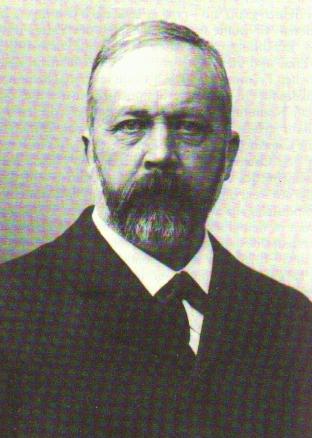
Julius Wellhausen


About 25 years ago, Father Guido Sarducci explained God and evolution for us on Saturday Night Live's "Weekend Update." He had charts and drawings that showed the evolution of God. He said something like: "And a-here is a-Neanderthal God; and a-here is Cro-Magnon God."

It was funny and bizarre, and in many respects not far off.

Genesis 1 tells us that God created humankind in God's image.
It is also true that humankind creates God in humankind's image.

As humankind evolves so does our understanding of God.

Julius Wellhausen took a more scholarly approach than Father Sarducci, but in a sense, showed us how God evolved in the Hebrew scriptures. He is famous for the Documentary Hypothesis. In a nutshell, the Hebrew Scriptures were stitched together over more than 1,000 years.

There was an original epic, modified by a storyteller we call J. Four hundred years later, this epic is modified by another storyteller we call P. Of course, long before anything is written, these stories are told and retold in oral form.

  • J gets her name by calling God, Yahweh. J's narrative was formed in the 10th century BCE
  • E calls God, Elohim. E represents the Northern Kingdom's view of history after the Israelite monarchy split in 922. (J represents the Southern Kingdom's view and eventually J and E are combined).
  • D stands for Deuteronomic history which accounts for the Book of Deuteronomy (7th century BCE).
  • P gets his name because he is a priest. P's narrative is dated in the 6th century BCE.
Here is a handy summary and here is an illustration of J and P in the flood story.

Here is a clever diagram:


There are two separate creation accounts in Genesis.

Genesis 1:1-2:4a is a later account written by P in the 6th century during the Babylonian captivity.

Genesis 2:4b-4:16 is the earlier account written by J in the 10th century BCE. This tells the story of Adam, Eve, the garden, the serpent and so forth.

In terms of the evolution of God, the second creation story is first. Later, the first story is added.

If you don't think you'll remember or particularly care about all of that information, here is all you need to know: God evolves.

Speaking of information that we forget, Father Guido Sarducci has a solution for the high cost of college with his "five minute university." Just hit play!

Namaste

Wednesday, October 04, 2006

Enuma Elish


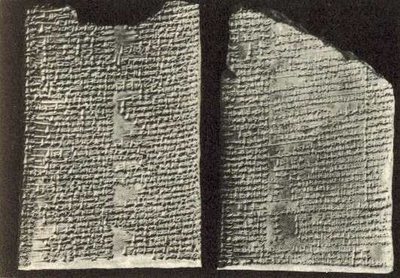
The Enuma Elish, is a Babylonian epic. Enuma Elish is translated as “When on high” and refers to its opening words. The clay tablets found in the 19th century CE date to no later than the 12th century BCE. The poem itself goes back much earlier, perhaps to 1700 BCE or even 2000 BCE.

For a helpful translation with a summary of each tablet go here. A more literal translation is here.

This poem celebrates Marduk as the king of creation. It was read at yearly festivals. This poem is important for understanding the biblical myths for a couple of reasons.

First, the writers of Genesis 1 would have been familiar with it during their period of captivity in Babylon that began in 587 BCE. The influence of Enuma Elish would have likely been part of the collective mythology even before the captivity of the people of Jerusalem.

Second, Enuma Elish holds many features in common, not only with Genesis 1, but other creation accounts in the Bible (ie. Job and the Psalter). It is clear that the writers of the Bible borrowed heavily from this myth as they wrote their own myths.

Tablets four and five describe Marduk’s slaying of Tiamat, the formation of Earth and Sky from her carcass and the establishment of the stars, sun, and moon (represented as gods) who under Marduk’s control keep things going.

This is from Tablet Four:

He constructed stations for the great gods,
Fixing their astral likenesses as the stars of the Zodiac.
He determined the year and into sections he divided it;
He set up three constellations for each of the twelve months.
After defining the days of the year by means of heavenly figures,
He founded the station of the pole star [Nebiru] to determine their bounds,
That none might err or go astray.

Alongside it he set up the stations of Enlil and Ea.
Having opened up the gates on both sides,
He strengthened the locks to the left and the right. (10)

In her belly he established the zenith.
The Moon he caused to shine, entrusting the night to him.
He appointed him a creature of the night to signify the days,
And marked off every month, without cease, by means of his crown.
At the month's very start, rising over the land,
You shall have luminous horns to signify six days,
On the seventh day reaching a half-crown.
So shall the fifteen-day period be like one another-two halves for each month.
When the sun overtakes you at the base of heaven,
Diminish your crown and retrogress in light. (20)


At the time of disappearance approach the course of the sun,
And on the thirtieth you shall again stand in opposition to the sun.
I have appointed a sign, follow its path,
. . . approach and give judgement."

[Lines 25-44 are badly damaged and untranslatable. Apparently after Marduk created the moon he then created the sun (Shamash).]


After he had appointed the days to Shamash, (45)
And had established the precincts of night and day,
Taking the spittle of Tiamat
Marduk created . . .
He formed the clouds and filled them with water.
The raising of winds, the bringing of rain and cold, (50)


Making the mist smoke, piling up . . .
These he planned himself, took into his own hand.
Putting her head into position he formed thereon the mountains,
Opening the deep which was in flood,
He caused to flow from her eyes the Euphrates and Tigris,
Stopping her nostrils he left . . . ,
He formed from her breasts the lofty mountains,
Therein he drilled springs for the wells to carry off the water.
Twisting her tail he bound it to Durmah,

. . . Apsu at his foot, (60)


. . . her crotch, she was fastened to the heavens,
Thus he covered the heavens and established the earth.
. . . in the midst of Tiamat he made flow,
. . . his net he completely let out,
So he created heaven and earth . . . ,
. . . their bounds . . . established.
When he had designed his rules and fashioned his ordinances,
He founded the shrines and handed them over to Ea.
The Tablet of Destinies which he had taken from Kingu he carried,
He brought it as the first gift of greeting, he gave it to Anu. (70)


Now compare to Genesis 1:14-19:


14 And God said, “Let there be lights in the dome of the sky to separate the day from the night; and let them be for signs and for seasons and for days and years, 15and let them be lights in the dome of the sky to give light upon the earth.” And it was so. 16God made the two great lights—the greater light to rule the day and the lesser light to rule the night—and the stars. 17God set them in the dome of the sky to give light upon the earth, 18to rule over the day and over the night, and to separate the light from the darkness. And God saw that it was good. 19And there was evening and there was morning, the fourth day.


A much condensed version! Note the “demythologizing”. Shamash (the sun god) becomes shemesh (the sun). The moon god becomes the moon. Elohim seems to screw in the light bulbs so to speak.

In Tablet six, Marduk creates humans out of the blood and bone of the slain Kingu, who had helped Tiamat in her uprising:


When Marduk heard the words of the gods,
His heart prompted him to fashion artful works.
Opening his mouth, he addressed Ea
To impart the plan he had conceived in his heart:
"I will take blood and fashion bone.
I will establish a savage, ‘man’ shall be his name.
truly, savage-man I will create.
He shall be charged with the service of the gods
That they might be at ease!
The ways of the gods I will artfully alter. (10)

Though alike revered, into two groups they shall be divided."
Ea answered him, speaking a word to him,
Giving him another plan for the relief of the gods:
"Let but one of their brothers be handed over;
He alone shall perish that mankind may be fashioned.
Let the great gods be here in Assembly,
Let the guilty be handed over that they may endure."
Marduk summoned the great gods to Assembly;
Presiding graciously, he issued instructions.
To his utterance the gods pay heed.
The king addressed a word to the Anunnaki: (20)

"If your former statement was true,
Now declare the truth on oath by me!
Who was it that contrived the uprising,
And made Tiamat rebel, and joined battle?
Let him be handed over who contrived the uprising.
His guilt I will make him bear. You shall dwell in peace!"
The Igigi, the great gods, replied to him,
To Lugaldimmerankia, counselor of the gods, their lord:
"It was Kingu who contrived the uprising,
And made Tiamat rebel, and joined battle." (30)

They bound him, holding him before Ea.
They imposed on him his punishment and severed his blood vessels.
Out of his blood they fashioned mankind.
He imposed on him the service and let free the gods.
After Ea, the wise, had created mankind,
Had imposed upon them the service of the gods--
That work was beyond comprehension;
As artfully planned by Marduk, did Nudimmud create it--
Marduk, the king of the gods divided
All the great gods [Anunnaki] above and below. (40)


And from Genesis 1:26-28


26Then God said, “Let us make humankind in our image, according to our likeness; and let them have dominion over the fish of the sea, and over the birds of the air, and over the cattle, and over all the wild animals of the earth, and over every creeping thing that creeps upon the earth.” 27So God created humankind in his image, in the image of God he created them; male and female he created them. 28God blessed them, and God said to them, “Be fruitful and multiply, and fill the earth and subdue it; and have dominion over the fish of the sea and over the birds of the air and over every living thing that moves upon the earth.”

Again, we have a much condensed version. Also, humans are not created from the blood of an enemy to be slave to gods, but are created by Elohim who blesses them.

Genesis 1 reflects a mature development in Hebrew theology. Genesis 1 is no earlier than the 6th century BCE. It is much more sophisticated than Enuma Elish or some of the earlier myths in the Bible itself (Job and Psalms). Genesis 1 is less “mythological” and it has a more positive vision of the creator and humankind.

But, Genesis 1 is still a myth. One of its basic functions was to tell the story of why humans are to work six days and keep the seventh day holy. It tells us nothing about how human beings, Earth, or the universe evolved. It is a myth based on the ancient understanding of the cosmos which I discussed in my last post.

Tuesday, October 03, 2006

Setting the Stage: How the Ancients Viewed the Cosmos


The above image is taken from Michael Palmer's web page in the
syllabus for his Religion 103 class,
"
The History and Literature of the Bible."


Imagine if you had never been told that Earth is a globe that rotates and revolves around the sun. You would likely never figure that out. In fact, Copernicus, just over 500 years ago, through observations, showed the Sun as the center of the solar system, not Earth. Copernicus shattered what seemed to be common sense.

Just going by your common sense observations, what would you see? You would see Earth that is flat. You look up and see a big blue dome that stretches to the horizon. By day, a ball of fire moves across the dome. How does that happen? At night another lesser light moves through the dome. And what are all of those white dots at night? You can see them through the dome. They move in patterns. Who moves them? What are they?

What holds up this dome? Probably the mountains at the edge. What holds up Earth? Perhaps pillars underneath. From where does the rain come? It appears like outside the dome is water and below Earth is water. On occasion, the spouts are opened and water flows down from the dome and up from Earth. What if it never stopped raining? The space between Earth and Dome would fill up with water. That would be scary. Everything would drown.

What if you could build a tower tall enough to reach the dome? That would be awesome! You could reach the dome and talk to the gods.

The ancients with variations saw their world--earth and heaven (sky-firmament-dome) in that way. Genesis 1 now makes sense:
6And God said, “Let there be a dome in the midst of the waters, and let it separate the waters from the waters.” 7So God made the dome and separated the waters that were under the dome from the waters that were above the dome. And it was so. 8God called the dome Sky. And there was evening and there was morning, the second day.
The "waters" are the whole of existence itself. Elohim makes a living space holding back the waters above the dome from below Earth. In the earlier Babylonian myth, Enuma Elish, Marduk does the same thing Elohim does. Except in the Babylonian myth, it is even more "mythological" in that virtually everything is personified. Marduk defeats Tiamat (a personification of the watery chaos) and splits her carcass in two. Half of Tiamat's carcass becomes the dome and the other half Earth.

The Babylonians and the Hebrews saw the same physical universe (the dome above and the earth below holding back waters) but they had a different mythology to explain its origins.

Obviously, Genesis 1 has nothing to say to us about the physical creation of the universe as we see it today. However, it can inform us theologically. For example, what is the difference between a god who violently creates Earth and Sky by defeating a chaotic monster versus a god who speaks and it is done and "it is good?"

Later in the Enuma Elish, Marduk creates humans. He creates them from the blood and bone of his enemy, Kingu. These humans are created to be slaves to the gods. What is the difference theologically between and understanding of humanity this a creation of violence enslaved to the forces of the universe and between an understanding of humanity that is the creation of a god who creates humanity in the image of god, and declares humanity good?

For more detail about this, here are some websites:

Hebrew Astronomy, Biblical Cosmology, and Council for Secular Humanism.

From the Biblical Cosmology website here are some wonderful quotes from Martin Luther who struggled with the Bible and the new cosmology of Copernicus who he calls "an upstart astrologer". I will close with these:

Martin Luther

Martin Luther (1483–1546) began the protestant reformations with his sincere attempts to interpret the exact meanings of Biblical scripture. Likewise, he made sincere attempts to grasp a Biblical understanding of astronomy.

  • "Scripture simply says that the moon, the sun, and the stars were placed in the firmament of the heaven, below and above which heaven are the waters... It is likely that the stars are fastened to the firmament like globes of fire, to shed light at night... We Christians must be different from the philosophers in the way we think about the causes of things. And if some are beyond our comprehension like those before us concerning the waters above the heavens, we must believe them rather than wickedly deny them or presumptuously interpret them in conformity with our understanding." --Martin Luther.
  • "...the whole firmament moves swiftly around, every moment thousands of leagues, which, doubtless, is done by some angel. `Tis wonderful so great a vault should go about in so short a time." --Martin Luther.
  • "People gave ear to an upstart astrologer who strove to show that the earth revolves, not the heavens or the firmament, the sun and the moon. Whoever wishes to appear clever must devise some new system, which of all systems is of course the very best. This fool wishes to reverse the entire science of astronomy; but sacred Scripture tells us that Joshua commanded the sun to stand still, and not the earth." --Martin Luther.


Monday, October 02, 2006

Creation Part 2: An Outline


Michelangelo, 1512, Sistine Chapel
The creation of Eve (top) and Adam (below)


Before we look at the various biblical accounts of creation, it is necessary to set the stage. Setting the stage will require that we try to look at the universe in terms that the biblical writers (and all people from the Ancient Near East) saw it. Setting the stage will also require that we look at the sources of these myths and compare the sources with the biblical accounts.


This can be summarized in this way:


How did the ancients see the physical cosmos?
What did their myths (both Babylonian and Hebrew) tell them about their relation to the cosmos?


It is that second question that will help us theologically in constructing a Christian theology of creation for the 21st century.
How and why did the biblical writers change these myths? I suggest that these changes will provide the theological basis for a 21st century Christian theology of creation.


Then, we will ask:
How do we see the cosmos?
What can we take from the biblical creation myths (particularly the theological relationship between God and creation) that will be useful for us?


I am going to need to break this up in order to keep each post relatively short and to spend adequate time on each part.
Here are my working titles for the next several posts:

Setting the Stage: How the Ancients Viewed the Cosmos

Setting the Stage: The Babylonian Myth, Enuma Elish

The Biblical Creation Accounts (from Job, the Psalter, Proverbs, and Genesis)

A Comparison the Hebrew Bible’s Theology of Creation with the Babylonian Theology of Creation

Some Theological Affirmations We Can Keep

The Modern View of the Cosmos

A Modern Creation Myth

To whet your appetite, check out this website for an overview of the biblical conception of the universe.


Wikipedia provides background on the Enuma Elish.
I strongly suggest you read a translation of Enuma Elish.

Finally, The History and Literature of the Bible is an excellent website to which we will be returning!


Next time, Setting the Stage: How the Ancients Viewed the Cosmos


Saturday, September 30, 2006

Song of the Fish People


I really like this poem by Pat Boran (picture above). It has a place in my "loose-leaf" Bible.


“Song of the Fish People”

Give us legs and arms
to run and fight and kill,
then give us other skills
to plant and farm.

Give us warm blood
to feel the variations
of temperature, the patience
to untangle bad from good

while the known world spins,
and give us the desire
to create, and the fire
to destroy. And take the fins.

But leave us always tears
that we may not forget
the salty depths
of our formative years.

--Pat Boran. New and Selected Poems
(Cambridge: Salt Publishing), 2005


In the spirit of locating good writing, I recommend the following article by Robert Jensen. Mr. Jensen was admitted to membership of the St. Andrew's Presbyterian Church in Austin, Texas, a church in many respects like the one I serve. Both churches are affiliated with The Center for Progressive Christianity .

Mr. Jensen's membership was challenged by others in the presbytery because of his unorthodox views. I won't say any more about that. I will let you read his story. It is exceptionally well-written. I think it relates through a personal account exactly what I am attempting to do on this blog and in my ministry. In my view, Christianity is changing and it needs to change. The honesty, intelligence, humility, and passion of folks like Robert Jensen is something to cultivate and celebrate in the life of the church. So do take the time to read this. It is well worth it.

Here are his opening paragraphs:
This past year, after decades of steadfastly avoiding churches of all kinds, I returned to church. Ironically, and completely by coincidence, I returned to a Presbyterian church, the denomination in which I was raised and to which I swore -- in both senses of the term -- I would never return. But return I have, prodigally perhaps, depending on one's position on various doctrinal issues, which we will get to tonight in due time.

I don't want to be overly dramatic, but my early experience with church had been life-threatening: I was bored, nearly to death. For me, growing up in a middle-of-the-road Protestant church in the Midwest, religion seemed a bland and banal approach to life -- literature, politics, and philosophy seemed far more fruitful paths to explore. As I have confessed to my pastor, in my entire life I have cheated on only one test -- the exam to pass confirmation class so I could fulfill that requirement imposed by my parents and be done with the whole enterprise. For that sin, I have neither sought nor been granted absolution.

So, my friends and family were somewhat startled [when] I joined--of my own free will, being of sound mind and body--St. Andrew's Presbyterian Church in Austin, TX....


Read more here...

The Struggle Over What It Means to be a Christian Today: Finding My Way Back to Church and Getting Kicked Out

Next time (maybe) a look at the pre-Hebrew creation myths to set the context for reading the creation myths in the Bible.

Namaste,
John


Friday, September 29, 2006

The Bible and the Modern World


Roy Hoover compiled this helpful chart of the difference between the biblical view of the history of the world and human life and the modern view of the history of the world and human life. This will be helpful as we construct a theology for the 21st century. More on Creation next time!


The Biblical View of the History of the World
and Human Life

Vs.

The Modern View of the History of the World
and Human Life


1. The origin of the universe

God created the heavens and the earth and all of the forms of life in the in six days by commanding them into being (Genesis 1). God rested from his creating work on the seventh day, thus establishing it as a day of rest for as long as the world lasts.

1. The origin of the universe

The universe came into being fifteen billion years ago, or so, following a “big bang.” Life on earth in its many forms has evolved and developed across hundreds of millions of years.


2. Space

The earth occupies the center of the whole cosmos. The sun, moon, and stars circle around it.

2. Space

Space is many light years in extent and seems to be still expanding. The earth is one of several planets orbiting the sun in a solar system that is part of the Milky Way galaxy.


3. Human origins

God created human beings in his image, made them male and female, commanded them to propagate and fill the earth, and delegated to them authority over and responsibility for the care of the plants and animals God had created (Genesis 1:26-31; 2:15).

3. Human origins

Human beings emerged comparatively late in the history of the earth from earlier forms of life and continue to be sustained by the whole ecosystem of the planet.


4. God

God is the world’s lord and king; he rules over it from his throne high in the heavens.

4. God

God is the symbolic term we use to refer to the ultimate reality and mystery with which we have to do. Theology is and always has been the constructive work of human beings and is useful only insofar as it succeeds in depicting the way things really are and in pointing out how we may live humanely amid the realities of the world.


5. History

God is directing the course of history to its final consummation which he determined for it from the beginning.

5. History

Human beings are characterized by self-conscious, self-transcending intelligence and imagination. This capacity gives us the ability to create culture and to shape history. It also gives us the inclination and ability to search for and recognize the meaning of our experience in the world, which we often express in the form of a religion.


6. Bible

God revealed, through Moses, the basic law by which human life is to be ordered, and sent prophets, apostles and other messengers to communicate his will to humankind. These revealed truths, recorded in scripture, make the Bible the Word of God.

6. Bible

God [esp. the rule of God] is the principal subject of the Bible, not its author. The writings—of priests, prophets, wisdom teachers, psalmists, anonymous gospel narrators, and apostles—that have been collected to form the Christian Bible are an irreplaceable source of information about the origins of the characteristically Jewish and Christian ways of viewing the human condition and a primary resource for theological reflection and public worship.


7. Jesus

God sent his only son, Jesus Christ, to preach the gospel and to die on the cross to save us from our sins. God raised Jesus from the dead and will likewise raise all who believe in him. This incarnation of the eternal son of God marks the beginning of the consummation of all things, which is even now playing out under God’s providential direction.

7. Jesus

Jesus of Nazareth was the pioneer and exemplar of a new form of ancient Israel’s faith that emphasized its universal rather than its ethnic meaning. The message Jesus preached was about “the Kingdom of God,” a vision of life ruled by the union of power and goodness. The political and religious establishments of that time regarded the threat to their legitimacy posed by this vision sufficient reason to execute him.


8. The future

The resurrected Jesus will return on the clouds of heaven at the end of history when God will defeat the powers of sin and death and bring into being his kingdom which will have no end.

8. The future

The literal statements about the resurrection lost their literal meaning when the modern view of the world displaced the ancient. The real core of ancient resurrection faith is the recognition that justice and moral virtue are indispensable for a truly human life, and that human life can be transformed in the direction of greater fulfillment.


Prepared by Roy W. Hoover
February, 2003
Some of the phrasing is drawn from Gordon D. Kaufman, In Face of Mystery. A Constructive Theology.
Printed from the January-February 2004 issue of the Fourth R, p. 3


Thursday, September 28, 2006

Creation: Part 1


I am not really sure how to go about articulating a theology. I imagine that what I write will be at times random and inconsistent. I may repeat myself. I will leave questions unanswered. Yet there is one thing I need to keep in front of me. The number one question is: why do I feel the need to do this?

Here is my answer to that question: I have two great-nephews and two great-nieces. What will the world be like when they reach my age (about 40 years from now)? What will our world be like in 2046? I care about that. I cannot think of a more important theological question than that one. I and you and everyone has a part to play today in what will happen in our future. If I were a medical doctor, teacher, whatever, that would still be my central question. I would seek to use my skills toward a positive future.

Because I am a clergyperson, theology is what I do. My role is a small one. I am simply trying to understand humanity and humanity's place in the cosmos in such a way that my theology can empower me for positive change. I believe the theology we have inherited is inadequate for the task we face. It is inadequate in function and in its understanding of the universe. You may disagree. That's good.

I do not engage in this to provide answers for others. It is my project, but I invite others to participate with me. You may decide to travel with me for a while then find your own path. I am going to raise some difficult issues. This theology is not mere speculation. If it cannot deal with the toughest issues humanity faces in 2006, then, to use an image from St. Paul, it is dung.

I begin with Creation. We go to Genesis chapter 1 for the creation story. We notice that it is Earth-centered. I will talk more about the various creation myths in the Bible, but the point today is that an Earth-centered creation myth is too small. A twenty-first century theology needs a Universe-centered creation myth.

Here are some basics (as I see them):
  • The Universe is between 12 and 20 billion years old.
  • Earth is but one planet revolving around a sun that is one of billions in its galaxy that is in turn one of billions of galaxies in the Universe.
  • Humankind has evolved from lower life forms in a process on Earth that began about four billion years ago.
  • The arrival of homo sapiens on Earth is so new as to be virtually incomprehensible in relation to the scope of time of the origin of Earth, let alone the Universe.

Theologically speaking, God must be at least as big as the Universe. God has been at work far longer than humans have been making up myths about Her and in places farther than humans have as yet ever imagined.

The birds of the air and fish of the sea have known God far longer than we.
I touched on this in a sermon entitled: "Theology is Earth Science".

A doctrine of Creation must take into account the vastness of the Universe and our Evolutionary process.

I have only begun!

Blessings,
John

Wednesday, September 27, 2006

Systematic Theology


Hi Friends,

I said I was going to take a stab at a 21st century theology that takes into account our context as folks who are Americans and Christians. Wikipedia offers this definition of systematic theology. I am interested in going through some of the topics. Here are some, again from Wikipedia...

"...Christian systematic theology will often touch on some or all of the following topics: God, revelation, creation and Divine providence, Theodicy, Theological Anthropology, Christology, soteriology, ecclesiology, sacrament, Pneumatology, Christian life, Heaven, and interfaith statements on other religions."

Supposedly, you can begin with any topic and move from topic to topic.

I think I will begin with Creation. This will include looking at texts from the Bible as well as looking at the 21st century understanding of the Universe. I will also include wisdom from the PCUSA confessions. Creation narratives from other faith traditions ought to be considered as well.

Creation from a theological perspective seeks to provide meaning for us. It gives us a narrative as to who we are, our nature, and our place in the cosmos.

If you have thoughts regarding other things that should be included in a doctrine of Creation, do let me know!

Remember, I am no professional. Anyone can do this. In fact, everyone should do this--that is to have a theology. It should be something you can say in your own words and (in my opinion) it should be able to be understood by other non-professionals, particularly (again in my opinion) someone with, say a high school education.

So if my language gets too technical, call me on it!

Peace,
John

Monday, September 25, 2006

The Semi-Pelagian Narrower Catechism


I found the following here.
This will be funny for you if...

You have some familiarity with the Westminster Shorter Catechism (hopefully, if you are a Presbyterian you might have at least heard of it) and if you have ever hung out with the Campus Crusade for Christ Crowd.

The Semi-Pelagian Narrower Catechism
1. Q: What is the chief end of each individual Christian?
A: Each individual Christian's chief end is to get saved. This is the first and great commandment.

2. Q: And what is the second great commandment?
A: The second, which is like unto it, is to get as many others saved as he can.

3. Q: What one work is required of thee for thy salvation?
A: It is required of me for my salvation that I make a Decision for Christ, which meaneth to accept Him into my heart to be my personal lord'n'saviour

4. Q: At what time must thou perform this work?
A: I must perform this work at such time as I have reached the Age of Accountability.

5. Q: At what time wilt thou have reached this Age?
A: That is a trick question. In order to determine this time, my mind must needs be sharper than any two-edged sword, able to pierce even to the division of bone and marrow; for, alas, the Age of Accountability is different for each individual, and is thus unknowable.

6. Q: By what means is a Decision for Christ made?
A: A Decision for Christ is made, not according to His own purpose and grace which was given to me in Christ Jesus before the world began, but according to the exercise of my own Free Will in saying the Sinner's Prayer in my own words.

7. Q: If it be true then that man is responsible for this Decision, how then can God be sovereign?
A: He cannot be. God sovereignly chose not to be sovereign, and is therefore dependent upon me to come to Him for salvation. He standeth outside the door of my heart, forlornly knocking, until such time as I Decide to let Him in.

8. Q: How then can we make such a Decision, seeing that the Scripture saith, we are dead in our trespasses and sins?
A: By this the Scripture meaneth, not that we are dead, but only that we are sick or injured in them.

9. Q: What is the assurance of thy salvation?
A: The assurance of thy salvation is, that I know the date on which I prayed the Sinner's Prayer, and have duly written this date on an official Decision card.

10. Q: What is thy story? What is thy song?
A: Praising my Savior all the day long.

11. Q: You ask me how I know he lives?
A: He lives within my heart.

12. Q: And what else hast thou got in thine heart?
A: I've got the joy, joy, joy, joy down in my heart.

13. Q: Where??
A: Down in my heart!

14. Q: Where???
A: Down in my heart!!

15. Q: What witness aid hath been given us as a technique by which we may win souls?
A: The tract known commonly as the Four Spiritual Laws, is the chief aid whereby we may win souls.

16. Q: What doth this tract principally teach?
A: The Four Spiritual Laws principally teach, that God's entire plan for history and the universe centereth on me, and that I am powerful enough to thwart His divine purpose if I refuse to let Him pursue His Wonderful Plan for my life.

17. Q: What supplementary technique is given by which we may win souls?
A: The technique of giving our own Personal Testimony, in the which we must always be ready to give an answer concerning the years we spent in vanity and pride, and the wretched vices in which we wallowed all our lives until
the day we got saved.

18. Q: I'm so happy, what's the reason why?
A: Jesus took my burden all away!

19. Q: What are the means given whereby we may save large crowds of souls in a spectacular manner?
A: Such a spectacle is accomplished by means of well-publicized Crusades and Revivals which (in order that none may be loath to attend) are best conducted anywhere else but in a Church.

20. Q: Am I a soldier of the Cross?
A: I am a soldier of the Cross if I join Campus Crusade, Boys' Brigade, the Salvation Army, or the Wheaton Crusaders; of if I put on the helmet of Dispensationalism, the breastplate of Pietism, the shield of Tribulationism, and the sword of Zionism, having my feet shod with the gospel of Arminianism.

21. Q: Who is your boss?
A: My boss is a Jewish carpenter.

22. Q: Hath God predestined vessels of wrath to Hell?
A: God hath never performed such an omnipotent act, for any such thing would not reflect His primary attribute, which is Niceness.

23. Q: What is sanctification?
A: Sanctification is the work of my free Will, whereby I am renewed by having my Daily Quiet Time.

24. Q: What rule hath God for our direction in prayer?
A: The rule that we must bow our hands, close our heads, and fold our eyes.

25. Q: What doth the Lord's Prayer teach us?
A: The Lord's Prayer teacheth us that we must never memorize a prayer, or use one that hath been written down.

26. Q: What's the book for thee?
A: The B-I-B-L-E.

27. Q: Which are among the first books which a Christian should read to his soul's health?
A: Among the first books which a Christian should read are the books of Daniel and Revelation, and The Late Great Planet Earth.

28. Q: Who is on the Lord's side?
A: He who doth support whatsoever is done by the nation of Israel, and who doth renounce the world, the flesh, and the Catholic Church.

29. Q: What are the seven deadly sins?
A: The seven deadly sins are smoking, drinking, dancing, card-playing, movie-going, baptizing babies, and having any creed but Christ.

30. Q: What is a sacrament?
A: A sacrament is an insidious invention devised by the Catholic Church whereby men are drawn into idolatry.

31. Q: What is the Lord's Supper?
A: The Lord's Supper is a dispensing of saltines and grape juice, in the which we remember Christ's command to pretend that they are His body and blood.

32. Q: What is baptism?
A: Baptism is the act whereby, by the performance of something that seems quite silly in front of everyone, I prove that I really, really mean it.

33. Q: What is the Church?
A: The Church is the tiny minority of individuals living at this time who have Jesus in their hearts, and who come together once a week for a sermon, fellowship and donuts.

34. Q: What is the office of the keys?
A: The office of the keys is that office held by the custodian.

35. Q: What meaneth "The Priesthood Of All Believers"?
A: The Priesthood Of All Believers meaneth that there exists no authority in the Church, as that falsely thought to be held by elders, presbyters, deacons, and bishops, but that each individual Christian acts as his own authority in all matters pertaining to the faith.

36. Q: Who is the Holy Spirit?
A: The Holy Spirit is a gentleman Who would never barge in.

37. Q: How long hath the Holy Spirit been at work?
A: The Holy Spirit hath been at work for more than a century: expressly, since the nineteenth-century Revitalization brought about by traveling Evangelists carrying tents across America.

38. Q: When will be the "Last Days" of which the Bible speaketh?
A: The "Last Days" are these days in which we are now living, in which the Antichrist, the Beast, and the Thief in the Night shall most certainly appear.

39. Q: What is the name of the event by which Christians will escape these dreadful entities?
A: The event commonly known as the Rapture, in the which it is our Blessed Hope that all cars driven by Christians will suddenly have no drivers.

40. Q: When is Jesus coming again?
A: Maybe morning, maybe noon, maybe evening, and maybe soon.

41. Q: When the roll, roll, roll, is called up yonder, where will you be?
A: There.

42. Q: Hallelu, hallelu, hallelu, hallelujah!
A: Praise ye the Lord!

43. Q: Praise ye the Lord!
A: Hallelujah!

44. Q: Where will we meet again?
A: Here, there, or in the air.

45. Q: Can I hear an Ay-men?
A: Ay-men.


Sunday, September 24, 2006

D.F. Strauss: A Heretical Hero


"Yet his basic claims—that many of the gospel narratives are mythical in character, and that "myth" is not simply to be equated with "falsehood" — have become part of mainstream scholarship. What was wildly controversial in Strauss's time has now become one of the standard tools of biblical scholars."
--Marcus Borg commenting on D.F. Strauss


In 1835, D. F. Strauss published "The Life of Jesus." At the time one reviewer said that the book was "the most pestilential book ever vomited out of the jaws of hell."


Marcus Borg takes a different view. Borg published David Friedrich Strauss: Miracle and Myth in the Fourth R in 1991. If you have ever wondered how to read the story of the feeding of the 5000 in the gospels, we could take a lesson from D.F. Strauss.

Many people do not realize that higher criticism has been around for quite some time. It is not, for example, an invention of Robert Funk, Marcus Borg, or the Jesus Seminar.

Perhaps the time has come when the church can take seriously this scholarship and use it to energize worship and Christian practice rather than view it as a threat.

Namaste,
John