
Shuck and Jive


Wednesday, November 08, 2006

Election 2006--Reflection

The Democrats have taken control of the House and depending on Montana and Virginia, could make the Senate 50-50. What will they do differently regarding ecology, energy, economy, and empire?

Here is a tally of the marriage amendments in various states:

State

Yes

No

Arizona

48.6%

51.4%

Colorado

56.0%

44.0%

Idaho

62.9%

37.1%

S.C.

78.0%

22.0%

S.D.

52.0%

48.0%

Tennessee

80.4%

19.6%

Virginia

56.9%

43.1%

Wisconsin

59.4%

40.6%


Thanks to Mass Marrier for this chart and an analysis. Arizona is the only state to defeat its marriage amendment proposal. Tennessee (ahem) is the least progressive of all. Carter County voted for the measure by 88% and Washington County by 81%. Link

Mass Marrier quotes a 41 year old woman from Lebanon summing up her view of same-sex relationships: "A lot of people don't realize that's damnation to their soul."

Here is how I look at it. The field is ripe for harvest. First Presbyterian of Elizabethton is the only congregation I know of in Northeast Tennessee that states its full welcome to LGBT people. Here is our statement of welcome:

First Presbyterian invites you to become a part of our fellowship as we worship God and serve others in the spirit of Jesus Christ. With a commitment to achieving a just and peaceful world community, our congregation welcomes those of every age, gender, sexual orientation, race and ethnic identity.

Those 19% in Washington County, 12% in Carter County could well find a home with us. If they found out about us, we will become a mega-church!

Peace,
John

Tuesday, November 07, 2006

God Through Experience

How can we know about God if there is a God to be known? In my experience as a minister, I would say that most people, if they speak of God, speak of God in terms of their experience. They will tell a story about God's presence at a particular moment in their lives or they will speak of situations in which God's presence is particularly evident for them. The experience and the name for this experience will vary with the person. It will vary given the language and rituals they have developed for naming this experience.

I am finding enjoyment listening to AM radio as I drive back and forth to the church and to various places in East Tennessee. I listen to the various religious broadcasts. This is educational for me. I hear gospel music mixed with prayers by local preachers and musicians. Sometimes the prayers will be spoken all at once, a cacophony of prayer. Sometimes one person will pray at length. "The Lord" and "Jesus" are the most common names used in prayer. I find these radio shows quite interesting. There is real care expressed for their listeners who are often named. Each is prayed for in some manner. Both preachers, pray-ers and listeners who call in will speak about what "The Lord" has done in personal terms.

While people may talk about other sources for information about God (such as the Bible), I find that when it comes right down to it, people will claim knowledge of God by the authority of their own experience. The punchline of the evangelical hymn, "He Lives" is this: "You ask me how I know He lives? He lives within my heart."

Personal experience is the way non-traditional Christians or progressive Christians approach God as well. They may not use the term God preferring the Sacred or the Divine or something else. They may use the Bible and often many other sources for inspiration. But as with almost everyone I have met, the authority of personal experience is the bottom line for "knowing" God. That is, of course, for those who are confident of the presence of God. I should also say that there are people who affirm the existence of God without referring to personal experience.

Whether or not these experiences of the Sacred or of God are experiences with something real or are conversations with themselves, I cannot say. For those who put great trust in their experiences, God certainly appears real to them.

Here is a quiz for you. What is Your Spiritual Type?

Monday, November 06, 2006

The Green Factor

My final election post! At election time we vote and act as if there are candidates from only two parties. Usually, it is a choice between the lesser of two incompetents. Every now and then, I get fed up and vote green. Here is the website of the Green Party of the United States. When I read over their platform, I find that their values are closer to mine than any other party. But I find myself in a quandary. Do I vote my conscience or take the politically expedient route? The Greens answer the charge that they are the "spoiler" party here.

Here are two Tennessee Greens. Chris Lugo is running for Senate and Howard Switzer for Governor.

I am the only candidate running for Senate in Tennessee who stands for the progressive ideals that have made this country great. I am truly interested in the needs of the poor, the elderly, women and children, working people, immigrants, gays and lesbians, and the environment. I am the only candidate who stands for peace. I have a long history of service to my community and working for a better Tennessee. (Chris Lugo from his website).


One look at my photo and you can probably tell I'm not your typical candidate for Governor. The typical office holder today has not been serving us very well because they are beholden to wealthy corporate contributors who do not represent the dreams and desires of most people. This corruption is reflected in our state policy to the detriment of every Tennessean. We can change that. (Howard Switzer from his website).


You can find other Tennessee Greens here.


Marriage Amendments

I want to clarify a statement I made in my last post. I wrote
Amendments regarding marriage are on many state ballots as well (including Tennessee and Virginia). I wrote previously regarding my opinion as well as a post why I think this issue is far less important than those that are truly facing us.
I intended to point out that the religious and political right are using this issue to divert us from larger issues that face us, namely, energy, ecology, and economy. However, the marriage amendments on the ballot are important for voters. These amendments deny basic rights, liberties, and protections for individuals and families. These amendments need to be exposed for their injustice and defeated. Rick Ufford-Chase, former moderator of the PCUSA wrote an article in the Arizona Daily Star regarding the amendment in Arizona. He published a reflection upon it on his blog. I am grateful to him for his public advocacy on behalf of gay, lesbian, bisexual, and transgender persons.

Friends,

Arizona, like many states, is increasingly turning to ballot propositions in our governance - something I have grave concerns about because it tends to reduce complex and nuanced public policy issues to twenty second soundbites on t.v. or yard signs that do nothing to create an informed electorate. This round, we've got 19 of these initiatives. I spent over an hour and a half reading the various proposals and their critiques and justifications, and still found it difficult to sort through them when I went to cast an early ballot last week. One of the most pernicious is Proposition 107, which would change our constitution to make same-sex marriage illegal in our state (it already is), and to deny any marriage-like benefits to all persons who are not married.

I felt strongly enough about this one to write an opinion piece for our local paper, the AZ Daily Star, which ran it in it's electronic version of the paper about a week ago. As it's circulation has widened, I've been asked by several people to share it more broadly through my blog.

So for those of you who are interested, here's my own take on this one - limited to the 500 words allowed by the newspaper. . .

Proposition 107 would explicitly deny any “marriage-like” benefits to persons who are not married, and would constitutionally define marriage as only being available to persons of opposite gender. Like the broader society, the faith community is deeply divided on this issue.

My experience as the highest elected official of the Presbyterian Church (USA) from June of 2004 to June of 2006 gave me a glimpse into the passion and divisiveness of this debate. Though it is clear that there is currently no consensus in our churches to broaden the definition of marriage, our denomination has been clear that we will not become unwitting participants in any movement to isolate gay and lesbian persons as a group, nor will we condone discriminatory practices against the lesbian, gay, bisexual or transgender community from our legislative, executive or judicial branches of government. This is entirely consistent with our denomination’s historic advocacy for women, persons of color, undocumented persons, and those who live with mental or physical disabilities, all of whom also face the possibility of discrimination because of who they are.

I long for the day when all who desire to make a lifelong commitment to one another are able, as I am, to do so within the bonds of the covenant of marriage. Someday, it could happen. After all, the biblical story is full of examples of God’s people being surprised by what God had in mind for them. We Presbyterians believe that God is constantly being revealed to us in ways that challenge, trouble, and occasionally delight us. For that reason, I will continue to be in dialogue with my sisters and brothers with whom I disagree about this matter. As people of faith, all of whom are struggling to be faithful to their understanding of God, we must find respectful ways to wrestle with this and many other issues that divide us.

However, what we must not tolerate are laws motivated by hate or discrimination, or that single out an entire class of people to be treated differently than the rest of us. Prop. 107 would take away domestic partner benefits such as health insurance from public employees. It would remove domestic violence protections from unmarried persons. It makes simple things like the right to visit a loved one in the hospital impossible.

Questions of how marriage is defined will continue to be debated within our faith communities and across our society. In the meantime, let’s assure that our laws embody the best of what our country has always been – a safe haven for those who might be targeted elsewhere because of who they are or what they believe. Let’s honor our country’s history as a place of tolerance, mutual forbearance, care and concern for all members of our communities. Those are values that all of us, both in and out of the church, ought to be able to affirm.

Please, vote “no” on Proposition 107.

Blessings on each of you as you also go to the polls in the next few days.
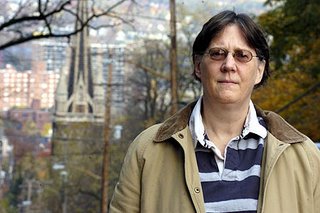
A friend of mine, Janet Edwards, a minister in Pittsburgh, Pennsylvania, has been an advocate for glbt rights in the church for a long time. She is on trial for conducting a marriage for a lesbian couple. Here is the article:

Most people send formal invitations for weddings, but the Rev. Janet Edwards has gone a step further with invitations to her church trial for conducting the wedding of two lesbians.

"I feel such delight in having an opportunity to engage in the absolutely essential discussion that has to go on in the Presbyterian Church over the place of gay, lesbian, bisexual and transgender people among us that I really do want the church to come and join in it and witness it. I can't quash that delight," said the Rev. Edwards, a minister of the Presbyterian Church (USA) and a pastoral associate at the Community of Reconciliation in Oakland.

Recipients are invited to the Nov. 15 trial at 9 a.m. in The Priory, a small hotel on the North Side. Out-of-town guests are advised of a block of hotel rooms with a shuttle to the trial, and that complimentary travel can be arranged. It further invites them to a "worship celebration and lunch" at the Pittsburgh Golf Club in Schenley Park. It concludes:

"Janet wants the world to come. Feel free to invite anyone."

"Wow," said Jerry Van Marter, news director for the Presbyterian Church (USA), who has covered many church trials and never seen anything the like.

"It's a real show trial, isn't it?"

But he was not surprised by the location. Trials must be held on neutral territory.

"The last trial I attended was in a hotel ballroom near the San Francisco airport," he said.

Both the Rev. Jim Mead, pastor to Pittsburgh Presbytery, and Jay Lewis, stated clerk to the presbytery, declined comment.

Trials are normally open to the public. They resemble civil trials with testimony and cross-examination. But there are multiple judges, typically seven or nine clergy and elders, Mr. Van Marter said.

Once testimony ends, the proceedings are closed as the judges deliberate.

Rulings are typically issued within days. Either side can appeal to the regional and then the national level.

The Rev. Edwards, 56, faces charges for a marriage ceremony she celebrated in June 2005. The denomination's high court has said that clergy in the Presbyterian Church (USA) may bless same-sex couples as long as the ceremony does not resemble a marriage liturgy.

But the Rev. Edwards has been clear that she celebrated a marriage. She argues that there is no ban on same-sex marriage ceremonies because the ruling said clergy "should not" conduct them -- language she believes falls short of a prohibition.

The Rev. Edwards, a former moderator of Pittsburgh Presbytery, has been an activist for gay people in the church since her ordination in 1977. She said she was inspired by the long, devoted relationship between a beloved uncle and his partner.

She will plead "not guilty." If she is convicted, penalties could range from a reprimand to removal from ministry.

While the Rev. Edwards said she would be crushed to lose her Presbyterian clergy credentials, she admits she has a freedom that many clergy lack.

An heiress married to a physician, she is a descendant of the founder of what is now National City bank, and of a silent partner in the founding of Standard Oil. In addition, the congregation she serves is supportive of her efforts and is affiliated with five denominations, one of which officially affirms same-sex marriage.

"I know that my situation is not the same as my colleagues," she said, noting that she doesn't have to worry about poverty. She said she is reminded of Mordecai's words to the biblical heroine Esther, who was chosen to be a queen of Persia at a time when Jews faced genocide.

"He said that perhaps it was for this very moment that you were brought to the position you are in. I very much feel that the circumstances of my life -- both my economic circumstances and the fact that my children are now grown -- have all configured to have me step forward at this moment," she said.


There are several advocacy groups within the PCUSA working for equality in church and society. They include More Light Presbyterians, That All May Freely Serve, The Shower of Stoles Project, The Witherspoon Society, and Covenant Network of Presbyterians.

Here are a few articles regarding my advocacy for sexual and gender minorities in church and society.

Church Politics:
Amendment A will Keep All God's Creatures in the Ark (Alas, it was defeated).
Not Justice, Not Progress: Just the Same Second-Class Status (I wrote against this amendment because I felt it did not go far enough in removing the discriminatory policies of our church. It did pass, however, and makes a small step toward equality).

Holy Unions:
Faith and Values: Recognize the Sacredness of Life, Love (This article appeared the same day we held a holy union service in my previous congregation).
Today is a Great Day! (The sermon I preached at that service).
Same Sex Marriage Raises Emotional Response (Debate in our community about the marriage amendment in Montana in 2004. Alas the amendment passed).

Education and Support:
A study group for gay, lesbian, bisexual, and transgender folks and supporters at my previous congregation.

AIDS Awareness and Remembrance:
Service Honors Aids Patients (A service at my previous congregation for AIDS Day).

Hate Crimes:
Support Legislation Against Hate Crimes (A letter to the editor in favor of including sexual orientation to the Montana hate crimes list. Alas, it failed).

Marriage Equality:
A letter to the editor in the Johnson City Press regarding the marriage amendment.

The following states have marriage amendments on their ballot this year. They include Arizona, Colorado, Idaho, South Carolina, South Dakota, Tennessee, Virginia, and Wisconsin. To find out more about the amendment in your state, go to the Human Rights Campaign. In Tennessee, the Tennessee Equality Project has information.

I am hoping for a miracle that this amendment will be defeated in every state. That miracle will happen if those who care enough for justice go to the polls on Tuesday and vote.

Be the change you want to see,
John

Sunday, November 05, 2006

You have the Power: Election 2006


I will return to summarizing the JSOR and to God and other critical topics. I want to offer this interlude on the election for Tuesday. This election is a critical one as it will determine the control of the Senate and the House and the direction our nation will take for the next several years. Senate races are hotly contested in several states including Tennessee. We have been exposed to all of the advertising. While the negative mudslinging creates nausea, it apparently is effective, or they wouldn't do it.

In an attempt to raise the level of conversation, I ask "What are the issues?"

I have stated earlier on this blog that the critical issues facing us as Americans and as the family of Earth are ecology, energy, and economy. Related to that is the response of empire. Under the guise of combatting "terrorism" we have responded to the three fundamental issues of ecology, energy, and economy with an endless "war on terror." Why are we in Iraq? Dick Cheney spells it out in this Washington Post article. "Full speed ahead....The war on terror is a battle for the future of civilization. It's a battle worth fighting," Cheney said. "It's a battle we are going to win."

We win by attempting to use military power to control the world's resources. Anyone who gets in our way is a "terrorist." Terrorism is a word we use to refer to an enemy who cannot be defined in any tangible way. Terrorism is what the "bad guys" do. It is an emotionally laden word that instills fear and submission in the "good guys" (in this case U.S. citizens) so that they may grant unlimited power to our military leaders to "defend" us.

It is a word to cover what is really happening. The United States is building an empire in order to secure for Americans our way of life that is disproportionate to the way the way of life of the vast majority of Earth's human inhabitants. How does 6% of the world's population sustain its use of 25% of the world's oil particularly when the world's oil is nearing its peak production? In the words of Dick Cheney: "Full speed ahead." Control the oil and label all opposition as terrorists. To help suport that cause you capitalize on societal prejudices such as homophobia and racism to get out the vote.

As we go to the polls on Tuesday, I invite you to reflect on the crucial issues and vote for the candidate that can be best equipped to face them. Click on the images to go to their web pages.


Tennessee:
Harold Ford, Jr. and Bob Corker


Virginia: George Allen and Jim Webb.


And, of course, I should throw in the candidates for my home state, Montana. Jon Tester and Conrad Burns.


Amendments regarding marriage are on many state ballots as well (including Tennessee and Virginia). I wrote previously regarding my opinion as well as a post why I think this issue is far less important than those that are truly facing us.

So, be the change you want to see. Vote on November 7th.

john

Saturday, November 04, 2006

Hinduism in the Bible Belt

Our Jesus Seminar the on the Road conference finished a few hours ago. In my next post I will gather my notes and offer a summary of this enlightening event. From conversations with participants it appears that we will hold another one next year. I want to talk about one of the points made during the conference on this post.


Hal Taussig talked about five characteristics that he observed in over 1000 progressive congregations in the United States. One of those characteristics is that progressive Christian communities value the insights of other religions.
Progressive Christians affirm that truth comes in many forms. Being Christian does not mean being exclusive.

First Presbyterian of Elizabethton is certainly progressive in this aspect. For example, on Wednesday evenings we have a meditation group. Through the insights of Hinduism, Buddhism, and Christianity we meditate and receive encouragement to do so. This is considered a ministry of our congregation. Here is an activities directory describing our ministries.

During our worship services we include prayers from other traditions. Tomorrow, during worship, we will include a prayer from the Hindu tradition. Through these activities we seek to build bridges with people from other traditions and affirm that God and Christ is present in all people, all living things, and in Creation itself.


Today, I want to celebrate the Regional Indo-American Community Center in Kingsport, Tennessee.


This community center serves the Tri-cities area of Northeast Tennessee and Southwest Virginia. The "Bible Belt" is more diverse than people might think.

Many of us American Christians are ill-informed about Hinduism. By interacting with people from these traditions we can challenge our prejudices and misconceptions. We also can increase understanding and make some great friends!

It is quiz time. Who are these figures in this image from their community center and what do they represent?


Here is a closer shot.


Answers to the quiz next time!

Namaste,
(which means "The God in me sees and honors the God in you")
John

Thursday, November 02, 2006

God as a Human Creation


Jack Miles earned the Pulitzer Prize for his 1995 book, God a Biography. He followed it in 2001 with Christ: A Crisis in the Life of God. I recommend both books for the literary analysis Miles provides. He treats "God" as the protagonist of the Bible rather than its author. From the book's description:


What sort of a "person" is God? What is his "life story"?

Is it possible to approach him not as an object of religious reverence, but as the protagonist of the world's greatest book--as a character who possesses all the depths, contradictions, and ambiguities of a Hamlet?

This is the task that Jack Miles--a former Jesuit trained in religious studies and Near Eastern languages--accomplishes with such brilliance and originality in God: A Biography.

Using the Hebrew Bible as his text, Miles shows us a God who evolves through his relationship with man, the image who in time becomes his rival.

Here is the Creator who nearly destroys his chief creation: the bloodthirsty warrior and the protector of the downtrodden; the lawless law-giver; the scourge and the penitent.

Profoundly learned, stylishly written, the resulting work illuminates God and man alike and returns us to the Bible with a sense of discovery and wonder.


I particularly admired his analysis of Job. In his view, Job wins the debate with Yahweh! More importantly, Miles shows us that the Bible is a literary creation. "God" is a literary character. This may be the one of the most difficult things for modern Christians to appreciate. Yet when we do discover that, then the veils of dogma can be lifted from our eyes and we can witness the beauty and pathos of scripture as a human attempt to approach the Divine.

His second work reveals a Christ as God incarnate, but not in the way much of Christian dogma has boxed him. From the book's description:

He presents Christ as a hero of literature based only in part on the historical Jesus, asking us to take the idea of Christ as God Incarnate not as a dogma of religion but as the premise of a work of art, the New Testament.

As this story begins, God has not kept his promise to end the five-hundred-year-long oppression of the Children of Israel and return them to greatness.

Under Rome, their latest oppressor, the Jews face a holocaust. This is God’s supreme crisis.

Astonishingly, God resolves the dilemma by becoming a Jew himself, Christ, inflicting upon himself in advance the very agony his people will suffer, revising in the process the meaning of victory and defeat.

By dying and rising as Christ, God not only swallows up the historical defeat of the Jews but also offers the promise of a cosmic victory that will “wipe away every tear” for all mankind.
Miles is not particularly interested in the historical Jesus. He takes both the Hebrew scriptures and the Gospels (mostly Mark) as literary works of fiction. This is a different path than that of historical scholars of Jesus. I find it, however, rewarding.


Another literary critic, Harold Bloom, does a similar thing with his book, Jesus and Yahweh: The Names Divine. Bloom is not enamored with Yahweh and his temperment. In an interview with Michael Kress, Bloom says:


You have to be absolutely a bad reader or crazy or so bound by Judaic tradition of that kind which produces Satmars or Orthodox... how can you possibly like him? He's very bad news....
He interests me greatly. I say toward the end of the book, I would like to tell him to just go away, since he's gone away anyway, but it isn't that easy. I end the book on a rather wistful note. There may be a little irony in the wistfulness, but I well remember the last sentence in the book, and it's very deliberately the last sentence, speaking of Yahweh it says, "Will he yet make a covenant with us that he both can and will keep?"

The point of this post is speak about "God," especially the god of the Bible as a creation of human imagination. Does that mean that there is not something real to which this god points? That is an important question too. In my opinion, we can begin to explore that question by taking seriously our contribution to the creation of God even as the God beyond (or through?) our imagination and our words speaks to us.

Atheists in Elizabethton?

The Kingsport Times-News hosts a citizens blogroll for residents in Northeast Tennessee and Southwest Virginia. I enjoy Tall Tales of the Bible Belt by the Evangelical Spectator. One of the posts was a news item entitled "Atheist Nabbed in Tennessee." Here is an excerpt:

An atheist was nabbed in Elizabethton, Tennessee. The suspect, Charles Van Dodge, allegedly was reading Jean-Paul Sartre and eating a melted cheese sandwich when he was spotted, chased through the streets and apprehended entering a shopping mall. Three Christians recognized him.

"He was big and hairy. Ears big as a rabbit," said Calvin Thobbs. "Personally I never seen a atheist. Somebody said they lived around here. I grew up around these parts. But never come face-to-face with one." Read More...


Since this story was published a few months ago, more atheists seem to be turning up in the Bible Belt. Elizabethton's atheist terror alert has been raised to bright red for this weekend due to the arrival of the Jesus Seminar at First Presbyterian Church. So far 63 people from five states have pre-registered with more expected at the door. Atheists likely will be among this number along with scattered omnitheists, panentheists, humanists, and those hard to pin down agnostics.

The Carter County Sheriff's Department will be watching for any signs of deity defiance and has informed the community to remain calm. "They won't strike unless provoked," a sheriff's department spokesperson said. Residents have been advised to keep a close watch on their New Testaments. "You don't want one of those Jesus Seminar Fellas changin' the words of Jesus in your Bible from Red to Black, or worse, to Pink," a local clergyman warned.

An especially dangerous time will be the lunch break on Saturday when the Jesus Seminar attendees will be infiltrating local restaurants. Suspicious activity will include ordering a Greek Salad when a perfectly tasty BBQ pork sandwich is on the menu. Residents are encouraged to overhear conversations. Telltale signs of atheism and other isms will be references to Don Cupitt, Lloyd Geering, or Karen Armstrong. "Anyone sporting a 'Bob Funk Loves Jesus Too' t-shirt will be arrested immediately," the sheriff said.


If you have not yet registered, you can at the door. The Friday night lecture will be $15 and will begin at 7:30. The Saturday workshops are each $25. The morning workshop will be held from 9:30 until noon and the afternoon workshop from 1:30 to 4 p.m. Student discounts are available, call 1-877-523-3545 for details. I look forward to seeing many of you there!

Wednesday, November 01, 2006

Name Your Theism!


"God" for the twenty-first century will require of us some philosophy. How do we conceive of whatever it is we call "God?" Is there one god? Are there many gods? Are there many gods with one being more powerful than the others? Is everything god? Is there no god?

Various religious and spiritual traditions have embraced each of these views and more.
I have two questions:
  • Which view (or views) is/are compatible with our modern view of the universe and with our Christian heritage?
  • Which view or views will move us toward blessedness, truth, and love?
First, the options. Here are some definitions from Wikipedia. You can read more about each one by clicking the link. More than one may apply to your philosophy. Again, which one or ones might be most helpful as we forge a theology for the twenty-first century?

Theism is the belief in the existence of one or more Gods or deities.

Atheism is the an absence of belief in any gods or deities.

Agnosticism is the the opinion that it is not possible to know whether gods or deities exist, or the opinion that one does not know.

Ignosticism is the view that the question of the existence of god is meaningless because it has no verifiable (or testable) consequences and should therefore be ignored.

Antitheism is a direct opposition to theism.

Dystheism is the belief that there is a god that does exist and that this God is evil, or at best not wholly good.

Animism is the belief that everything is alive; that spirits are in all things, or that all things have souls.

Monotheism is the belief that only one god exists.

Monolatry is the belief that there may be more than one deity, but only one should be worshipped.

Tritheism is the belief that there are three distinct, each powerful gods, who form a triad.

Binitarianism is a theology of two in one God, as opposed to one (unitarianism) or three (trinitarianism).

Trinitarianism is the belief of three in one god.

Unitarianism
is the belief in the oneness of god as opposed to the Christian trinity.

Monism is the metaphysical and theological view that all is of one essence, principle, substance or energy.

Deism is the belief in the existence of a god which, having set up the universe initially, plays no further part in the running of the universe.

Duotheism is the belief in two deities, most commonly in a single god and a single goddess.

Henotheism
is the belief that there may be more than one deity, but one is supreme

Polytheism is the belief in many gods or deities.

Pantheism
is the belief that god and the universe are equivalent.

Panentheism
is the belief that the universe is entirely contained within a deity that is greater than just the universe.

Omnitheism is the belief that every religion contains at its core an appreciation of the nature of the universe.

Kathenotheism is the belief that there is more than one deity, but only one deity at a time should be worshipped. Each is supreme in turn.

Transtheism
is the belief in one or more deities that transcend the universe and are yet immanent.

Acosmism in contrast to pantheism, denies thereality of the universe, seeing it as ultimately illusory and only the infinite unmanifest Absolute as real.

Humanism upholds human reason, ethics, and justice, and rejects supernaturalism.

Mysticism is the pursuit of achieving communion or identity with god through direct experience, intuition, or insight.

What views have I missed or misrepresented?

I will try to narrow down the field next time!

Tuesday, October 31, 2006

Halloween!

This past weekend I had the honor of officiating at my niece's wedding. Ministry is a "calling" for me. I cannot imagine doing anything else. But occasions like these make ministry a true joy as well.


Back to blogging. It is Halloween! I love Halloween. On Halloween we let our id have its night! Wikipedia offers this article on Halloween.

Our discussion of "God" continues. Next time we look at the various "theisms" such as monotheism, polytheism, atheism, pantheism and so forth. Pick your favorite!

Boo!
John