Shuck and Jive


Sunday, March 04, 2012

Big Coal Buys Out Control of Vista Act

Here is an excellent opinion piece by Robert Houk of the Johnson City Press in today's Press, Big Coal Has Bought Out Control of Vista Act.
A popular mantra among many Republicans has been, “Drill, baby, drill!” Now we are hearing: “Blast, baby, blast!”

There are many in this state who don’t want to see the tops of their mountains blown off to get to a little bit of coal. Unfortunately, they are not represented in the state General Assembly.

The issue came up again last week when a bill that was originally written to expressly prohibit mountaintop coal removal in Tennessee was amended and passed in the state Senate’s Energy and Environment Committee to allow for the opposite. Sponsors of the amendment to Tennessee Scenic Vistas Protection Act say their measure adopts the U.S. Department of Interior’s definition of mountaintop removal.

Now really, what could be wrong with that? After all, opponents of the mountaintop coal removal ban have long argued that Tennessee law already forbids the practice. This harmless little amendment to a bill that the mining industry has held up in committee for years just further codifies what is already in the law.

Don’t be fooled by the clever semantics that are being used to distract from the real purpose of the amendment. The truth is the Tennessee Scenic Vistas Act has been hijacked by Big Coal to allow mining companies to blast off the tops of mountains in Tennessee.

One local environmentalist told me last week the amendment would allow mining companies to remove mountaintops as long as ‘they pile the rubble back on to re-form the original contours.”

This is a practice known in the industry as cross ridge mining, and as long as valley fill is not involved then it is not classified as “mountaintop removal.”

Whatever you want to call it, the end results are the same. Dawn Coppock, the legislative director for LEAF (Lindquist Environmental Appalachian Fellowship), said the amended bill repeats a federal law on what coal companies can do with “overburden,” which she calls a “sad industry pseudonym” for what is left of a mountain after it is blasted apart.

If the amended Tennessee Scenic Vistas act becomes law, environmentalists fear the measure will spell doom for ridgelines in Claiborne, Campbell and Anderson counties, where 98 percent of all coal in Tennessee is mined.

“The bill, as amended, says that there is no mountain top removal so long as the coal industry molds the rubble into the ‘approximate original contour,’ ” Coppock said. “The Northern Cumberland Plateau is not known for ‘approximate original mountains.’ It is known for some of the oldest and most beautiful mountains on this earth, molded not by engineers and bulldozers, but by the hands of God himself.”

Not surprisingly, Lt. Gov. Ron Ramsey praised the amendment as a sensible compromise that protects Tennessee’s mountains while allowing mining companies to continue to do business in this state.

“After years of controversy on this issue, I believe we have finally reached a point that all honest stakeholders in this process can be proud of,” said Ramsey, who has collected more than $195,000 in campaign contributions from coal companies in recent years.

Not so fast. Some of those “stakeholders” say Ramsey is not being honest when he says all interested parties have had an equal place at the negotiation table. They say the coal mining industry has clearly purchased a seat at the head of the table.

Meanwhile, environmental groups weren’t allowed anywhere near the bargaining table.

“He (Ramsey) appears to be is calling the advocates of protecting our ridgelines, like LEAF, dishonest,” Coppock said. “This is ironic in light of the circumstances.”

Coppock said LEAF and other organizations will continue to oppose any efforts to allow mountaintop coal removal in Tennessee. She said the group’s efforts to ban the practice “is not a shell game or semantics.”

The bill is expected to move through the General Assembly with ease, now that it has been buoyed by the pro-mining industry amendment.

This is no longer a bill to protect Tennessee’s precious vistas and watersheds from molestation and contamination. It’s now about jobs and profits. As Ramsey famously told a TV reporter in Nashville a few years ago, “Profits are not a bad word.”

But despite all the talk of the coal mining jobs that would be protected by the amended Tennessee Scenic Vistas Act (which is estimated to number 400 at this time), I’ve not heard a single word regarding what the bill’s passage will cost Tennessee in regard to lost tourism dollars. Torn up mountains are not exactly conducive for growing the state’s emerging eco-tourism industry.
Robert Houk is Opinion page editor for the Johnson City Press. He can be reached at rhouk [at] johnsoncitypress.com 


Thursday, March 01, 2012

Carol Delaney: Abraham On Trial on Religion For Life

Cultural anthropologist, Dr. Carol Delaney, talks about her book, Abraham On Trial: The Social Legacy of Biblical Myth, on the next Religion For Life. Dr. Delaney explores the roots of patriarchy by asking the question, what gave Abraham the right to sacrifice (murder) Isaac? What is the legacy of this myth on the way we regard children today?


Listen via livestream...

Thursday, March 8th at 8 pm on WETS, 89.5.
Sunday, March 11th, at noon on WEHC, 90.7.
Sunday, March 11th, at 2 pm on WETS, 89.5.
Monday, March 12th at 1 pm on WEHC, 90.7.
Via podcast beginning March 13th.

"Tennessee Is Better Than Blowing the Tops Off Its Mountains"

The title of this post is from a prayer delivered before the Tennessee Senate opened this morning by Presbyterian Minister, Rev. Michael McGloughlin.  Watch and listen here.

Yesterday in committee, The Tennessee Scenic Vistas Protection Act was passed as amended.  The amendment destroyed the intent of the act just as coal companies are intent on destroying Tennessee's signature mountains.    The amendment would allow coal companies to blow off the tops of mountains as long as they try to put them back together again.

Sorry.  No way.   Tennesseans do not want you outsiders blowing up our mountains.  Period.

This is coming to Tennessee unless legislation is passed to prevent it:


Read more about yesterday's action from Appalachian Voices
While we are terribly disappointed by the mockery of the legislative process made by Senator Bell, the fact is that the bill could have died in Committee today, or it could have moved to the floor. We now have a chance to go to the floor of the Tennessee State Senate and have a conversation about mountaintop removal, while trying to add some meaningful language back into this bill. 

This critical conversation continues, and we need to make sure all Tennesseans step up the pressure and contact their state Senators to let them know that they want to protect our mountaintops in the state of Tennessee by adding meaningful, powerful language back to the bill that will protect our mountaintops and our Appalachian citizens.
 I just received this from LEAF:

LEAF is very disappointed with SB 577 as amended by the Senate Energy and Environment committee on Feb. 29, 2012.


The sponsor, Mike Bell, and the Lt. Governor both say the amended bill simply codifies current practice. Current practice includes blasting off Tennessee's ridgelines. For five years, citizens of this state have asked the legislature just to put a buffer zone around the highest elevation ridgelines. Now they have passed a bill which they admit does not change the status quo, and call that a "point all honest stakeholders can be proud of." The bill was not discussed or shared in advance of the committee meeting with any stakeholder other than industry. Industry does seem to be proud of the bill as now written.


As to the substance of the bill:


LEAF must take exception with the claim that SB 577, as amended by the Bell Amendment #0137872, is a ban on mountain top removal.


LEAF's request to stop mountain top removal, is not a shell game or semantics. We mean, do not let coal companies blow the top off mountains to get the coal out. LEAF is not working for a bill like the current amendment that relates to what happens after the mountain is blown up. We are concerned with the only time that matters for Tennessee’s virgin mountains, before the permit is issued.


The bill voted out of committee repeats federal law on what coal companies do with “overburden,” a sad industry pseudonym for the little pieces the mountain becomes after it has been blasted apart. LEAF is not working for a bill about where to put the little pieces. LEAF seeks and will continue to seek protection of the natural ridgelines.


The bill, as amended, says that there is no mountain top removal so long as the coal industry molds the rubble into the “Approximate Original Contour.” The Northern Cumberland Plateau is not known for “Approximate Original Mountains.” It is known for some of the oldest and most beautiful mountains on this earth, molded not by engineers and bulldozers, but by the hands of God himself.


If a state has no mountain top removal, it has no need to reaffirm federal law regarding molding rubble. On the floor, LEAF calls on the Senate to redeem this weak deception by voting for the bill as proposed by the sponsor, the bill that requires the coal companies to leave the original ridgelines on Tennessee’s mountains.
I am happy my denomination is stepping up.  This is from the PC(USA) Washington Office:
As part of our prophetic witness, we take a stand against the injustice of mountaintop removal coal mining and the devastating impacts it has on Creation and local communities' health and livelihoods.


Over the past 20 years, mountaintop removal mining has left thousands of communities in extreme poverty, destroyed 14 million acres of forest and 2,000 miles of headwater streams, and leveled 501 mountains.


Mountaintop removal puts nearby communities at risk from: mudslides, flooding, loss of crops, and increased levels of birth defects, respiratory disease, and cancer.
I have been told that Stated Clerk (and Tennessean, Rev. Gradye Parsons) will write an op-ed for the Nashville Tennessean that hopefully the paper will print. 

In the meantime, it is critical to contact your Tennessee Senator before March 8th when it could go before the senate.   Tell her or him to restore the original language of the bill and protect the original ridgelines of Tennessee's mountains.  SB 577.

For inspiration, last Sunday following worship members of my congregation sent a total of 119 handwritten leetters to key people on the committee.  Please send a letter to your senator. 


Locally:

Senator Rusty Crowe
301 6th Ave North
8 Legislative Plaza
Nashville, TN 37243
615-741-2468

Lt. Gov. Ron Ramsey
301 6th Ave North
1 Legislative Plaza
Nashville, TN 37243
615-741-4524.

Sunday, February 26, 2012

Be Your Own Shepherd--A Sermon


Be Your Own Shepherd
John Shuck

First Presbyterian Church
Elizabethton, Tennessee

February 26, 2012
First Sunday in Lent

John 10:1-42 (Scholars' Version)

We are making our way through John’s gospel.   John’s gospel is about Jesus.  But the Jesus depicted here is not the historical person.  John’s Jesus is an imaginative construction.    The events and the dialogue we just read from chapter ten are probably not events and dialogue that took place, that someone (ie. the author we call John) wrote down, but rather, a scene created by some author we call John.   

Now that makes a big difference.    For those who believe that the Bible is inerrant, to say what I just said would be blasphemy.   To say that there is a difference between the historical person of Jesus and theological and literary construction of Jesus really messes with people’s heads.   Some people get angry about such a suggestion.

That was the reaction to the work of the Jesus Seminar in the 80s and 90s when they meticulously went through every saying and deed attributed to Jesus in the canonical gospels and in other gospels to see what could be historically plausible and what was literary or theological creation.    Folks were mad as heck.  

Not only were the folks who didn’t want scholars messing with their Jesus upset, other scholars were upset as well.  It appears that they didn’t like that the Jesus Seminar did this all in public and offered their methods and conclusions in language that non-specialists could actually read.   The Jesus Seminar let the cat out of the bag. 

This type of historical-literary criticism has been used in academic circles for decades, centuries even.    But it was so shrouded in academic language that it seldom left the academy.   We preachers got the message both from seminary and from our congregations that sharing this type of stuff with church folks was unhealthy to one’s career.   Furthermore, we were instructed that offering critical assessments of scripture or theology was damaging to the faith of the sheep. 

The sheep are simple.  The sheep need to be fed.  The sheep need to be led.  The sheep need to be protected against wolves like the Jesus Seminar and against hired hands who don’t care about the sheep, like ministers who share blasphemous ideas like ‘Jesus probably didn’t say most of the stuff the Gospel of John said he said.’   

Won’t somebody think of the sheep?

Baaaa.

One of my favorite criticisms over the years has been by other ministers that I am leading my sheep astray.    That would be you.  In this schematic you are the sheep and I am the shepherd.   How is it that ministers made that assumption about themselves?   Who dreamed up this plan?  Even the word “pastor” comes from the pastoral metaphor of a shepherd as pastor of the flock. 

Now granted some ministers are quick to say, “Jesus is the shepherd.  But we are the under-shepherds.”  Yeah, whatever.   There is a reason why those in authority like to think of themselves as shepherds or under-shepherds.  That is to have control over the sheep.   It is loving control of course.  Because the sheep need to be fed.  The sheep need to be led.  The sheep simply cannot handle life at all except that a loving shepherd tells them what to eat, where to sleep, and what to think.   If you are a sheep you don’t need to do a lot of thinking.  Mostly just obeying.  Listen to the voice of the shepherd and follow.

In the Five Gospels, the Jesus Seminar wrote this about the tenth chapter of John:
“…there is no echo here of the authentic voice of Jesus; the Johannine community is attempting to work out its self-definition in terms delivered from the scriptures.”  P. 436.
In other words, John made it up.   

John borrowed images of shepherding from the Hebrew Scriptures in places like Ezekiel and the Psalms and of the story of David as a shepherd boy and applied them to Jesus.     I doubt that the historical Jesus ever thought of himself as a shepherd.    To me Jesus was more like a guy who would say,
“Don’t wait for a shepherd.  Be your own shepherd.”  
His parables and aphorisms were about inspiring people to find their own voice and to use it.  
“The kingdom of God is within you!” 
“You are the light of the world.” 
“You are the salt of the Earth.”
Why then does John turn Jesus into a shepherd?

This is not about Jesus.  It is about John.   He wants sheep.   The theme throughout John is to believe what "we" told you.  “We” being the ones who control and own the story.     Some scholars suggest that the original ending for The Gospel of John was the end of chapter 20.   It is the scene in which Thomas the doubter is scolded by Jesus for not believing the others. 
“’Do you believe because you have seen me?’ asks Jesus.  ‘Those  who can believe without having to see are the ones to be congratulated.’”
 Then the book seems to end with the narrator saying:
“Although Jesus performed many more miracles for his disciples to see than could be written down in this book, these are written down so you will come to believe that Jesus is the Anointed, God’s son—and by believing this have life in his name.”    
Don’t doubt.  Believe.  Be a good sheep.

Elaine Pagels in her book Beyond Belief suggests that the Gospel of John and the Gospel of Thomas (that did not make it into the Bible) represent competing communities.   Whereas John saw Jesus as an object of belief, Thomas saw Jesus as inspiration to discover oneself.    This section in which Jesus addresses the character Thomas, Pagels sees as a dig at the community that centered itself around the Gospel of Thomas.   Don’t be like Thomas.  Don’t be like that group.   They will lead you astray.

Interesting stuff.  Thomas’ Jesus is made up too, although the Jesus Seminar discovered that more of the sayings of the historical Jesus have been preserved in Thomas than in John.  However, Thomas’s Jesus is also a creative theological fiction as is John’s Jesus.  These early communities were competing over not only who Jesus was but who Jesus is.     

Those competing visions of Jesus were competing ways of living.   That competition had to do with authority.    It had to do with boundaries of who is in and out of the community and what was the hierarchy of authority.    One can imagine that it might be easier to build a church around the Gospel of John than around the Gospel of Thomas

I offer this critical assessment for a number of reasons.  The Bible is not always what it seems.  It was created by numerous human authors.  Every one of them had an agenda.   They created these stories and these images for a variety of reasons.  Reasons that we may never know.

Still today these stories in the Bible are used for certain agendas.    People will quote from the Bible and from Jesus as if it or he were the final authority and then claim authority as under-shepherds to interpret it and him for you.  

Now you may say, "John Shuck, why should we believe you?"   My answer is you shouldn’t.  If you disagree with my interpretation of the Bible, good for you.  Be your own shepherd.   I can’t lead you astray if you are not sheep. 

If I succeeded at least in part by encouraging you to look at John’s gospel, and actually the whole Bible, critically, good.  That was my devious plan.   I also want to offer another spin on the shepherd story.  

There is something that is endearing and comforting about the shepherd.   In our busy industrial society, the notion of leaving it all and moving to Kansas to wander around with sheep all day sounds like a pleasant idea.  

There is a reason why the most beloved psalm, the psalm that is most likely to be known by heart is the 23rd Psalm. 
The Lord is my shepherd, I shall not want,
He makes me like down in green pastures,
He leads me beside still waters,
He restores my soul.
He leads me in right paths for his name’s sake.

Even though I walk through the valley of the shadow of death,
I fear no evil.
For thou art with me.
Thy rod and thy staff
They comfort me.

Thou preparest a table before me in the presence of mine enemies,
Thou annointest my head with oil.
My cup overflows
Surely goodness and mercy shall follow me all the days of my life,
And I shall dwell in the house of the Lord forever.
I remember it in the King James version.

The image of Jesus as The Good Shepherd is a comforting image.   As comforting images go, it is one of the best, at least one of the most popular.    In those times in our lives in which the valley is dark and life is anything but peaceful and pastoral and we are surrounded by enemies and dangers, when we do fear evil, to know that the Lord is my shepherd and that the Lord has a face, perhaps the face of Jesus as we have imagined him or have seen images of him in artwork, is comforting.   We can reach this Jesus through meditation, prayer, scripture, and song.  It restores the soul.  

Even as I advocate critical study of images, I find that image and others to be powerful and comforting.   In part because I grew up with it and it is embedded in my psyche.  But also because there is a longing we humans have for a comfort and an anchor, for a shepherd.  That is why our hymns are filled with that kind of imagery.      

But the image of Jesus or of God as the shepherd or the gate or the anointed one or God’s Son and so forth is an image.  They are all images.   They are the way our brains work to get in touch with the ineffable.   

We can make an idol of any these images.  We can make an idol of our religion as a whole.  We can make an idol of the Bible, our images of God, Jesus even.  Idol-making usually leads to violence.  Think of the craziness in Afghanistan over the Qur'an burning.    Christians can be equally crazy when criticism of creed or the Bible is equated with blasphemy.    The critical study of these images is important because it keeps them from becoming idols.   

Yet we wouldn’t want our critical study of images to keep us from using them.    That is where I part ways with those who want to do away with religion.   I think these symbols and images can help us live meaningful and joyful lives.   

In traditions that use icons for prayer, the instruction is not to pray to the icon, but through the icon.   The icon or image is a vehicle.   The image of Jesus as Good Shepherd is, for me, a vehicle, not an end.  As I have come to see it now, the feelings of comfort, of belonging, of care, of peacefulness of purposefulness, are the real thing.    Jesus is the vehicle, but at the end of the day, you are your own shepherd. 

You are your own shepherd. 

Those feelings of love, comfort, belonging, care, and purposefulness are not dependent on something or someone outside giving them to you.  They are yours.   You can activate them within by many means, including by the use of these beautiful images.   

So go ahead, sing the songs, pray the prayers alone or with others, and embrace the tradition with awareness.  Yes you walk the lonesome valley.  But you do so with the awareness that the kingdom of God, the lamp of truth, and the love that holds the universe is within you.  

Amen.

Saturday, February 25, 2012

Take Action Now Against Mountain Top Removal

This is from Dawn Coppock of LEAF.    Tennesseans who care about our mountains need to make phone calls before Wednesday. 
February 24, 2012

Dear Caretakers of Creation,

The Tennessee Scenic Vistas Protection Act is up for a vote next Wednesday, February 29th at 10:30am in the Senate Environment Committee.  The vote is too close to call. The power of LEAF has always been your prayers and contacts to policy makers. We need you!

The following “Yes” votes need a thank you call or e-mail: Senators Stewart, Marrero, and Herron.

The remaining Environment Committee members would benefit from your e-mailed note or call of encouragement.  (List of all members' e-mails for copying.)

You can compose an original letter, or just ask each Senator to “Please support SB 577 to protect Tennessee’s mountains.” If you need facts go to the Legislative Toolkit.

A powerful TV ad was produced and aired across the state by the Tennessee Conservation Voters to build on your contacts with legislators. It is encouraging to see. Check it out.

Keep the mountains and LEAF in your prayers, particularly between now and Wednesday.
Sign up for LEAF’s weekly updates at www.tnleaf.org. Also “Like” LEAF on Facebook and follow TNLEAF on Twitter.


Thank you,
Dawn Coppock
Legislative Director, LEAF

Here are some resources:

Thursday, February 23, 2012

Evolution Sunday and the Clergy Letter Project


Here is some fun. My church board has submitted two overtures to the presbytery to send on to the General Assembly regarding Evolution Sunday and the Clergy Letter Project.  I honestly have no idea whether or not these will pass in our presbytery.  But the debate will be fun!

Here is the first one:
Overture to the Holston Presbytery from the Session of First Presbyterian Church of Elizabethton, TN.

The Presbytery of Holston overtures the 220th General Assembly (2012) of the Presbyterian Church (USA) to designate the 2nd Sunday in February as Evolution Sunday to recognize the influence that the Theory of Evolution has had in changing the world view of our natural environment.

Rationale:

Evolution has been wrongly viewed in some Christian communities as contrary to Christian beliefs. As a scientific theory based solidly on extensive scientific evidence, it has shaped our thinking in the natural sciences and has become the underlying theory for numerous medical advances. As a scientific theory it does not contradict the existence of God, but can be seen as a natural, creative process in God's creation.

In a recent study of why young people are leaving the church, 29% of the youth reported being discouraged by the church's antagonistic view of science, and that many young people are “turned off by the creation-versus-evolution debate.” The research also “shows that many science-minded young Christians are struggling to find ways of staying faithful to their beliefs and to their professional calling in science-related industries.”

(Ref. You Lost Me: Why Young Christians are Leaving the Church...and Rethinking Faith. David Kinnaman, 2011, The Barna Group.)

The 214th General Assembly of the Presbyterian Church (USA) has stated that it:

1. Reaffirms that God is Creator, in accordance with the witness of Scripture and the Reformed Confessions.
2. Reaffirms that there is no contradiction between an evolutionary theory of human origins and the doctrine of God as Creator.
3. Encourages State Boards of Education across the nation to establish standards for science education in public schools based on the most reliable content of scientific knowledge as determined by the scientific community.
4. Calls upon Presbyterian scientists and scientific educators to assist congregations, presbyteries, and the public to understand what constitutes reliable knowledge.

Other denominations have also recognized the compatibility of modern science and theology. For example, The Book of Discipline of The United Methodist Church - 2008 states, in part, "We recognize science as a legitimate interpretation of God’s natural world. We affirm the validity of the claims of science in describing the natural world and in determining what is scientific. We preclude science from making authoritative claims about theological issues and theology from making authoritative claims about scientific issues. We find that science’s descriptions of cosmological, geological, and biological evolution are not in conflict with theology."

Thus it is fitting to set aside the 2nd Sunday in February as Evolution Sunday to celebrate the importance of evolution by designating the birthday (12 February 1809) of the founder of evolutionary theory, Charles Darwin, as Evolution Sunday.
And the second:
Overture to the Holston Presbytery from the Session of First Presbyterian Church of Elizabethton, TN.

We bring this overture in the spirit of faith that joyfully acknowledges
that God brings all things into being by the Word. (W-1.2001),
that God transcends creation and cannot be reduced to anything within it (W-1.2002),
that God created the material universe and pronounced it good, and
that the material world reflects the glory of God. (W-1.3031), and,
with the understanding that in prayer we earnestly thank God for creation and providence. (W-3.3613)

The Presbytery of Holston overtures the 220th General Assembly (2012) of the Presbyterian Church (USA) to join with the General Conference of the United Methodist Church, the Southeast Florida Diocese of the Episcopal Church, the Southwestern Washington Synod of the Evangelical Lutheran Church in America, and with 12,794 members of Christian Clergy, 482 Rabbis of Judaism and 251 Clergy of Unitarian Universalists in endorsing the Clergy Letter Project and the Christian Clergy Letter printed below:

Within the community of Christian believers there are areas of dispute and disagreement, including the proper way to interpret Holy Scripture. While virtually all Christians take the Bible seriously and hold it to be authoritative in matters of faith and practice, the overwhelming majority do not read the Bible literally, as they would a science textbook. Many of the beloved stories found in the Bible – the Creation, Adam and Eve, Noah and the ark – convey timeless truths about God, human beings, and the proper relationship between Creator and creation expressed in the only form capable of transmitting these truths from generation to generation. Religious truth is of a different order from scientific truth. Its purpose is not to convey scientific information but to transform hearts.


We the undersigned, Christian clergy from many different traditions, believe that the timeless truths of the Bible and the discoveries of modern science may comfortably coexist. We believe that the theory of evolution is a foundational scientific truth, one that has stood up to rigorous scrutiny and upon which much of human knowledge and achievement rests. To reject this truth or to treat it as “one theory among others” is to deliberately embrace scientific ignorance and transmit such ignorance to our children. We believe that among God’s good gifts are human minds capable of critical thought and that the failure to fully employ this gift is a rejection of the will of our Creator. To argue that God’s loving plan of salvation for humanity precludes the full employment of the God-given faculty of reason is to attempt to limit God, an act of hubris. We urge school board members to preserve the integrity of the science curriculum by affirming the teaching of the theory of evolution as a core component of human knowledge. We ask that science remain science and that religion remain religion, two very different, but complementary, forms of truth.

(see: http://www.theclergyletterproject.org/Christian_Clergy/ChrClergyLtr.htm)

Sandy Westin and the United Religions Initiative on the next Religion For Life

Sandy Westin served as the North American Regional Coordinator of the The United Religions Initiative or URI from July 2009 through December 2011. The United Religions Initiative seeks

"to promote enduring, daily interfaith cooperation, to end religiously motivated violence and to create cultures of peace, justice and healing for the Earth and all living beings."

A chapter or cooperation circle of URI is active in the Tri-Cities. Ms. Westin talks with me about the United Religion Initiative's work around the world and in our neighborhood. Sandy Westin is my guest on Religion For Life.


Listen via livestream...

Monday, February 27th at 1 pm on WEHC, 90.7.
Thursday, March 1st at 8 pm on WETS, 89.5.
Sunday, March 4th, at noon on WEHC, 90.7.
Sunday, March 4th, at 2 pm on WETS, 89.5.
Via podcast beginning March 6th.

Wednesday, February 22, 2012

Who's Got the Power?

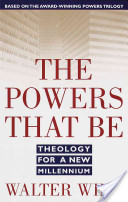
Our Thursdays With Jesus group is taking on The Powers That Be.


Beginning March 1st we will read Walter Wink's book, The Powers That Be:  Theology for a New Millennium.


Here is a review from Spirituality and Practice:
The author, who is Professor of Biblical Interpretation at Auburn Theological Seminary in New York City, presents an ethically challenging reframing of angels, demons, principalities, and powers. He writes: "Every business corporation, school, denomination, bureaucracy, sports team — indeed, social reality in all its forms — is a combination of both visible and invisible, outer and inner, physical and spiritual." These systems, institutions, and structures can do good and evil at the same time: "They form a complex web that we can neither ignore nor escape."

One of the challenges for Christian churches in our time is to discern the spirits of institutions and structures. If they are organized around idolatrous values and what Wink calls "the Domination System," they must be recalled to their divine vocation — the well-being of all individuals. With great clarity and clout, the author attacks the myth of redemptive violence and proclaims Jesus's path of practical nonviolence as its antidote ("It is the way God has chosen to overthrow evil in the world.")

Wink ends with a clarion call to seek God in our enemies, to practice justice in prayer, and to work every day for the "freeing of the Powers." Reading this watershed book will open your eyes afresh to the significance of spirituality, evil, politics, and redemption in our world.
Good stuff from an important thinker who acts for justice as well.
Join us Thursday from 10:30 until noon at FPC Elizabethton!


Tuesday, February 21, 2012

GAPJC Rules Against Rev. Janie Spahr

This is from Jim Rigby regarding the trial of Rev. Jane Spahr
Janie just called. The verdict was guilty by a 6-8 verdict. As far as I am concerned, the church renounced Christ when they said that Janie did what Jesus would do, but they would follow our own human rules over the law of love. 
I agree, Jim.  The church wants to do this the hard way.  So we will change the constitution.  It begins at this summer's General Assembly.  And we won't stop until it is changed.   

Meanwhile, we will bless these holy relationships.


Sunday, February 19, 2012

From Blindness to Sight--A Sermon

From Blindness to Sight
John Shuck

First Presbyterian Church
Elizabethton, Tennessee

February 19, 2012
John 9:1-41 (Scholars' Version)

This is my favorite story from the Gospel of John. It is filled with irony and snark. There may have been an event in the life of the historical Jesus that is the basis for this story. The Jesus Seminar concluded by a narrow majority that the historical Jesus might have cured one blind person by the use of spittle. Not that the spittle was medicinal but that Jesus fit the profile of a charismatic healer and the healing was of blindness due to psychosomatic therapy.

The story became part of the lore about Jesus. In Mark 8:22 ff., Jesus cures a blind man with spittle. In Mark 10:46 ff., he cures Bartimaeus of his blindness.   Both may be narrative elaborations of one common event. Thus this story in John chapter 9 may be a further elaboration in which the author of John’s gospel places the healing in the context of another struggle altogether.

That is the struggle in John’s time between these two infant sibling religions that arose after the destruction of Jerusalem and the Temple by the Romans in 70 CE. These two siblings became Judaism and Christianity. The common parent for these two religions was Biblical Israel. The Gospel of John is one side of the squabble between these siblings. Jesus never had a conflict with “the Jews”. He was a Jew. That is John’s conflict. He creates these stories to present Jesus on his side.

Ancient religion was about the sacrifice of animals. You go to the Temple or to a holy shrine whether it is the Temple of Zeus or the Temple of YHWH and you sacrifice animals. That is worship. It appears that a couple of things are happening. The Temple in Jerusalem is destroyed. That makes animal sacrifice a logistical problem. Also a consciousness has been arising of thinking of worship without animal sacrifice. This sacrificial practice is slowly becoming symbolic or commemorative.

At least two paths develop, one centering on Jesus as sacrifice represented by the Lord’s supper and another on Torah, circumcision, and Sabbath. Neither requires animal sacrifice. One path becomes centered in the church and the other in the synagogue. John’s gospel reflects this early division from the perspective of what would become church. When characters in John’s gospel are kicked out the synagogue that reflects the situation in the author of John’s time, not in the time of the historical Jesus.

So John takes this story in the lore of Jesus of healing a blind person probably psychosomatically and elaborates making it a teaching moment. There is nothing psychosomatic in John’s telling of it. Jesus has been exaggerated to become God incarnate. He barely touches the ground. He speaks in exalted terms about himself. “I am the Light of the World!” Just to show that this healing was no parlor trick, John has the blind person be born blind.

This gives the disciples an opportunity to ask a theological question. Whose sin caused him to be born blind? If you have a just God who runs the place, you can’t have people suffer for no reason. You have to blame someone, either the man who sinned (either in the womb or in a previous life) or his parents. John sets up a classic question of theodicy. 

By the way, a side note. Since I mentioned theodicy, it might be fun to go there for a minute. Theodicy is the attempt to explain the injustice of God. If you have an all-powerful and all-good God, why is there suffering and evil? Much thought, energy, and time have been spent on that question. You can tie yourself in knots over this. We ask this question in many different ways, whenever there is suffering in our own lives or in the lives of others, we ask what is God doing?

If you have found an answer that works for you of why an all-good and all-powerful God can allow for suffering and evil, then I say go with it. If you have an answer that works I don’t want to take it away from you.

Personally, I take the easy road. I think an all-good and all-powerful God on one hand co-existing with suffering and evil on the other is a logical impossibility. I find that any explanation for someone’s suffering by implying that God could fix it if God wanted to is cold and cruel.

I let go of the idea of an all-powerful God. The answer then is easy. God is not all-powerful. There is no magic fix out there. Life is a mix of good, evil, suffering, and joy, and we make the best of it. But I do believe God is all-good. Not all-powerful but all-good. That to me means Life is worth giving it a go and hanging on for the ride. It also means that part of Life’s purpose is to look for and to find decency, compassion and joy and to make life more decent, compassionate, and joyful for ourselves and others. If you would like to read someone who agrees with me, I recommend Rabbi Harold Kushner, When Bad Things Happen to Good People.

Here is how the Gospel of John handles the question of theodicy.
As Jesus was leaving he saw a man who had been blind from birth. His disciples asked him, “Rabbi, was it this man’s sin or his parents’ that caused him to be born blind?”
Jesus responded, “This man did not sin and neither did his parents. [He was born blind] so God could display his work through him. We must carry out the work of the one who sent me while the light lasts. Nighttime is coming and then no one will be able to do any work. So long as I am in the world I am the light of the world.”
This is an interesting answer. What John’s Jesus is saying is that you can spend a lot of time worrying over who to blame for misfortune and suffering. You can blame the victim. You can blame the parents. You can even blame God. Or you can carry out the work of healing while you have the light to do it.

John’s gospel is a symbolic gospel. Nothing is to be taken literally. Jesus is not just about Jesus. The figure Jesus is not a one of a kind supernatural God-Man. I see him as representing the Authentic Human. He is a symbol, an archetype perhaps, of what it means to be an integrated, authentic, and aware human being. When Jesus speaks so exaltedly about himself, we can read it that he is speaking exaltedly about human beings.
Jesus is you when you see yourself as you truly are.
So the answer to the question of why do bad things happen to good people is this: 
So you can do good today. 
So pick up some spit and let’s go heal this guy. Here is the text:
With that he spat on the ground, made mud with his saliva, and smeared the mud on the man’s eyes. Then Jesus said to him, “Go, rinse off in the pool of Siloam” (the name means “Emissary”). So he went over, rinsed off [his eyes], and came back with his sight restored.
That is all done in the first three small paragraphs, the first seven verses. The rest of the narrative, the next couple of pages, the next 34 verses are about the responses to this healing. This is all John’s creation. Remember this is all fiction. John made this whole thing up. Part of this narrative is John’s sniping at his sibling, the synagogue. John writes later in the narrative:
“…the Judeans had already agreed that anyone who acknowledged [Jesus as] the Anointed One would be banned from their congregation.”
That is the historical issue behind John’s gospel. Those are John’s fighting words. His crowd in his time as he sees it has been thrown out of the synagogue. This is reminiscent of church splits.

You know there are dozen (give or take a couple) Presbyterian denominations in the United States. Last month, another one started. It is another splinter off the PC(USA). Apparently, the PC(USA) does not believe in the authority of Scripture. Because if we did we wouldn’t allow gays to be ministers. If we really loved Jesus we wouldn’t allow gays to be elders or deacons either. From our end we say the issue might not be scripture but perhaps a wee bit of prejudice on your side? 

Now imagine either side writing a gospel and putting Jesus in the script. Imagine the snark and sarcasm that would be embedded in the text. I know I could write a doozy. That is John’s gospel. The hurt and the anger jump off the page.

But it isn’t all snark and sarcasm. It does rise above that on occasion. Jesus certainly is a figure used to bolster one side in a sibling squabble. But he also represents the authentic human. In order to read it the second way, we have to allow ourselves to be the opponent of Jesus in the text as well as his ally.

The Pharisees or the Judeans or the leaders of the synagogue represent the folks who cannot see beyond their own traditions. These are those who believe that unless something receives their stamp of approval it cannot be legitimate. Anyone who does work outside the bounds of the authoritative structures is to be mocked and not acknowledged.

They are blind for doing that.

But…is there a sense in which we do the same on occasion? If honest I have to admit my blindness too.

There are forms of religious expression that I find particularly blind, silly, and superstitious even. I am suspicious of faith healers. I don’t like the way some people read the Bible as if it is a supernatural revelation from heaven. I don’t like certain views of Jesus dying for sins and whatever.

I think everyone would benefit from a dose of religious and scientific literacy. But if I cannot open my eyes enough to see that not everyone experiences life, our religious tradition, spirituality, and healing in the same way I do, then I am like the Pharisees who ask smugly,
“We’re not blind are we?”
Well, yeah, kind of, you are.

There are many different ways to live in this world. We all have our blind spots. We have blind spots about ourselves and we have blind spots about others. Sometimes others can point out our blind spots. That can be painful or embarrassing. That should be done sparingly and with love, not fake love, real love. Before we point out the speck in the other’s eye, we could remove the plank in our own as Jesus is reported to have said.

It seems that the gift of insight, the ability to see with the heart, is the gift that recognizes ironically, that we see very dimly. The greater the insight, the less omniscient we become. The greater our horizon of knowledge and wisdom, the larger is the abyss of the unknown. Insight then becomes humility.

That is the insight of John’s story. The blind beggar, the most humble of all has the gift of sight, whereas the scholar, the leader, the person with authority, is blind. The blindness on the part of the leaders in the text is not due to their lack of knowledge or wisdom. The blindness is the unwillingness to see that others can see where they cannot. It is the lack of humility.

Humility as insight is not hiding your truth. It is telling your truth but recognizing that your truth is provisional, meaning it can change. Humility also recognizes that your truth is one truth among many. None of us has a corner on truth.

One of the more rewarding aspects of ministry is being able to be present when people have their eyes opened in such a way to see things about themselves, or others or the significance of their lives. This is different than trying to pull the wool over someone’s eyes. This is different than the blind leading the blind. The posture of seeing is one of permission-giving and of humility. It is a posture of invitation. It is not forcing one’s truth on another but allowing through the telling of your truth for others to discover theirs. It is the gift of listening so that others may find the space to become whole.

Our story began with the disciples asking Jesus whose sin caused this man to be born blind. Jesus turns the question. He says it is nobody’s sin. It is life. In fact, it is an opportunity.

To the suffering and blindness in the world, you have the opportunity, with your life, with your truth, with your limited sight, to respond with compassion and healing.

Work while you have the light.

Amen.